Three nene goslings survive at Liliuokalani Gardens, first in years
Three nene goslings at Liliuokalani Gardens made it to flight feathers, a rare survival in a Hilo park where young birds have often died. The win came after monitoring, barriers and tighter cat control.
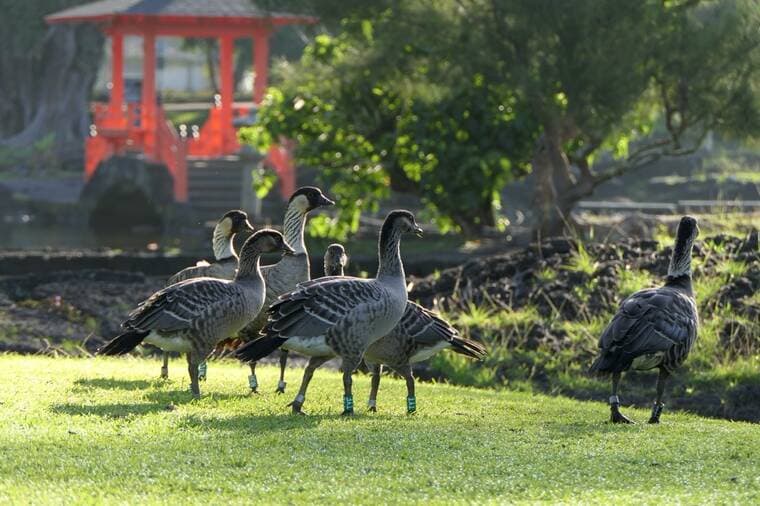
Three nene goslings survived long enough to grow their flight feathers and leave Liliuokalani Gardens, a rare outcome in a Hilo park where young birds have repeatedly fallen to cars, dogs, disease and human disturbance.
The family was closely watched by the state Department of Land and Natural Resources and Nene Research and Conservation, which monitored the nest, banded the birds and checked their health before they took off several weeks ago. The success matters because it was the first time in recent years that goslings at the park made it through that most vulnerable early stage.

Jordan Lerma of Nene Research and Conservation said the season may signal more positive nesting years at the park, but only because several things lined up. The nest was placed in a different part of Liliuokalani Gardens, barriers were set on the bridge to keep people back, and the nest sat about 150 yards from the feral cat colony. Lerma also pointed to the community response and to county Bill 51, which banned feeding feral cats on county land.
That law, signed to take effect on Jan. 1, 2026, prohibits feeding or attempting to feed stray or feral animals on county property and carries fines of up to $50 for a first offense and up to $500 for later violations. In a park officially listed by Hawaii County at 49 Banyan Drive in Hilo, that kind of rule can shape whether people and wildlife can share the same space without another loss.
The park’s nene have not had an easy run. Last March, DLNR said a gosling died there and was likely killed by toxoplasmosis, an infection spread only through feral cat feces and deadly to nene. State wildlife managers have also cited predation by nonnative mammals, habitat loss, nutritional deficiencies, exposure stress and human disturbance as ongoing threats.
The broader species has recovered from the brink, but the Hilo nest showed how fragile that recovery still is in a public park. The nene was downlisted from endangered to threatened in 2019, and the U.S. Fish and Wildlife Service estimated the population at 3,252 in 2019 and 3,862 in 2022. Even with those gains statewide, the survival of three goslings in Liliuokalani Gardens was not routine. It was the result of active management, public restraint and a mother bird that tried again after losing a gosling and seeing another nest destroyed.
This article was produced by Prism’s automated news system from verified source data, official records, and press releases, then run through automated quality and moderation checks before publishing. The system is built and supervised by the people who set the standards it runs under. Read our full AI policy.
Did this article answer your question?