UH students’ lunar power project named NASA competition finalist
UH Hilo and Mānoa students took a lunar power concept to NASA’s final round, putting Big Island engineering talent in front of space-industry judges.
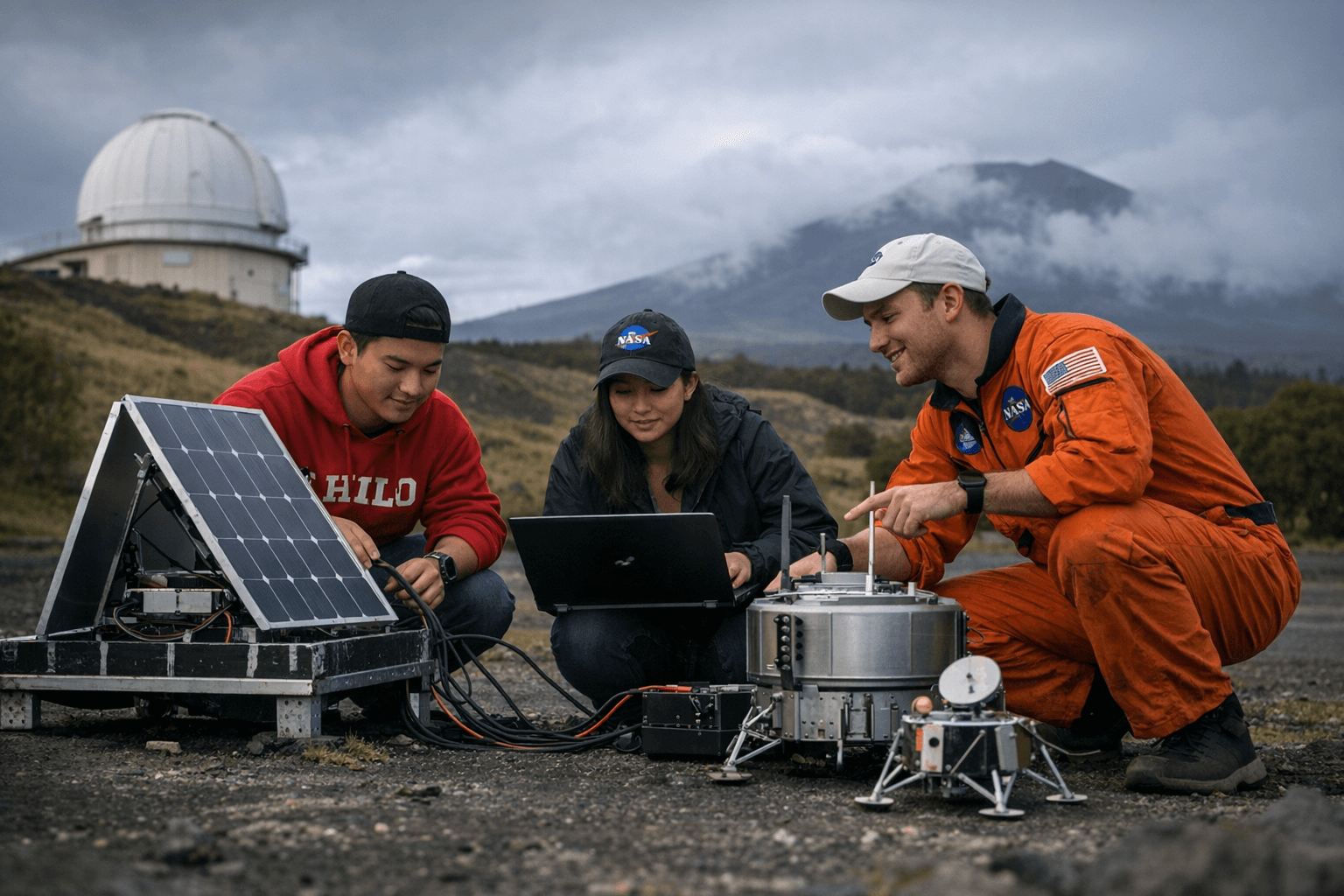
A University of Hawaii team with roots in Hilo and Mānoa has pushed local student engineering onto NASA’s national stage, with a lunar power project that could shape how people live and work on the Moon and, eventually, Mars.
Team RoSE, short for Robotic Space Exploration, was named one of 14 university finalists in NASA’s 2026 Revolutionary Aerospace Systems Concepts-Academic Linkage competition. The student-led group’s proposal, Project PETAL, stands for Power Energy Transfer Architecture for the Lunar and centers on a scalable power management and distribution system for lunar operations.
The concept combines nuclear power with energy storage built around lunar soil, a technical approach aimed at supporting sustained human activity in harsh environments where reliable power is a basic requirement for survival and research. NASA said the competition is designed to advance exploration technology for the Moon, Mars and beyond, and this year’s themes included Lunar Surface Power and Power Management and Distribution Architectures.
For Hawaii, the selection carries a bigger message than a single award. Team RoSE draws students from the University of Hawaii at Mānoa and the University of Hawaii at Hilo, showing that serious aerospace work is no longer confined to the mainland pipeline. It gives Big Island students a visible path into a field that usually demands expensive, off-island connections, and it places local classrooms, labs and faculty mentorship in direct conversation with NASA engineers and industry professionals.
The team received a $7,000 finalist award and will present at the RASC-AL Forum in Cocoa Beach, Florida, from June 1 to 4, 2026. There, NASA engineers and industry professionals will judge technical merit, innovation and presentation quality, a review that can help determine whether a student concept has the credibility to move closer to real mission planning.
Nathan Chong, a UH Mānoa computer engineering freshman and project manager for the team, said the work showed the students what it takes to develop a concept that could be considered for future lunar and Mars missions and highlighted the value of cross-campus collaboration.
Project PETAL is part of the UH Space Science and Engineering Initiative, which is also linked to broader university space work, including a lunar rover instrument being developed at UH Mānoa that is slated to fly on NASA’s Artemis 5 mission. With faculty advisors Matthew Siegler and Marvin Young from UH Mānoa and Branden Allen from UH Hilo, the project gives Hawaii students a direct route from campus engineering to national aerospace credibility.
This article was produced by Prism’s automated news system from verified source data, official records, and press releases, then run through automated quality and moderation checks before publishing. The system is built and supervised by the people who set the standards it runs under. Read our full AI policy.
Did this article answer your question?