Vibrant Hawaii seeks more Big Island sites for summer food program
More than 9,500 families have already sought summer meal support, but Big Island delivery still depends on local sites stepping up in every district.

The real bottleneck is not food, it is the island network needed to move it
Vibrant Hawaii’s push for more Kaukau 4 Keiki distribution sites lays bare a Big Island reality: when school is out, food access depends on whether a church, school, farm hub, nonprofit, business, or neighborhood group can become a pickup point close to home. The nonprofit says it has already received more than 9,500 applications this year, a number that shows how quickly summer demand can outgrow the island’s delivery infrastructure.
That is why the call is spread across Hawaiʻi Island, from Hāmākua and Honokaʻa to Kailua-Kona, Keaʻau, North Hilo, North Kohala, Naʻalehu, Ocean View, Pahala, Puna makai, Puna mauka, South Hilo, South Kona, Waimea, Waikoloa and Volcano. The message is straightforward: the more local hosts that sign on, the fewer families are forced to make long drives for weekly food boxes.
Where the program still needs help
Vibrant Hawaii is looking for partners who can lead distribution sites in places where families already gather or can reach without an expensive detour. That includes schools, churches, nonprofits, informal neighborhood groups and other community organizations that can handle local pickup and keep the process familiar and low-barrier.
The need is not abstract. On Hawaiʻi Island, geography often turns a routine errand into a half-day trip, especially for families in rural stretches of Puna, North and South Kona, Hāmākua, North Hilo and Kaʻū. A site in the right place can mean the difference between a child getting a weekly box of food or a parent having to decide whether gas money, work hours or caregiving duties make the drive impossible.
What it takes to host a site
Vibrant Hawaii says no prior experience is required. The organization will provide training, coordination and supplies so new hosts can operate successfully, which lowers one of the biggest barriers for smaller groups that want to help but do not have staff or food-program experience.
That model matters on an island where local trust often determines whether a program is used. A familiar site can feel less intimidating for families than a distant agency office, and the program’s structure is built around that idea. Sites serve as local distribution points where families pick up their weekly food boxes, keeping the program close to the neighborhoods it is meant to serve.
For groups considering whether they can take part, the practical need is not perfection. It is space, reliability and a willingness to coordinate with Vibrant Hawaii so the boxes get where they need to go each week.
The summer schedule is already taking shape
Kaukau 4 Keiki is scheduled to run from the week of Monday, June 15 through Friday, July 24, 2026. Site registration is open through April 20, 2026, giving prospective hosts a limited window to step forward before the summer rollout begins.
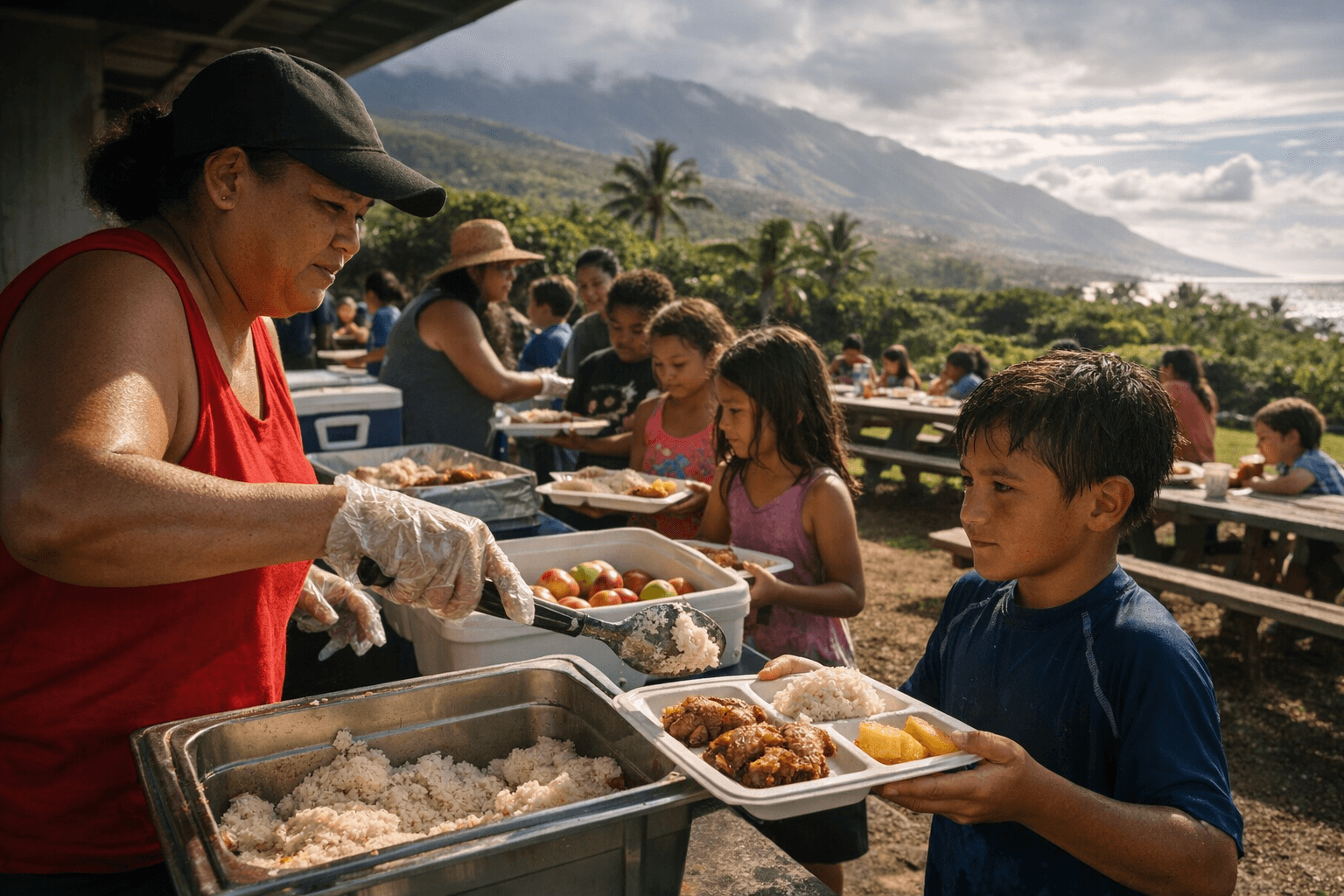
The program is also tied to the USDA Summer Food Service Program, with Vibrant Hawaii serving as the sponsor agency for Hawaiʻi County. For this summer, the organization says it will provide breakfast and lunch supplies for approximately 10,000 keiki over six weeks, a scale that makes site recruitment more than a courtesy. It is the backbone of the whole operation.
Why this program carries so much weight
Vibrant Hawaii describes Kaukau 4 Keiki as the island’s largest community-based summer meal program, and says it has operated since 2021. In a February 2026 notice, the nonprofit said the program has provided thousands of healthy, locally sourced meals to keiki across Hawaiʻi County, with meals distributed close to home to reduce travel burdens for ʻohana while supporting local producers and community-led solutions.
The islandwide model has already proven its reach. A 2025 Vibrant Hawaii recap said 31 distribution sites across Hawaiʻi Island served 6,000 keiki each week from June 16 to July 25. An earlier 2024 post said the program was serving 4,000 keiki and relied on hundreds of community volunteers. This year’s goal of reaching about 10,000 keiki over six weeks shows how much the operation has expanded, and how much pressure remains on the people and places that make it run.
That pressure is visible beyond the summer program too. A March 2026 Vibrant Hawaii relief event in Pāhoa drew a large crowd, another sign that food assistance needs remain high across the island and are not limited to one season. The broader picture is one of recurring demand, uneven access and a community response that has to be rebuilt and replenished each year.
Summer meals are only part of the safety net
Families on the Big Island may have more than one option during school breaks. The Hawaiʻi State Department of Education also offered free summer meals to children 18 and under at Big Island schools in summer 2025, including 15 schools. That kind of overlap can help, but it also highlights the patchwork nature of food access on Hawaiʻi Island, where different programs serve different corners of the county and not every household can easily reach every site.
For working parents, grandparents and other caregivers, the biggest issue is often timing and transportation. School-year meals are built into the day; summer support has to be stitched together across districts, roads and schedules. That is why the location of each host site matters so much, and why a school gym, church hall, storefront, or community room can become essential infrastructure for the season.
How community groups can step in
Vibrant Hawaii is still recruiting site leads through April 20, and interested groups can contact k4k@vibranthawaii.org or call (802) 221-4697. The organization is asking for leaders in every community, not just the big population centers, because the success of Kaukau 4 Keiki depends on a countywide web of trusted local sites.
The program’s core idea is simple, but the logistics are not: on Hawaiʻi Island, summer food security works best when the food moves toward the people, not the other way around. That is the difference between a program that exists on paper and one that reaches keiki in the places where they actually live.
This article was produced by Prism’s automated news system from verified source data, official records, and press releases, then run through automated quality and moderation checks before publishing. The system is built and supervised by the people who set the standards it runs under. Read our full AI policy.
Did this article answer your question?