Storm Lake first graders test crops in Moon Room space science lab
A grant turned one Storm Lake classroom into the Moon Room, where 200-plus first graders grew arugula, radishes and “space salads” for a NASA-linked challenge.
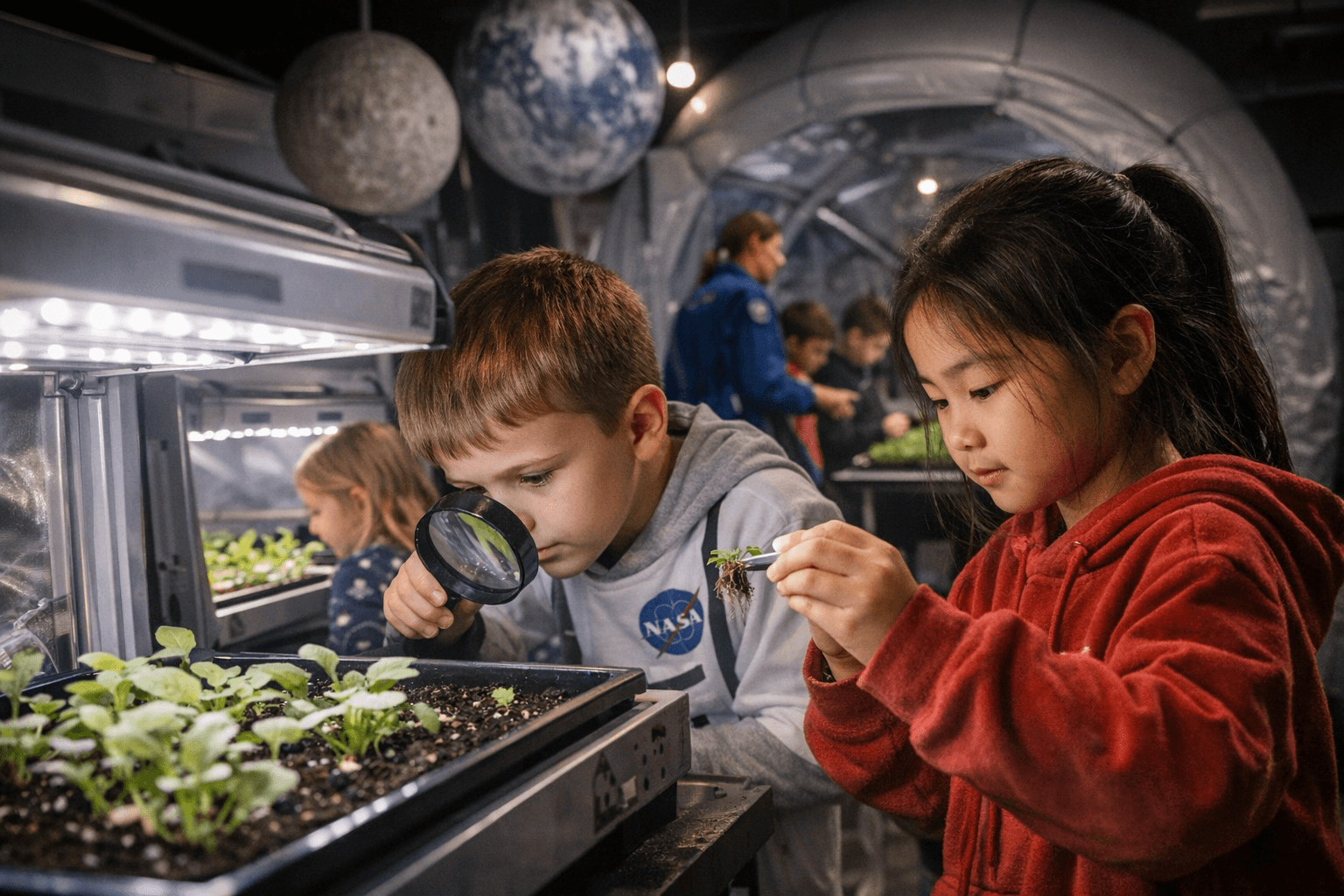
Jacquie Drey turned a Storm Lake Early Elementary classroom into the Moon Room, and more than 200 first graders used it to test how crops might grow in a space science project tied to NASA’s Artemis era. The grant-funded setup gave 21 first-grade teams a chance to do real plant research instead of reading about it from a worksheet.
By April 16, the students had moved into the evaluation phase of the Plant the Moon Challenge Jr., an eight-week experiment built around a project guide, student-selected crops and experimental variables, and final reports judged with a scoring rubric. Drey said the class had already harvested a couple of “space salads,” along with batches of arugula, and was preparing to check radishes later that day. The produce was not for eating. It was for measuring, comparing and submitting as data.
That distinction matters in Storm Lake, where Drey has spent years expanding hands-on STEM learning at the elementary level. She told Iowa education officials in 2024 that Storm Lake Community Schools began its STEM work in 2018 after a trip to NASA, and the district later used STEM BEST awards to build out an elementary STEM classroom. Storm Lake Early Elementary received a $40,000 STEM BEST award in 2022 to help connect early learners with agriculture through community partnerships.
The building itself also set the stage for this kind of work. Phase two of the Storm Lake Early Elementary project, which houses first graders, was completed in time for the 2024-25 school year, giving the school the space for specialized learning rooms like the Moon Room. The district’s staff directory lists Drey as STEM/Media Teacher at Storm Lake Early Elementary, and earlier coverage identified her as the district’s 2018 Northwest Region Iowa STEM Teacher of the Year.
The Plant the Moon Challenge Jr. is run through the Institute of Competition Sciences and tied to NASA’s Artemis lunar exploration program. The challenge opens registration each fall and spring, and its structure gives young students a direct path from hypothesis to harvest to review. In Storm Lake, that has meant first graders handling the full scientific process, from planting and observation to final scoring, in a room built to make space science feel local, concrete and worth repeating.
This article was produced by Prism’s automated news system from verified source data, official records, and press releases, then run through automated quality and moderation checks before publishing. The system is built and supervised by the people who set the standards it runs under. Read our full AI policy.
Did this article answer your question?