Buncombe County commission race centers on growth, flood risk, sustainability
Buncombe voters are choosing who shapes housing, floodplain rules and rural land protection, with 47 FEMA buyouts already approved and 114 Helene recovery projects underway.
What the District 1 race changes for everyday county decisions
The Buncombe County Commission race in District 1 is less about campaign slogans than about what the county allows to be built, protected or moved out of harm’s way. The open seat covering much of southeast Buncombe will help decide how aggressively county leaders steer housing toward safer places, how much rural land stays off the development map, and how much weight they give to flood risk when growth pressures mount.
That matters because the next commissioner will be voting inside a county that is still rebuilding after Helene while also trying to carry out long-term sustainability goals. The county’s 2030 Strategic Plan was nearly finished before the storm, then paused and refocused afterward. It is set to take effect on January 1, 2026, and its energy and environment goals are tied directly to the kind of land-use decisions that now sit in front of voters.
The candidates are offering different instincts on growth
Democrat Anna Stearns and Republican Rob Stetson are the two candidates in the November general election for the open District 1 seat. Their answers in Mountain Xpress’s sustainability Q-and-A point to a contest over how county government should respond to the pressure for more homes without repeating the mistakes that make flooding and slope failure worse.
Stearns argues that Buncombe should stop rebuilding in high-risk places and should avoid pushing farther into floodplains and unstable slopes after Helene. She treats land-use decisions as public-safety decisions, not just planning preferences. That framing would push the county toward stronger limits in vulnerable areas and more explicit protection for forests, floodplains and stormwater systems.
Stetson’s answers, by contrast, place the debate in the familiar county challenge of balancing housing demand with environmental limits. For voters, the key question is not whether growth happens, but whether the county uses zoning, infrastructure spending and conservation tools to guide where it lands. The race will help determine whether the county leans toward stronger restraint, more flexibility for development or a middle path that tries to do both.
The county’s own plans give the stakes real numbers
Buncombe’s strategic plan is not vague about the scale of the county’s environmental commitments. Its Energy and Environment goals include restoring 10,000 linear feet of streambank, conserving 20% of the county’s total acres by initiating conservation of 700 acres per year, and reaching 100% renewable energy usage for county operations.
Those targets become more concrete when set against county farmland-preservation materials, which estimate Buncombe County at 420,480 acres total. On that math, 20% equals 84,096 acres. County materials say about 18% is currently protected, 0.5% is in progress, and 1.5% more acres are needed to reach the goal. That is the gap the next board will have to manage while housing demand keeps pressing into the same land base.
That is why this race is really about county decision-making, not abstract ideology. A commissioner who prioritizes conservation can influence zoning pressure, stormwater policy and the pace of subdivision into rural areas. A commissioner who favors faster growth can push the county to focus on supply, infrastructure and service expansion. Either way, the choice will shape where homes go and what land stays intact.
Flood risk and housing recovery are now part of the same conversation
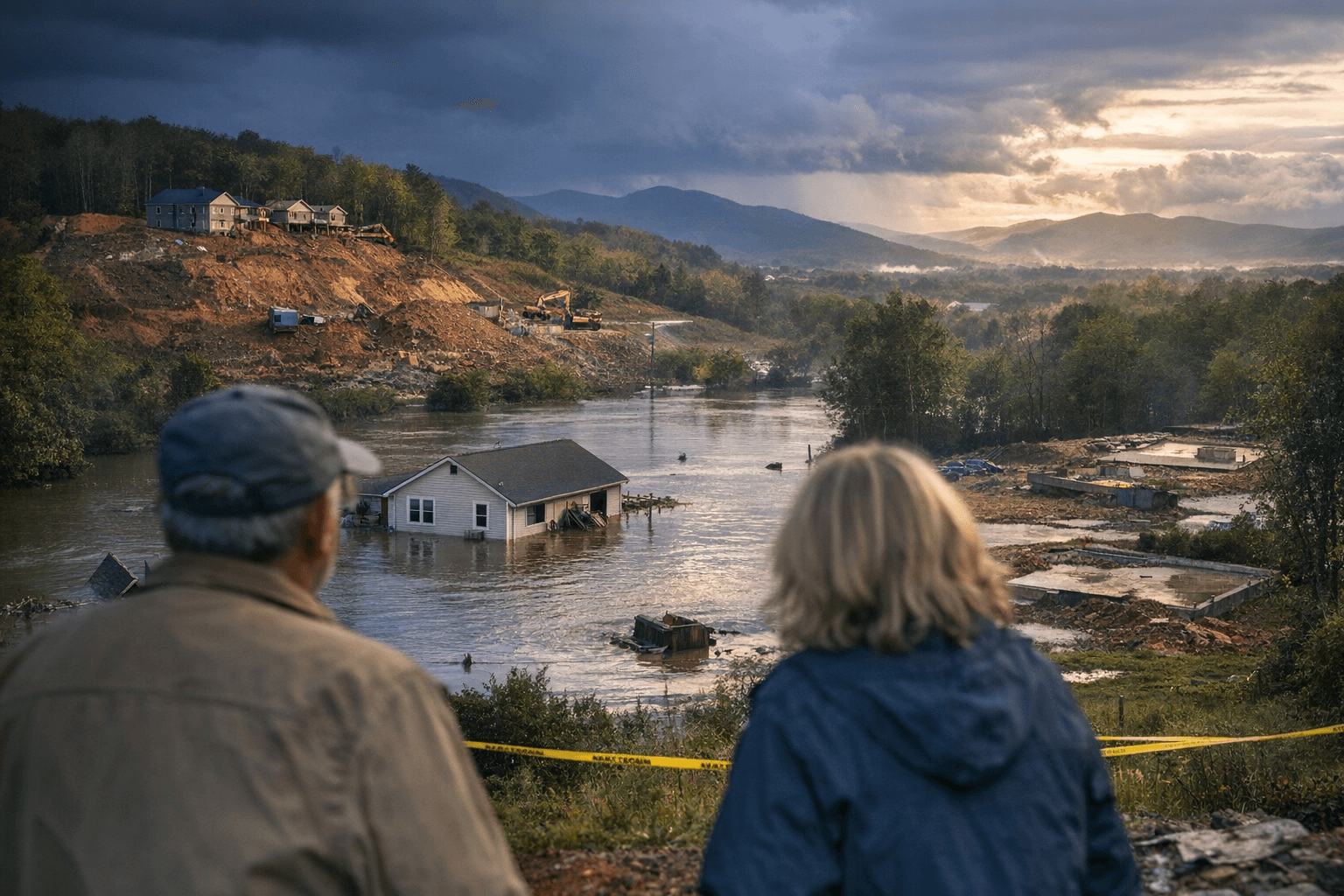
Helene made the connection between housing and hazard planning impossible to ignore. Buncombe County says it is using a Housing Recovery Support Function to identify temporary, short-term, long-term and permanent housing solutions. At the same time, the county and its municipal partners have a Helene Recovery Plan with 114 projects aimed at rebuilding housing, repairing infrastructure, restoring natural resources and strengthening disaster resilience.
The county is also moving people and property out of danger where it can. In March 2026, county officials said 47 Buncombe properties had been approved by FEMA to begin the Hazard Mitigation Grant Program acquisition process. That is a strong signal that flood-risk relocation is not theoretical. It is already part of the county’s recovery playbook, and the next commissioner will help determine how quickly and how far that effort should go.
For District 1 voters, this is where the campaign becomes immediate. The question is not only how many homes Buncombe needs, but whether those homes are placed in places the county can safely protect with roads, water, sewer and stormwater systems. If new development keeps spreading into steep or flood-prone terrain, the county inherits higher repair costs and more risk. If growth is concentrated in safer areas with existing services, the county can preserve more rural land and lower future exposure.
Sustainability is also about whether people can actually use the programs
Stearns has also argued that county sustainability programs only work if they are local, affordable and easy enough to use in daily life. That point matters because county environmental policy is not just about big plans and long-range targets. It is also about whether residents can realistically compost, add solar energy or take part in programs without unnecessary barriers.
That practical view fits the county’s larger challenge. Buncombe cannot control every housing decision in private hands, but it can set the conditions around land use, conservation and infrastructure priorities. It can decide how much to invest in resilience, how much to protect stream corridors and farmland, and how aggressively to direct growth away from the most vulnerable land.
A race inside a larger transition in county leadership
The District 1 contest is unfolding alongside a broader shift in Buncombe County leadership. County records list Jennifer Horton and Al Whitesides as the District 1 commissioners in the current term, and county records identify Al Whitesides as the first African-American to serve as a Buncombe County commissioner. That history gives the district race added weight, especially in a year when the county is reworking its planning around post-Helene recovery.
The political backdrop is also shaped by who did not take part. District 2 candidates Lonnie Israel and Greg Parks did not respond, and District 3 Commissioner Al Whitesides was invited but did not participate. That leaves the District 1 matchup between Stearns and Stetson as the clearest window into how county voters may judge the future of growth, forests and flood-risk policy.
What emerges is a race with unusually direct consequences. The next District 1 commissioner will help decide whether Buncombe County leans harder into conservation, accelerates development or tries to thread the needle between the two while recovery work is still underway. In a county where land, water and housing are already tightly linked, that choice will shape what gets built, what gets protected and how safely the county grows next.
This article was produced by Prism’s automated news system from verified source data, official records, and press releases, then run through automated quality and moderation checks before publishing. The system is built and supervised by the people who set the standards it runs under. Read our full AI policy.
Did this article answer your question?