Buncombe County ranks fifth in North Carolina for fentanyl deaths
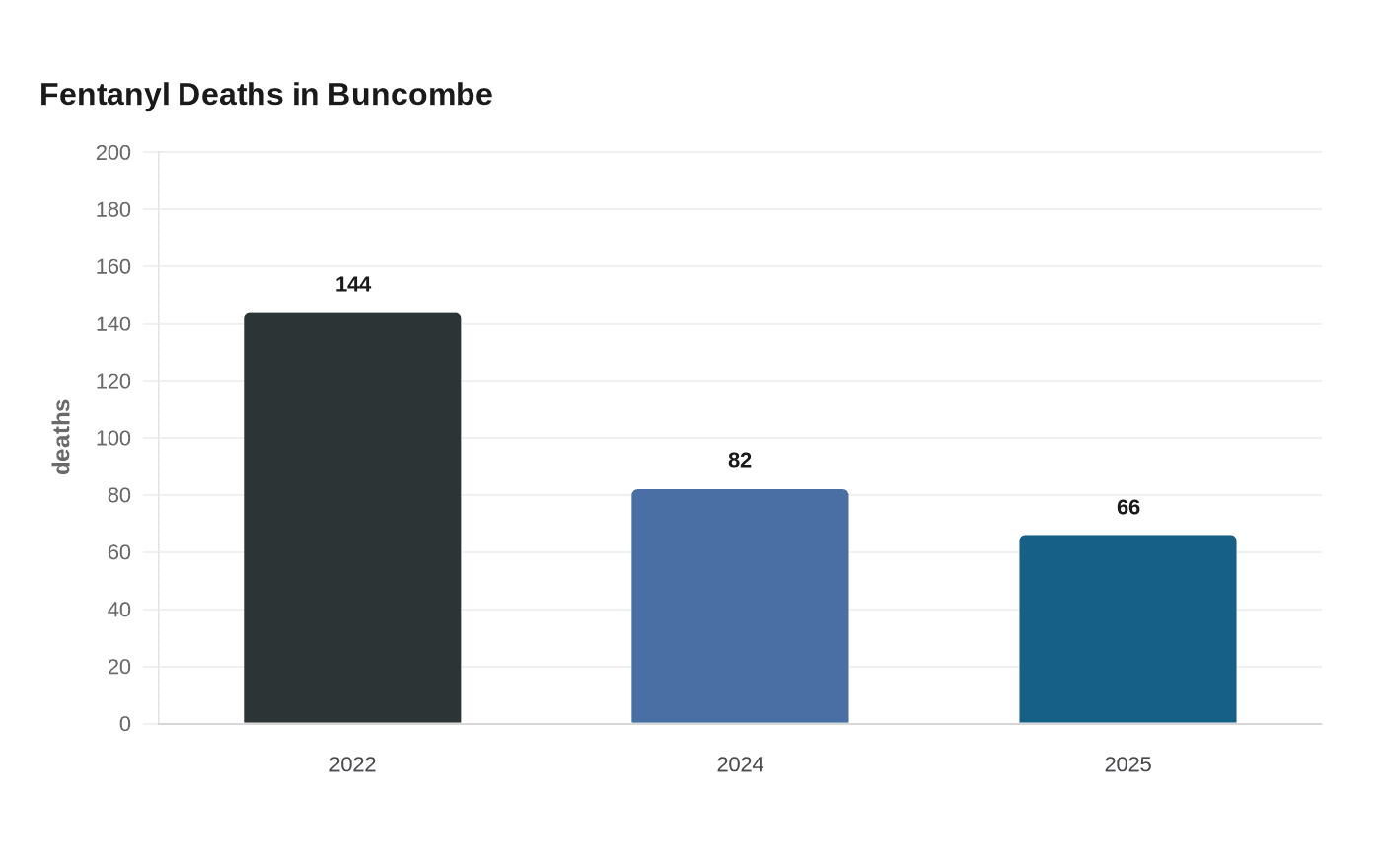
Buncombe County still ranks fifth in North Carolina for fentanyl deaths, despite a drop from 144 in 2022 to 66 in 2025. Pisgah View Apartments has now seen three overdose deaths.

Families in Buncombe County are still facing fentanyl death not as a distant statistic, but as a repeated emergency on the same streets and in the same apartment buildings. New county data puts Buncombe fifth in North Carolina for fentanyl death rate, even after fentanyl-positive deaths fell to 66 in 2025 from 82 in 2024 and 144 in 2022.
The most immediate warning sign is Pisgah View Apartments in West Asheville. Asheville police said 23-year-old Rachael Tuck was found dead in a vacant apartment there on June 9, and local reporting now says the complex has been linked to three overdose deaths total, including a suspected overdose at the same site. The apartment complex has also been the scene of a March homicide and a narcotics-and-guns seizure operation, turning one housing site into a recurring flashpoint for violence, drug activity and grief.

That concentration matters because it shows how the crisis lands on a specific neighborhood, not just on a countywide spreadsheet. Buncombe County data tied to the North Carolina Office of the Chief Medical Examiner shows 18 fentanyl-involved deaths in January through April 2025, and 455 fentanyl-involved fatalities from 2013 through that same spring period, out of 801 total medication and drug fatalities. In that span, fentanyl accounted for 57% of all such deaths in the county.
The state says fentanyl-positive death data are provisional, and that fentanyl found at death does not always mean fentanyl caused the death. Even so, the broader picture remains stark. North Carolina said more than 44,500 people died from drug overdoses from 2000 through 2024, and the state estimated 2,731 overdose deaths in 2025. Mary Beth Cox said, “All signs do point toward a decrease,” but Buncombe’s numbers still place it among the state’s hardest-hit counties.
The pattern points to a system still struggling to keep pace with the drug supply, especially in places such as the 28806 ZIP code, where overdose risk has remained elevated. For first responders, family members and harm-reduction providers, the work is relentless: reach people sooner, reverse overdoses faster, and connect survivors to treatment before another call comes in. Buncombe’s latest ranking shows the county has not solved the fentanyl crisis. It has only made the next failure visible.
This article was produced by Prism’s automated news system from verified source data, official records, and press releases, then run through automated quality and moderation checks before publishing. The system is built and supervised by the people who set the standards it runs under. Read our full AI policy.
Did this article answer your question?