Buncombe County Sheriff’s Office already runs surveillance system with 1,600 cameras
Buncombe County already runs a surveillance network spanning schools, county buildings and downtown. The unanswered question is who controls it, what it keeps, and what residents can challenge.
The surveillance system is already here
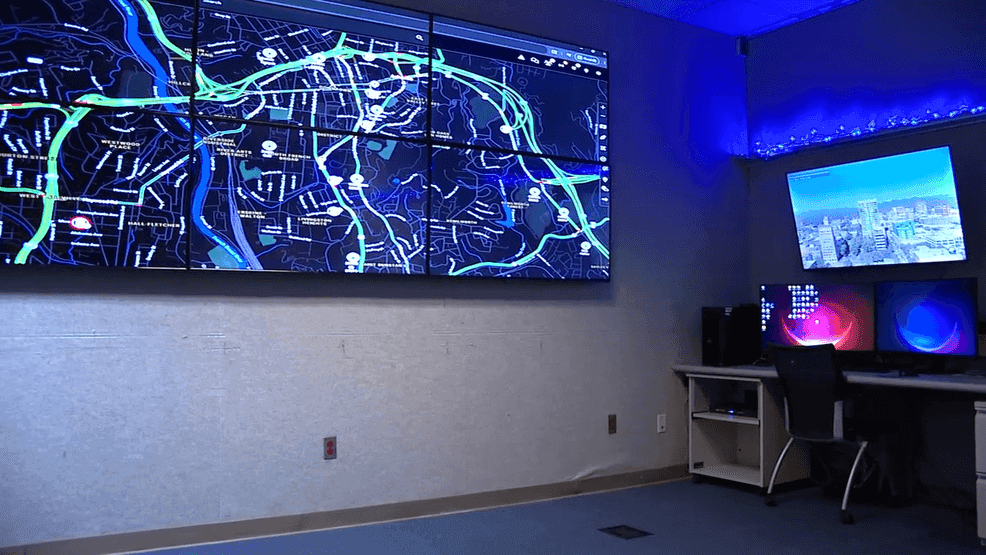
Buncombe County residents are not debating a future camera network from scratch. The Buncombe County Sheriff’s Office already operates a real-time intelligence center, and the system reaches into schools, county buildings, downtown Asheville and selected private-camera feeds. That is why the central public-right-to-know issue is not whether surveillance exists, but how much of it there is, who approved it, and what ordinary people can actually learn about its use.
Matt Marshall, the sheriff’s office spokesperson, said the system includes about 1,600 surveillance cameras, with the vast majority located in Buncombe County Schools or county government buildings. The office also has access to seven livestream cameras downtown, plus body-camera and in-car feeds, automated license plate readers and a camera registry that allows private owners to volunteer their devices for possible law-enforcement use.
How the county’s RTIC works
Buncombe County says its real-time intelligence center was initially funded by forfeiture dollars, not tax dollars, and the sheriff’s office describes itself as the first sheriff’s office in the western part of North Carolina to have its own RTIC. The center is meant to help investigators gather intelligence and deploy resources more effectively, while RTIC technicians can relay information to deputies as they respond.
The system is built to stitch together multiple feeds. The sheriff’s office says it uses Fusus software to integrate live video from body cameras, in-car cameras and registered doorbell cameras. It also relies on Axon body cameras and in-car cameras, with 500 of those devices in the mix, and on 20 stationary license plate readers plus two mobile units. The result is a network that is not limited to one technology or one location. It is a layered system that can follow a call from a school hallway to a patrol car to a street corner.
The county’s own RTIC page also describes a free camera registry and community camera-sharing program. Homeowners and businesses can register cameras at no cost, which lets the sheriff’s office know a camera exists so deputies can request footage later if it becomes relevant to a crime. Owners can also choose to buy a Fusus CORE device if they want to stream live video to the sheriff’s office.
What the sheriff’s office says it cannot do
The most important privacy point in the county’s description is also one of the least visible to the public. The sheriff’s office says it cannot directly access private doorbell cameras. It can only see where they are located, then contact owners if a crime happens nearby.
That limit matters, but it does not resolve the larger oversight question. Residents may know a camera exists on their block, but not always who can request its footage, how often requests are made, what standards govern access, or how far the information can travel once it enters the system. The department says it documents every entity with whom it shares footage, which is a useful record, but that does not by itself create public visibility into day-to-day use.
The retention policy raises another question. The sheriff’s office says footage is kept for five years under federal guidelines. For residents, that means an image captured during an ordinary day in Asheville, a school lot or a county building may remain in storage long after the event itself has faded from public memory. The retention period may aid investigations, but it also widens the gap between what is recorded and what the public can realistically monitor.
Why schools sit at the center of the system
The county’s surveillance footprint is heaviest around schools for a reason. Buncombe County Schools says a Safe Schools task force was formed after Sandy Hook, when Sheriff Van Duncan and Superintendent Baldwin created a group to review school safety practices and resources. That history helps explain why so much of the camera network is concentrated on school property and why surveillance has been sold locally as a safety tool rather than only a policing tool.
Earlier reporting shows how the system expanded in stages. A 2021 WLOS report said deputies were receiving real-time video during school emergencies. A 2022 Citizen-Times report described the sheriff’s office needing a way to manage money for a growing camera network that was increasingly fed by schools and businesses. In 2023, WLOS reported that the RTIC system had 1,780 cameras. The current count cited by Marshall, about 1,600 cameras, still points to the same reality: Buncombe County has spent years building the infrastructure, not debating whether to start.
That history also helps explain why the county’s surveillance system is not a side issue. It is tied to school operations, emergency response, and evidence collection. Once those functions are woven together, the line between public safety and routine monitoring becomes harder for residents to track.
The oversight gap residents keep running into
Buncombe County does have a security camera policy, and it is more specific than many residents may realize. The county says cameras are meant to protect the public, employees and county resources while respecting privacy interests. The policy says cameras should not be placed where there is an inherent expectation of privacy, including restrooms, locker rooms, private offices, health or counseling spaces, voting enclosures and some investigative or human-resources areas. Departments can also adopt more restrictive rules.
That policy creates boundaries, but it also exposes the key problem for public oversight: the rules are scattered across county policy, sheriff’s office practice and technology vendor systems. Residents can be told that a camera should not go in a private space, but still have little direct access to how footage is collected, reviewed, retained, or shared once it leaves the camera itself.
That is the civil-liberties question hanging over the system. Who approves a new camera location? Who decides when a feed is opened? Who audits requests for footage? How are license-plate readers used and by whom? Those answers matter because the technology is not theoretical. It is already operating in county life.
Why Asheville’s fight matters beyond city limits
The county’s system now sits in the middle of Asheville’s own surveillance debate. On May 13, 2026, Asheville City Council approved a package tied to the Asheville Police Department’s proposed real-time intelligence center after a meeting that ran nearly six hours. The package included a $1.14 million federal Community Project Funding award, a budget amendment and a resolution reaffirming civil-liberties protections for public-facing cameras, license plate readers and an RTIC.
That meeting also exposed the political cost of the issue. Residents waited nearly six hours to speak, and more than 20 people were left unheard when public comment closed. The arguments were not just about technology, but about process, consent and trust. For Buncombe County, that debate matters because APD is not building in a vacuum. It is moving into a local surveillance ecosystem that already includes county cameras, school cameras, downtown feeds and private registries.
The broader lesson is straightforward. Buncombe County has already accepted a model of public safety that depends heavily on cameras, software and data sharing. What remains unresolved is whether residents can see enough of that system to judge it, challenge it, and know where the line sits between protection and permanent observation.
This article was produced by Prism’s automated news system from verified source data, official records, and press releases, then run through automated quality and moderation checks before publishing. The system is built and supervised by the people who set the standards it runs under. Read our full AI policy.
Did this article answer your question?