NC advisory council urges adult-use cannabis legalization, unified THC regulation
Council says NC’s intoxicating-THC market has “no legal minimum age” and urges lawmakers to legalize adult-use cannabis with one statewide THC rulebook.
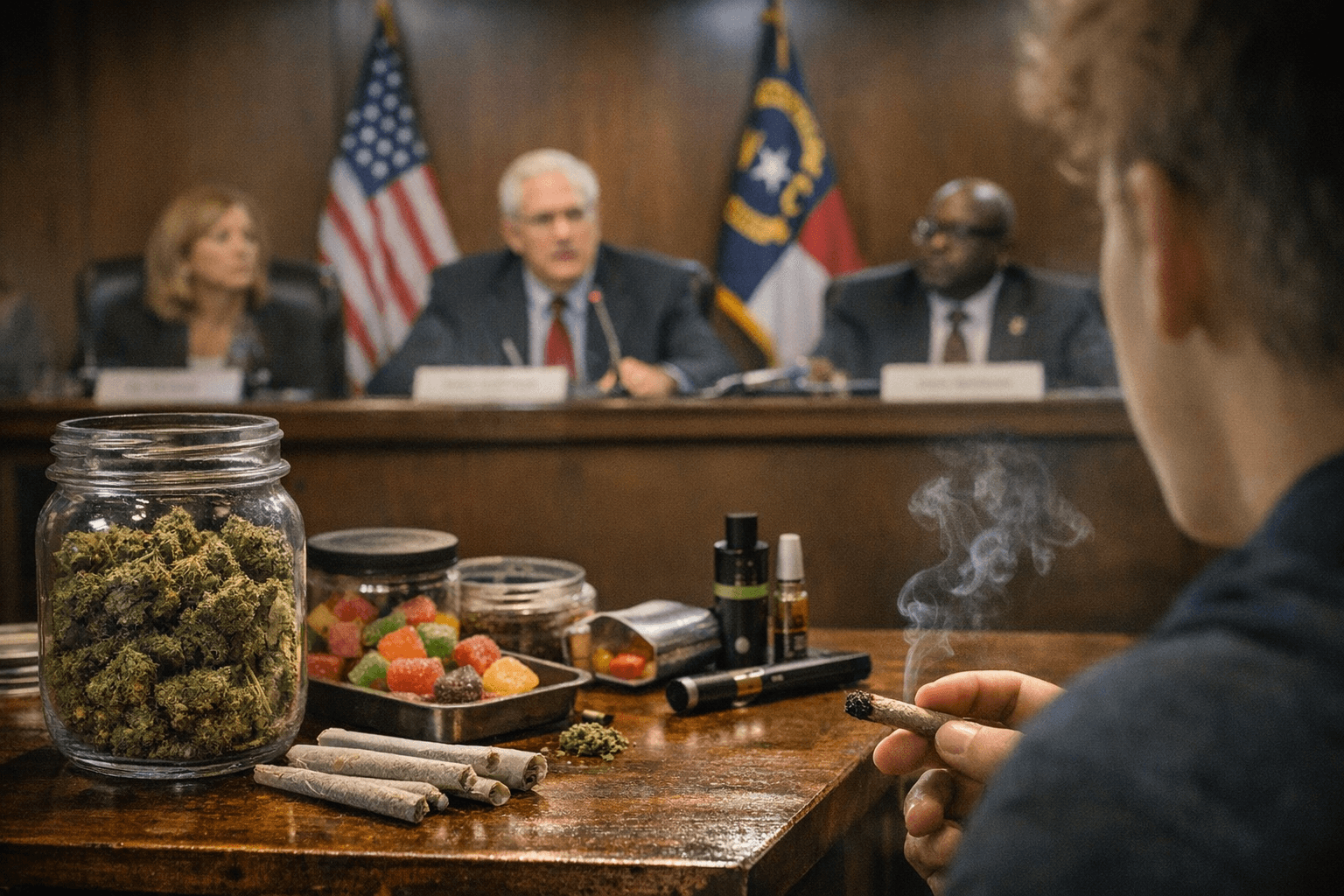
North Carolina’s Advisory Council on Cannabis has urged state lawmakers to legalize adult-use cannabis under a tightly regulated system and to rewrite THC oversight so intoxicating products are regulated by effect, not by whether they come from “hemp” or “marijuana,” a shift that could hit Asheville’s already-booming hemp-derived marketplace first and hardest.
Gov. Josh Stein created the council by executive order on June 4, 2025, calling North Carolina’s intoxicating-THC marketplace a “wild west.” In that announcement, Stein said there was “no legal minimum age” to buy intoxicating THC products in vape shops at the time, and he tied the council’s work to age verification, packaging and labeling standards, public health and public safety, support for North Carolina agriculture, expunging past convictions for simple THC possession, and investing revenue in addiction and mental health resources and drugged-driving detection.
The council’s interim recommendations were made public in early April 2026. NCDHHS posted a draft interim report dated March 31, 2026, and the department’s council page listed a council meeting on April 2, 2026, from 2:30 to 3:15 p.m. A final report with more detailed recommendations is expected later in 2026.
At the center of the interim report is what NCDHHS describes as a “unified approach” that regulates cannabis products based on total THC content and intoxicating potential. The council argued the existing split regulatory system is “unworkable” as intoxicating hemp-derived products have proliferated, leaving edibles and drinks sold without uniform statewide standards for manufacturing, testing, labeling, packaging, and age verification, and without a clear statewide enforcement and oversight authority.
The council framed legalization as a consumer-safety and market-control strategy as much as a criminal-justice question, pointing to estimates that North Carolina’s illicit cannabis sales already run into the billions of dollars annually. The recommendation calls on the North Carolina General Assembly to authorize a licensed retail market for adults and to build a regulatory framework likely touching multiple agencies, including revenue, public safety, transportation, and justice functions tied to taxation, licensing, enforcement, and impaired-driving detection.
For Buncombe County, where Asheville has been described as an “epicenter” of the hemp-derived intoxicating products trade, the effects-based THC system could rapidly change day-to-day business operations, from mandatory age checks and standardized labeling to product testing requirements and clearer enforcement lines. If lawmakers act, local governments could also face immediate decisions about zoning for licensed dispensaries, coordination with public health strategy, and training demands for law enforcement around impaired driving.
Council membership and state discussions have also pointed to an in-state precedent lawmakers cannot ignore: cannabis sales to adults 21 and older on Eastern Band of Cherokee Indians land. The interim report now puts the policy fight squarely in the 2026 short session, where tax rates, local control, and social-equity licensing rules will decide whether North Carolina’s “unified approach” becomes enforceable law or remains a warning label on a system state leaders say is already out of control.
This article was produced by Prism’s automated news system from verified source data, official records, and press releases, then run through automated quality and moderation checks before publishing. The system is built and supervised by the people who set the standards it runs under. Read our full AI policy.
Did this article answer your question?