Banker's House shows how postwar prosperity shaped Shelby's growth
The Banker’s House links Shelby’s banking boom to the buildings Cleveland County chooses to save, and to the tourism and redevelopment choices that follow.
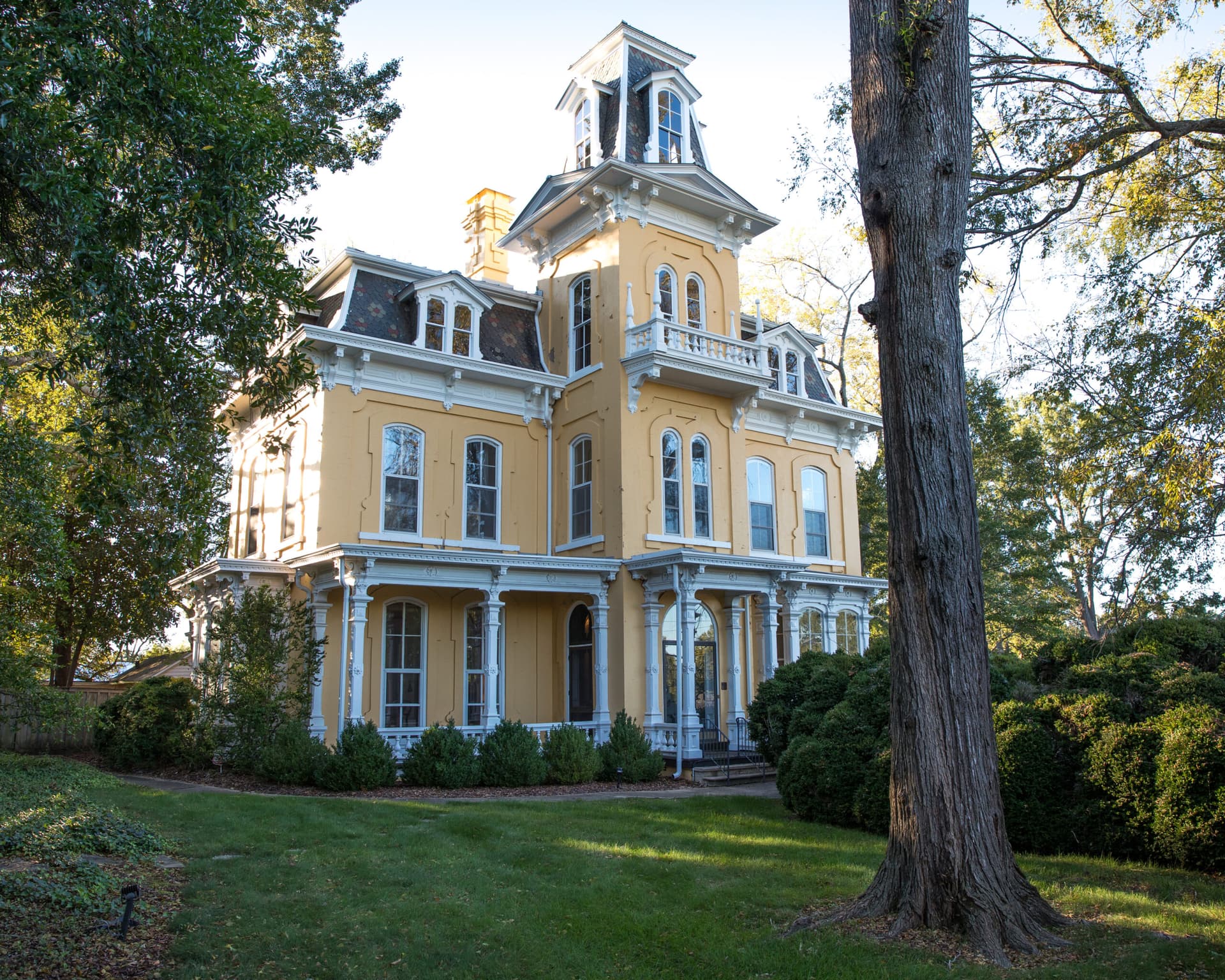
At 319 North Lafayette Street, just a few blocks from Shelby’s court square, The Banker’s House still points to the moment when post-Civil War money and influence began reshaping the county seat. Built in 1874-75 for banker Jesse Jenkins and now used as a special events venue, it shows how one landmark can explain both Shelby’s growth and the preservation decisions that still affect downtown today.
From banking house to county landmark
The house was designed in 1874 by architect G. S. H. Appleget for Jesse Jenkins, who built the home but occupied it only briefly. Jenkins and H. Dekalb Lee were also behind Shelby’s first bank, J. Jenkins and Company, created in 1874, which ties the house directly to the financial network that helped organize the town’s next phase of growth. That connection matters because The Banker’s House is not just an elegant survivor; it is part of the story of who had capital, who shaped local institutions, and how Shelby’s courthouse square became more important after the war.
The home passed quickly into another banking family’s hands. It sold at public auction in 1879 for $1,500 to Sara Damron Lee, wife of banker H. Dekalb Lee. Lee later became one of the directors of the Cleveland Savings Bank, established in 1875, and around 1878 he, Burwell Blanton, and S. J. Green reorganized the remaining holdings of Jenkins Co. directors under the name H. D. Lee and Company, Bankers. The ownership chain makes the house a clean entry point for understanding how banking power, family ties, and downtown real estate were already intertwined in Shelby in the late 19th century.
Why the architecture still stands out
The Banker’s House is widely recognized as one of North Carolina’s finest Second Empire houses. It is a 2 1/2-story stuccoed brick house with a 3 1/2-story tower, a mansard roof, projecting bracketed eaves, and a colored slate roof arranged in flower motifs. That mix of features gives the building its visual weight, but it also tells a broader story: the style signaled confidence, and the unusual stuccoed-brick construction is especially notable in North Carolina.
The tower and mansard roof read as part of a period when Shelby’s courthouse square and surrounding streets were gaining financial and political importance. The neighborhood around the house is now largely made up of twentieth-century houses and small businesses, so the building survives as a visible marker of an earlier downtown era. In practical terms, that makes it more than a pretty façade. It is a preserved reference point for how Shelby looked when banking, governance, and civic ambition were starting to concentrate in the center of town.
What its survival says about preservation in Cleveland County
The Banker’s House belongs to a much larger preservation landscape. Cleveland County’s historic landmarks inventory places it alongside the county courthouse, Double Shoals Cotton Mill, Joshua Beam House, Central School Historic District, and other protected resources. The county currently has 30 places listed on the National Register of Historic Places, and 16 of them are in Shelby alone. The National Park Service’s Shelby itinerary adds that the city has about 20,000 residents and 29 listed historic places in Shelby and surrounding towns, reflecting a community that has long served as an agricultural, industrial, cultural, and political center.
Those numbers matter because they show that preservation in Cleveland County is selective. Not every old structure gets the same level of care or recognition, and the buildings that survive shape how people understand downtown value. When a place like The Banker’s House is maintained and interpreted, it helps define which parts of Shelby’s history are treated as assets, which blocks are marketed to visitors, and which settings are more likely to influence redevelopment decisions. In a county where property values and reinvestment are always part of the conversation, historic buildings can quietly steer where attention, money, and foot traffic land.
A building that still earns its keep
The house’s present use makes that preservation story concrete. It is now a special events venue, which means it is not locked behind the logic of a museum-only model. The building hosts weddings, reunions, camps, and community gatherings, turning architecture into an active part of the local economy rather than a static exhibit. That kind of adaptive reuse is important in a downtown setting because a landmark that draws people in can support surrounding businesses while keeping the structure itself in regular use.
The calendar also gives Cleveland County residents a straightforward way to experience the site. Weekly Wednesday open houses run from 2 to 5 p.m., and admission is free for county residents during that window. That kind of access helps the house function as a public resource, not just a venue for private events. It also gives Shelby a preservation asset that can serve both local families and out-of-town guests without separating the building from everyday community life.
What to notice when you visit
A visit to The Banker’s House is most useful when the architecture and the location are read together.

- Start with the setting at 319 North Lafayette Street, only a short walk from Shelby’s court square.
- Look up at the 3 1/2-story tower and the mansard roof, the clearest signs of Second Empire style.
- Notice the stuccoed brick, an unusual building method in North Carolina.
- Trace the house back to the banking names tied to it, including Jesse Jenkins, H. Dekalb Lee, Burwell Blanton, and S. J. Green.
- Remember that the building now works as a special events space, which is part of why it remains maintained and visible.
The house also gives Cleveland County a way to talk about itself beyond nostalgia. Its stewards describe Shelby as within easy reach of Charlotte and Asheville, which helps position the county as both a hometown place and a regional destination. That geographic reach matters when heritage tourism, event bookings, and downtown investment overlap. The Banker’s House survives because it still has a role to play, and that role keeps tying Shelby’s past to the choices shaping its future.
This article was produced by Prism’s automated news system from verified source data, official records, and press releases, then run through automated quality and moderation checks before publishing. The system is built and supervised by the people who set the standards it runs under. Read our full AI policy.
Did this article answer your question?