Boiling Springs grew from bubbling springs into an incorporated town
Boiling Springs began at two forceful springs, and that waterway-shaped settlement still explains the town’s church, school and government.
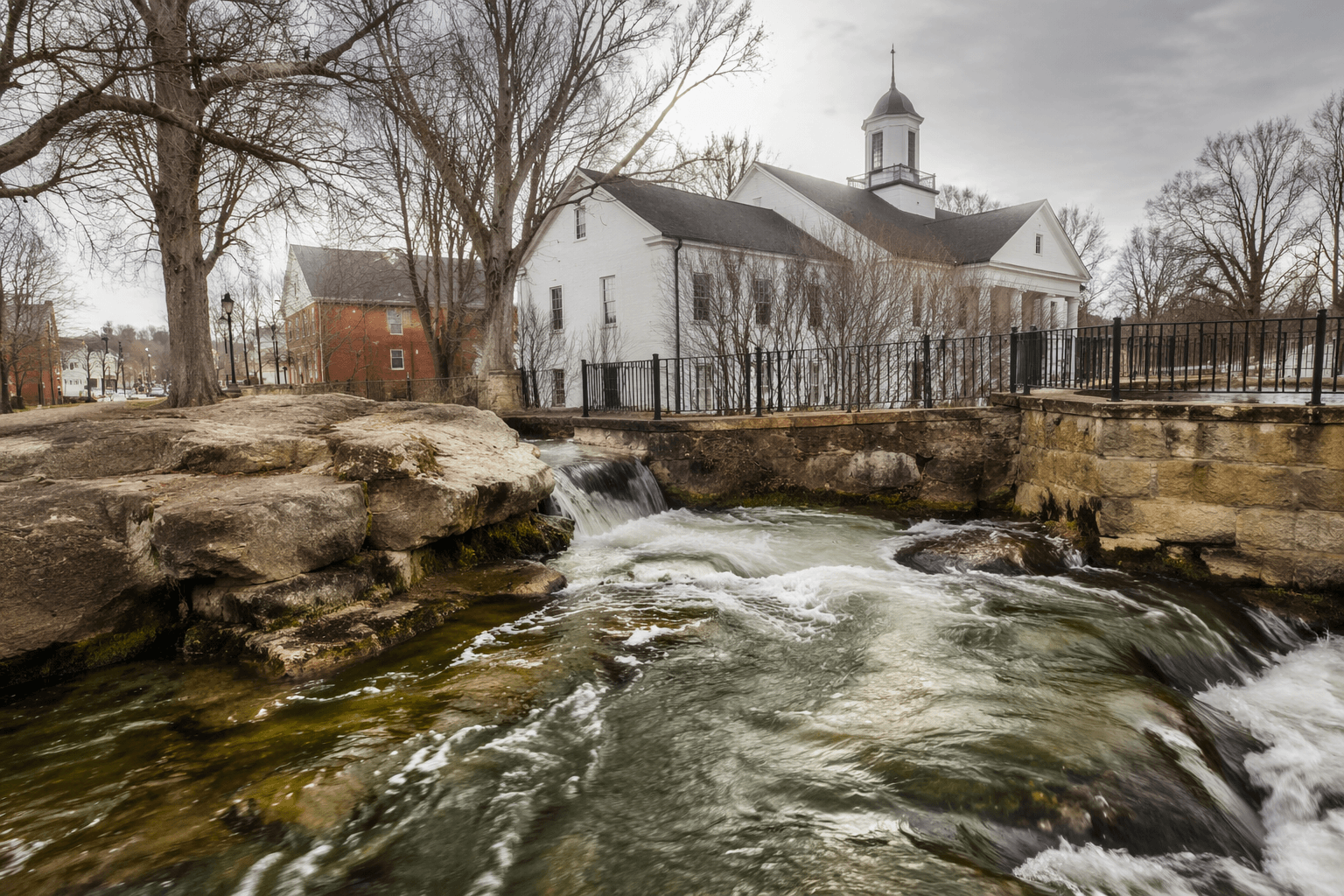
Two underground springs gave Boiling Springs its name, but they also gave the town its first public square, long before there was a town government to manage one. The springs bubbled six to eight inches above the surface and spread across about five feet, drawing families, candidates and neighbors to the same place for picnics, campaign speeches and even tax payments. That is why Boiling Springs reads less like a place that simply appeared on a map and more like a community that organized itself around a natural landmark from the start.
The springs at the center of town
Boiling Springs began to take shape around 1843, when the first families identified in the town history, the Hamricks, the Greenes and the McSwains, settled near the water. The springs were not a decorative feature at the edge of town. They were the town’s reason for being, a shared place where civic and social life crossed in the same patch of ground.
That early pattern matters because it explains the town’s identity in a way a street grid alone cannot. The springs were where residents gathered, talked politics and handled practical business, which meant the town’s origin was rooted in daily use rather than distant planning. Even the way the water rose above the surface gave the place a physical presence strong enough to name a community after it.
A church, a school and a community taking shape
Boiling Springs Baptist Church followed in 1847, built roughly 100 yards from the springs. That short distance says a great deal about how quickly the natural site became the center of local life. Families did not move away from the springs after settlement began; they built their church close enough to stay connected to the same water source that had already anchored the community.
For decades after that, Boiling Springs remained a quiet place with no railroads, no industries, few stores and no paved streets. The town’s growth was slow, but it was not stagnant. In the early 1900s, the Kings Mountain and Sandy Run Baptist Associations began looking for a site for a denominational high school, and local residents rallied around the opportunity. Boiling Springs High School opened in 1905, adding an institution that changed the town’s reach far beyond the spring itself.
That school became a turning point because it tied Boiling Springs to education, church life and regional attention at once. The town was no longer just a settlement near a bubbling water source. It had become a place where people came for instruction, where families could see their community invest in a larger future, and where the physical landscape started to shape public institutions.
Incorporation and the first town leaders
Boiling Springs was incorporated in 1911 after O. Max Gardner introduced the bill. At the time, the population was only 250, a reminder that formal government arrived when the town was still very small by modern standards. The first mayor was D.J. Hamrick, and the first aldermen were D.S. Lovelace, E.B. Hamrick, C.M. Hamrick, J.L. Pruett and J.F. Moore.
Incorporation changed what the town could do for itself. With municipal authority, Boiling Springs could provide water, police and fire protection, paved streets and garbage collection, not just for the town but also for the school. That practical shift is one of the clearest signs that the springs had done more than attract settlers. They helped produce a town that eventually needed the tools of modern local government.
Those services also show how the town’s early institutions fed into one another. A church near the springs, a school built in response to denominational planning, and a chartered town government all emerged from the same place-based story. The name did not merely describe the water. It described the settlement pattern, the first public buildings and the reason a local government became necessary.
What the origin story still tells Cleveland County
Boiling Springs remains useful as a Cleveland County story because it shows how a small natural feature can shape everything that comes after it. The springs determined where people gathered, where the church stood, where the school emerged and why incorporation eventually made sense. The town’s early history is unusually tangible: you can trace its growth from water source to worship site to school town to incorporated municipality without leaving the same stretch of ground.
That makes the place more than a historical footnote. Boiling Springs still carries the mark of the springs in the way its identity formed around a single physical source, then expanded into institutions that served residents for generations. For anyone coming into town today, that is the key to understanding it: Boiling Springs was built from water, but it endured because people kept turning that water’s location into a community center, a church neighborhood and, finally, a town with the power to govern itself.
This article was produced by Prism’s automated news system from verified source data, official records, and press releases, then run through automated quality and moderation checks before publishing. The system is built and supervised by the people who set the standards it runs under. Read our full AI policy.
Did this article answer your question?