Crowders Mountain’s Boulders Access blends hiking, history and geology
Boulders Access is the quickest way into Crowders Mountain’s steep trails, bouldering and rare geology, with a conservation story that shaped every mile.

Boulders Access is one of the smartest starting points in Cleveland County for anyone who wants a hard hike, a little climbing, and a reminder that this landscape was saved, not just mapped. From 108 Vandyke Road in Kings Mountain, it opens onto Crowders Mountain State Park’s long ridgelines, wildlife habitat and trail connections that stretch well beyond the county line.
Why Boulders Access stands out
For Cleveland County residents, Boulders Access is useful because it does more than send you up a trail. North Carolina State Parks places it in Cleveland County, about 38 miles west of Charlotte, and describes it as a place for long hikes, bouldering and wildlife viewing. The access also links into a broader corridor that reaches Kings Mountain State Park and Kings Mountain National Military Park, which gives this corner of the park a regional role instead of a strictly local one.
That matters in a county where outdoor spaces are not interchangeable. Boulders Access is one of the few places where a short drive can put you into a steep, dramatic landscape that feels much more rugged than the surrounding Piedmont. It is a practical entry point for a morning hike, a workout climb or a quieter visit to watch songbirds, red-tailed hawks and turkey vultures move over the slopes.
What you can do there
Boulders Access is best known for giving direct access to the park’s tougher and more scenic routes. The trail system includes the Ridgeline Trail at 6.2 miles one way and the Pinnacle Trail at 2 miles one way. From Linwood Road Access, the map also shows the Backside Trail at 0.8 mile, the Rocktop Trail at 1.5 miles and the Tower Trail at 1.8 miles.
That range is why the park works for different kinds of outings. A visitor can make a longer, more demanding day of it on the Ridgeline Trail, or choose a shorter route that still delivers the steep terrain and open views that define Crowders Mountain. Bouldering adds another layer of use, making Boulders Access especially valuable for people who want more than a walk in the woods.
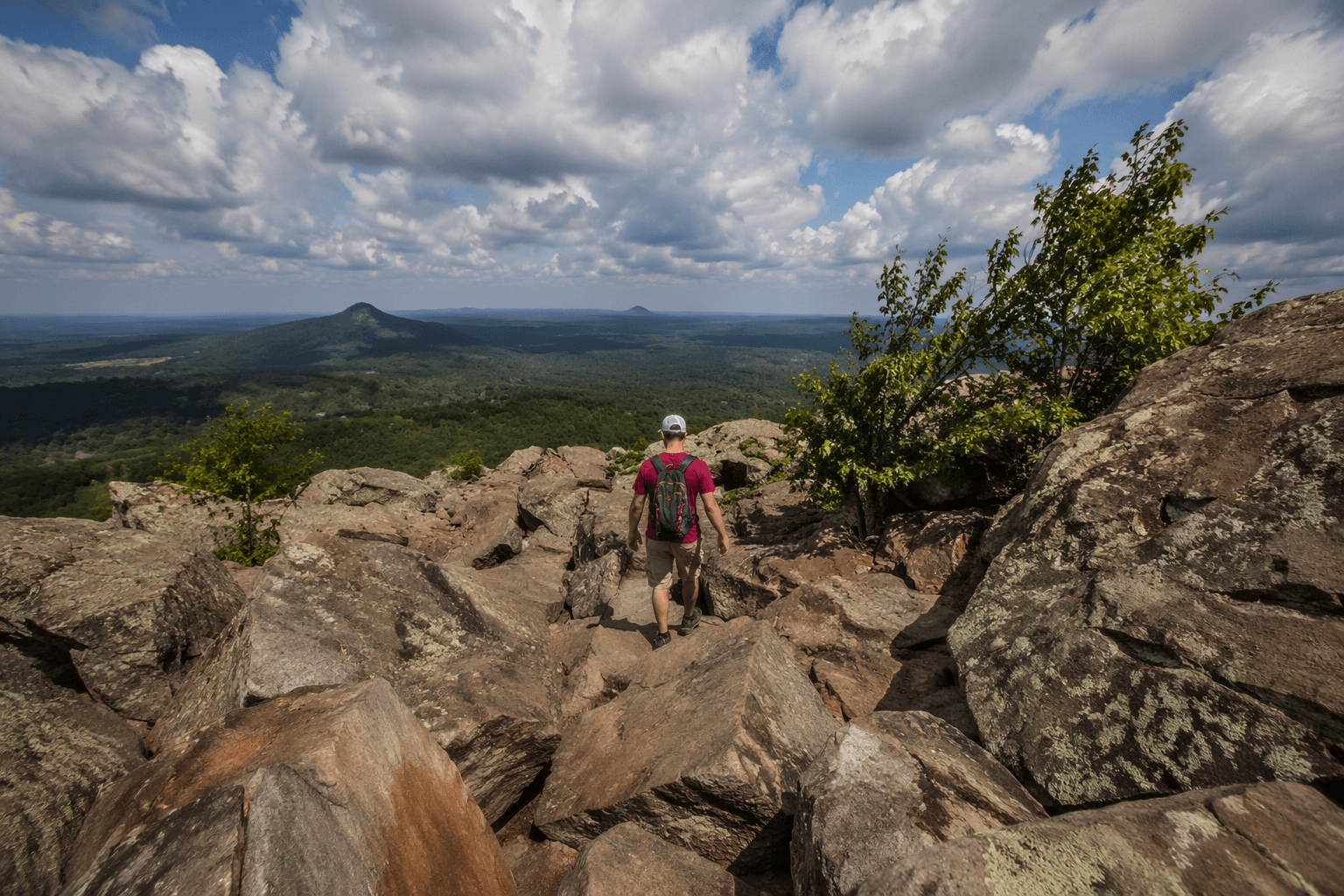
The trail network also helps explain the park’s place in everyday county life. It is not only a destination for serious hikers. It is also a place for families with a few free hours, people looking for a quick outdoor reset after work, and birders who want to watch raptors ride the wind over the peaks.
How the trail system fits together
Crowders Mountain’s trail layout gives Boulders Access meaning beyond its own parking area. Carolina Thread Trail materials say the Crowders Mountain Trail is 2.5 miles and links Linwood Road Access to Sparrow Springs Access. That connection gives the park a more usable shape for day hikers who want options instead of a single out-and-back route.
Each major access has restrooms and parking, which makes the park easier to use without turning a visit into a logistical project. Linwood Road Access is at 4611 Linwood Road in Gastonia, and the visitor center is at 522 Park Office Lane in Kings Mountain. For many local trips, that combination of access points is what turns Crowders Mountain from a one-time outing into a place you can return to in different seasons and on different schedules.
The larger state park system also helps put that access in context. North Carolina State Parks says the system manages more than 250,000 acres and welcomes more than 19 million visitors annually. In that kind of network, a single access point like Boulders is not minor infrastructure. It is part of how people actually reach public land.
The geology that makes the climb feel different
The ground underfoot is one of the reasons Crowders Mountain feels unlike the rest of the Piedmont. State planning documents describe the park’s geology as a quartzite hogback with unusually large bladed kyanite crystals and Draytonville conglomerate. NCpedia identifies Crowders Mountain as a monadnock in the Piedmont, with the mountain rising to about 1,625 feet and standing roughly 800 feet above the surrounding plateau.
Those numbers translate into what visitors feel on the trail: steep grades, exposed rock and long views that open up quickly once the climb begins. The park’s size is listed at about 5,126 acres in NCpedia and about 5,217 acres in other state park materials, which reflects different measurement dates but the same broad reality, a substantial protected landscape with enough elevation change to make the topography memorable.
The geology is not just a scientific footnote. It shapes where trails run, how far the views carry and why the mountain stands out so sharply against the lower land around it. That is part of what makes Boulders Access so distinctive. It is a doorway into a landscape whose shape is the story.
How the mountain was saved
Crowders Mountain State Park exists because local people pushed to protect the land from possible strip mining. State management materials say the park was established in 1973 as a result of a grassroots citizens’ effort, and the park opened to the public in 1974. That timeline matters because it ties today’s trail access to a specific preservation fight rather than to routine park development.
The organizing began earlier. In November 1970, a citizens’ group wrote to the North Carolina Division of State Parks asking how to establish a park at Crowders Mountain. Supporters included the Sierra Club, the Gaston County Conservation Society, the Centralina Council of Governments and the Gastonia City Council. The protest movement drew attention from the General Assembly, and within two years the mountain became a state park.
That origin story still shapes the site’s stakes. Every trail mile at Boulders Access sits inside land that was preserved because residents and civic groups understood that the mountain’s value went beyond its mineral potential. The park is now a source of local pride, but that pride rests on a clear history of organizing and refusal.
A deeper local history in the land itself
The mountain’s public story also reaches into the lives of the people who lived on and worked the land before the park existed. North Carolina State Parks says the land that now contains the park campgrounds was once owned by Jacob and Rebecca Brevard, who were born enslaved and later became among the early Black-Cherokee landowners in Gaston County. The Brevards owned 24.75 acres of farmland and raised 14 children.
That history adds another layer to the conservation narrative. Crowders Mountain is not only a place of hiking and views. It is also tied to family land, racial history and the long record of who has had access to land in this part of the state. Those details help explain why the park’s preservation carries meaning beyond recreation.
Planning a visit
If you are heading to Boulders Access, the key facts are straightforward. The access is at 108 Vandyke Road in Kings Mountain. The park’s main visitor center is at 522 Park Office Lane in Kings Mountain, and Linwood Road Access is at 4611 Linwood Road in Gastonia.
- a direct route into the park’s longer hikes
- a place to boulder or spend time on the rock
- wildlife viewing along steep Piedmont terrain
- access to the broader trail network tied to Kings Mountain and beyond
Use Boulders Access when you want:
Crowders Mountain works because it combines practical access with a preserved landscape that still looks and feels consequential. Boulders Access keeps that experience within easy reach for Cleveland County, and the case for protecting it remains tied to the same history that created it.
This article was produced by Prism’s automated news system from verified source data, official records, and press releases, then run through automated quality and moderation checks before publishing. The system is built and supervised by the people who set the standards it runs under. Read our full AI policy.
Did this article answer your question?