Crowders Mountain’s conservation fight shaped Cleveland County landmark
Crowders Mountain was saved from strip mining, and that fight still protects a Cleveland County trailhead, rare habitat and a park that drew 799,427 visits in 2025.
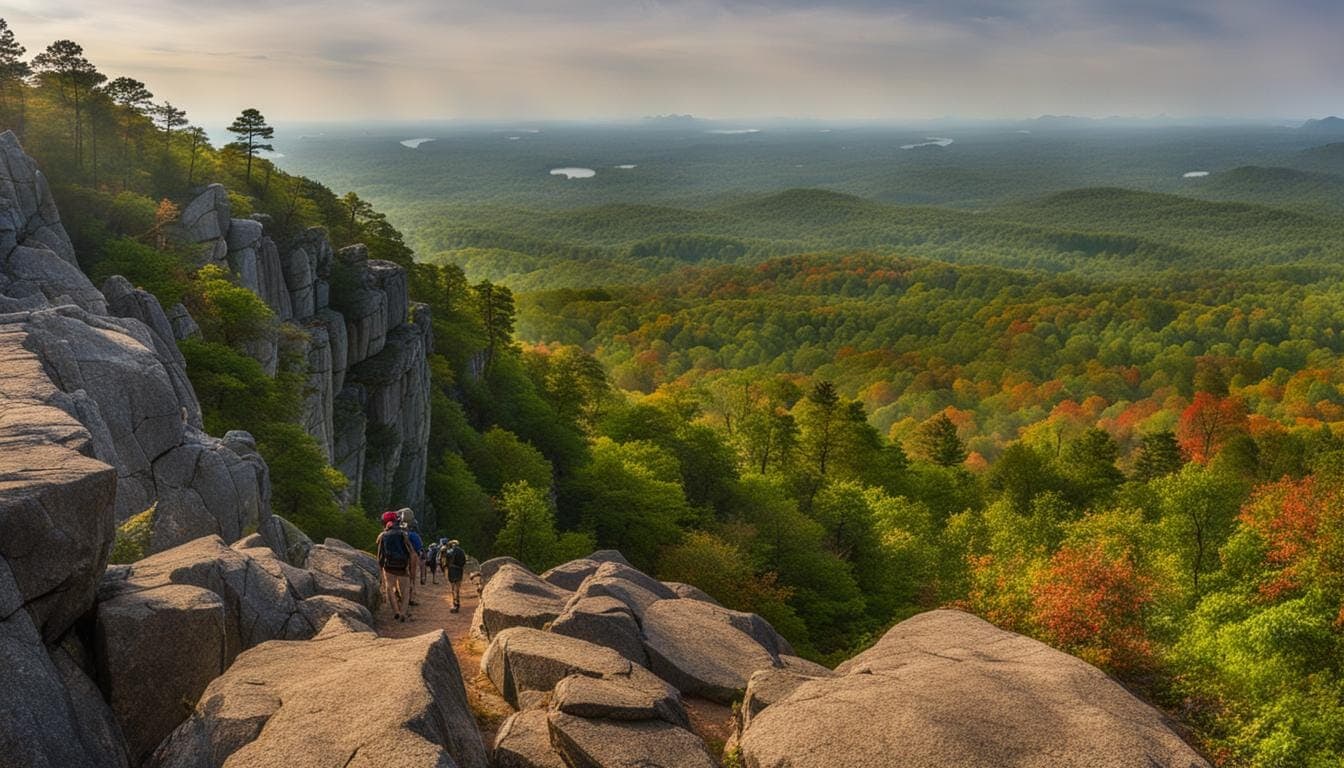
Crowders Mountain might look like a simple day-hike destination, but its existence rests on a conservation fight that kept a rare ridge from possible strip mining. The result is a Cleveland County landmark with real public value: an 800-foot rise above the Piedmont, a heavy stream of visitors, and a trail system that still anchors weekend recreation for families close to home.
Saved from strip mining
Crowders Mountain State Park was established in 1973 after a grassroots citizens’ effort to protect the land from possible strip mining. The timeline matters because the state’s move was not symbolic, but immediate: based on a 1971 proposal, North Carolina approved Crowders Mountain as a potential state park the next year, set aside land-acquisition funds in 1972, and opened the new park to the public in 1974. The mountain itself did not enter the park boundary until 1977, and The Pinnacle was added later in 1987.
That sequence explains why the park still feels like a piece of land that had to be defended in stages. Student protests were part of that pressure campaign in 1971, turning a scenic ridge into a public cause before the bulldozers could define its future. The park that exists now is the result of that civic decision, not a routine land purchase.
What visitors see from the ridge
The park’s two highest peaks, Crowders Mountain and The Pinnacle, rise about 800 feet above the plateau, which is why the views open so dramatically over the Piedmont. North Carolina State Parks describes Crowders Mountain as a place where the skyline changes quickly from ordinary rolling country to a steep, isolated ridge. That steepness is not just scenery; it is the visual record of a landscape that resisted erosion while the terrain around it wore away.
The park is also a major access point for regional recreation. Crowders Mountain State Park sits 32 miles west of Charlotte, while the Boulders Access is in Cleveland County, 38 miles west of Charlotte. The Ridgeline Trail links Crowders Mountain State Park to Kings Mountain State Park and Kings Mountain National Military Park, which makes the area feel less like a single park and more like a connected corridor of recreation and history.
In practical terms, that matters on the weekends. A park that logged 799,427 visits in 2025 sends people into Kings Mountain for gas, food, trail supplies and a quick escape into the outdoors. For western Cleveland County families, that means a nearby place to hike without a long drive, and a local landmark whose preservation keeps recreation close to home instead of pushing it farther out.

The geology under your boots
The land is unusual because the rocks are unusual. The General Management Plan identifies a quartzite hogback, large bladed crystals of kyanite and the Draytonville conglomerate as standout geologic features. A North Carolina Geological Survey overview describes Crowders Mountain as a monadnock near the center of the Piedmont, formed from highly resistant kyanite quartzite that held its shape while the surrounding land eroded.
A geology study of the Kings Mountain terrane reinforces that picture, finding that Crowders Mountain and The Pinnacle are dominated by quartz and kyanite. The summit geology is also tied to the Battleground Formation, adding another layer to a ridge that is important not just for views but for what it reveals about the region’s deep geologic history. If the mountain had been opened to strip mining, the result would have been the loss of a landform that is scientifically distinctive, not just visually memorable.
Rare plants and wildlife still hold on here
The management plan also points to a compact but notable set of species and plant communities that depend on the ridge. Among the names it highlights are Bradley’s spleenwort, ground juniper, Appalachian golden-banner, Biltmore carrion-flower, mountain witch alder, smooth sunflower and the Long Dash butterfly. Those are the kinds of species that make a park more than a view; they turn the trail into a living field site.
That ecological specificity helps explain why Crowders Mountain matters to residents who may never study geology maps or plant lists. The same rocky, well-drained habitat that gives hikers a hard climb also supports species adapted to a narrow set of conditions. Keep the ridge intact, and you keep the conditions that let those plants and insects survive.
A landscape with older human histories
Crowders Mountain’s conservation story sits on top of a much older human landscape. NC State Parks says the area was once home to a mineral spring resort, a seminary, an all-women’s college and a Black college. The park history also ties the land to Indigenous travel and trade: after the Revolution, André Michaux passed through the region, and the peaks marked hunting grounds and trade routes for Catawba and Cherokee peoples.
The Brevard family story gives the land another crucial layer. Jacob and Rebecca Brevard were born enslaved and became early Black-Cherokee landowners in Gaston County. They owned 24.75 acres of farmland and raised 14 children, a reminder that the area’s history is not only about preservation and recreation, but also about Black landownership and survival in western North Carolina.
The broader region also connects the park to the Revolutionary era, including nearby Kings Mountain. That makes Crowders Mountain part of a longer historical geography, where natural features, military history and settlement patterns all overlap in a relatively small area.
Why Cleveland County still has skin in the game
For Cleveland County, the value of Crowders Mountain is local and immediate. Boulders Access gives the county a direct connection to one of the state’s most recognizable high points, while the Ridgeline Trail links the park to neighboring historic sites that draw their own visitors. That connection helps keep outdoor spending, day-trip traffic and regional visibility from draining elsewhere.
The conservation fight also has a quality-of-life dimension that is easy to miss if the mountain is treated like a backdrop. The park preserves a place where western Cleveland County families can hike, look out over the Piedmont and experience a landscape that still feels wild because citizens once insisted it should not become a mine. That decision still shapes the county’s edge today, one ridge, one trailhead and one weekend visit at a time.
This article was produced by Prism’s automated news system from verified source data, official records, and press releases, then run through automated quality and moderation checks before publishing. The system is built and supervised by the people who set the standards it runs under. Read our full AI policy.
Did this article answer your question?