Delta State honors 1969 student sit-in with Freedom Trail marker
Delta State University marked the 1969 Black student sit-in with a Freedom Trail plaque outside the president’s office, turning the campus into a public lesson in civil-rights history.
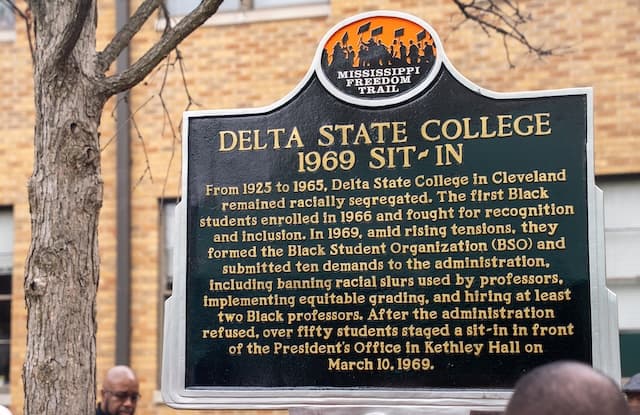
A Mississippi Freedom Trail marker now stands on the Delta State University campus in Cleveland, recognizing the 1969 student sit-in that pressed the school toward racial equity and inclusion. The marker places the protest, led by Black students at then-Delta State College, in the public record at the very spot where it unfolded outside the president’s office.
The sit-in took place in March 1969, with the Mississippi Free Press reporting that about 50 Black students peacefully protested for equal treatment on March 10, 1969. Delta State identifies the action with the Black Student Organization, and Mississippi History Now places it within the broader struggle for increased representation and inclusion of Black students in Mississippi higher education. The marker now gives names and place a permanence that a line in a history book cannot.

Among those remembered are Mary Carter, Effie Sledge, Pearlie White, Maggie Crawford, Yvonne Stanford and Lula Jones, whose participation was identified in a photo caption in The Leland Progress. Their protest is now tied to a marker that local students, alumni and families can encounter on campus rather than only in archives or oral histories. Delta State also has a documentary project, Voices from the Sit-In, which revisits the protest and its outcomes.
The Freedom Trail designation links Delta State to a larger Mississippi civil-rights landscape. The Mississippi Humanities Council says the Mississippi Freedom Trail was created to commemorate people and places that played a pivotal role in the American Civil Rights Movement, and the first markers were unveiled in 2011. Visit Mississippi said the Delta State ceremony was cohosted with the Mississippi Humanities Council and the Delta Center for Culture and Learning, placing the campus marker within a statewide memory project rather than a stand-alone plaque.
That broader context matters in Cleveland and the surrounding Delta, where the university is one of the region’s most visible institutions. The marker turns a campus corner into a teaching tool for current students and for residents who have watched the university grow alongside the community around it. It also fits into a wider preservation effort that includes the Mississippi Delta Civil Rights Heritage Archive, which keeps the region’s civil-rights history accessible to the public.
At Delta State, the new marker does more than commemorate 1969. It marks a decision to tell the university’s story in full, including the students who forced change into view and the campus history that followed.
This article was produced by Prism’s automated news system from verified source data, official records, and press releases, then run through automated quality and moderation checks before publishing. The system is built and supervised by the people who set the standards it runs under. Read our full AI policy.
Did this article answer your question?