How Cleveland County’s earliest roads grew from trails and crossings
Cleveland County’s road map began as bridle paths, ford crossings, and ferries. Those routes still explain where Lawndale, Fallston, and the county’s business corridors grew.
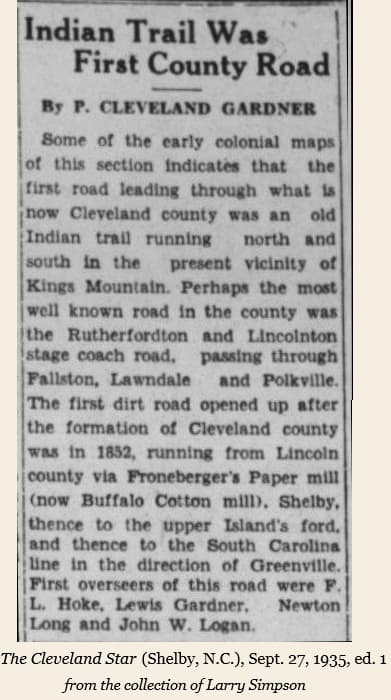
Cleveland County’s earliest roads were not roads in the modern sense. They were dirt bridle paths and wagon trails that followed Indian trails, buffalo traces, and deer trails, then bent toward the shallowest places in the First Broad River and its creeks because people, horses, and wagons needed firm footing more than straight lines.
That geography still explains a lot about the county’s layout. The places that became crossings, stage stops, mills, and town centers are the places where travel was easiest, and the places where travel was easiest became the places where trade concentrated.
Trails before highways
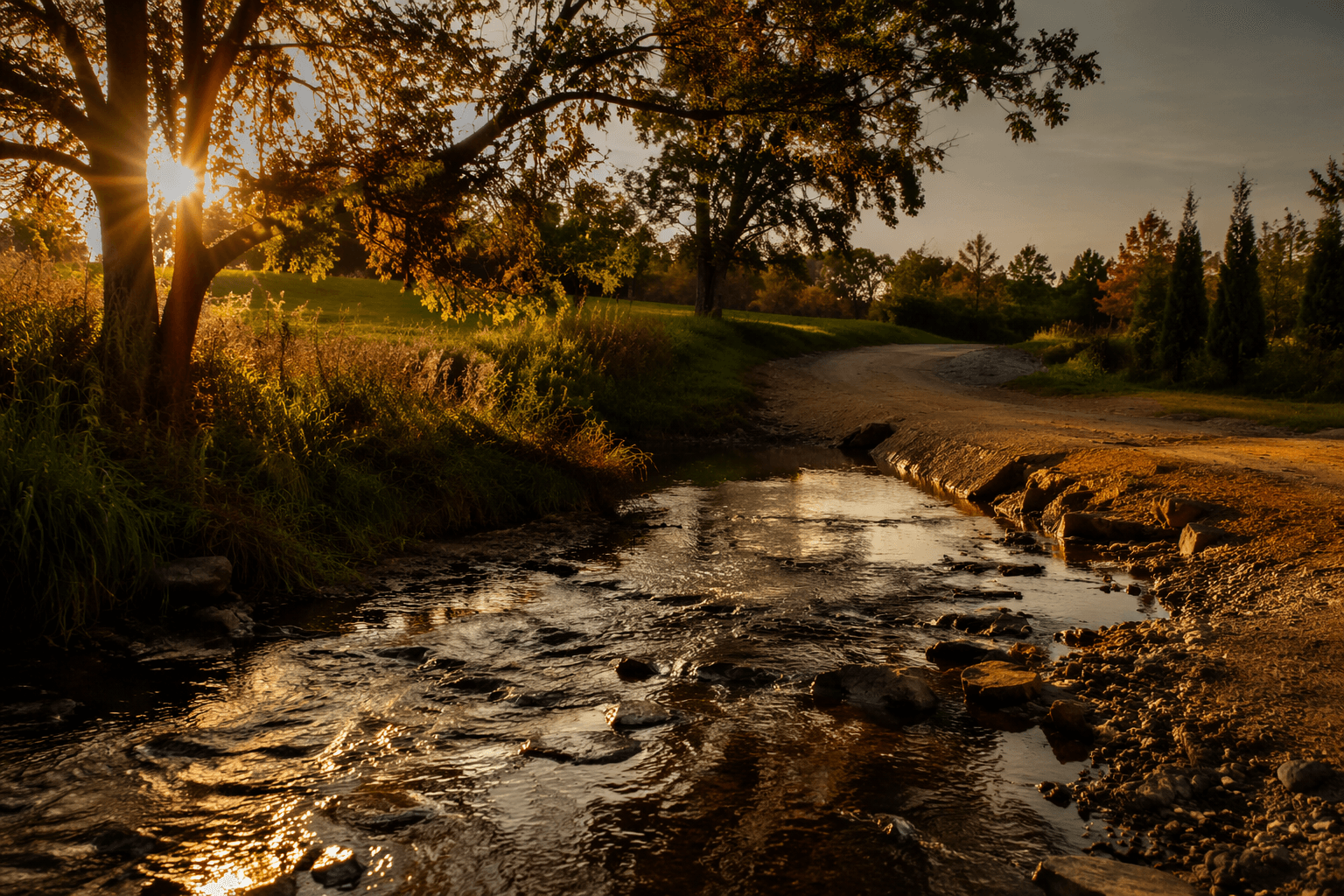
Before paved highways, movement in Cleveland County followed the land itself. A route survived if it could reach a ford, keep a wagon out of the mud, and connect one settlement to another without wasting time on hills or swampy ground. The county’s first transportation system was therefore built around natural crossings, not engineered intersections.
That local pattern matched a wider North Carolina story. In the 1700s, travel routes often grew from American Indian paths, and by the 1830s and 1850s the state was experimenting with plank roads as a way to improve over dirt surfaces. By 1910, North Carolina had nearly 50,000 miles of road, but only about 2,000 miles were paved, which shows how long the county’s older crossings remained important before modern highway building took hold.
Gardner’s Ford and the Lawndale crossing
One of the clearest examples sits in the Lawndale area. Gardner’s Ford on the First Broad River became a stagecoach stop on the Lincolnton-to-Rutherfordton route, and the Town of Lawndale still sits at that crossing near today’s Main Street bridge.
Stagecoaches were not random trips through the countryside. They were scheduled public vehicles, usually drawn by teams of two to six horses, and they moved in 10- to 15-mile stages before changing horses at predetermined stops. Gardner’s Ford fit that system exactly: the river crossing made the stop possible, and the stop made the crossing a permanent point on the county’s map.
The same corridor later helped anchor industry. The Double Shoals Cotton Mill, the first cotton mill in Cleveland County, opened in 1874 about three miles south of Lawndale. A year later, Henry Franklin Schenck converted an old grist mill on Knob Creek into a cotton mill, creating Cleveland Mills and showing how water, roads, and manufacturing began to cluster along the county’s early travel routes.
Fallston began at a stagecoach stop
The Lincolnton-to-Rutherfordton stagecoach route also reached farther east, where the stop known as “Kitchen Corner” marked the beginning of what would become Fallston. That detail matters because it shows how a settlement could start with nothing more than a regular stopping place on a route that already had traffic.
Fallston’s origin fits the same countywide pattern as Lawndale. Once a route carried mail, passengers, and goods through a particular place on a regular schedule, that place had a better chance of becoming a community. In Cleveland County, a stage stop was often the first step toward a town.
Elliott’s Ford and the county bridge budget
After Cleveland County was formed in 1841, the county spent $125 to build a bridge at Elliott’s Ford on the First Broad River. That may sound like a small line item now, but it was a major public investment in a place that already mattered to travelers.
Elliott’s Ford is tied to Martin Elliott, a Revolutionary War veteran whose grave is said to be on the hill near the modern highway intersection of Highway 74 West and Polkville Road. The old ford and the present highway crossing sit in the same broad corridor, which is one reason the county’s transportation history still reads like a map of today’s traffic patterns.
The modern U.S. 74 West bridge across the First Broad River descends from that earlier crossing. The road has changed, but the logic has not: where the river could be crossed efficiently, the county kept building.
Quinn’s Ferry, Ellis Ferry, and the Broad River crossing
Not every crossing was a bridge. One Broad River crossing was first known as Quinn’s Ferry and later operated by Charles Ellis. Ferries were not relics of some distant past, either. North Carolina still uses them today, with 24 ferries running on seven routes across rivers, sounds, and an ocean access inlet.
An 1898 photograph caption preserved on the county history site identifies Ellis Ferry and names B. Oswald Randall, Rev. Ambrose Hopper, his wife, and Doff Thomasson, who was pushing the ferry from shore. That image captures how practical and labor-intensive river travel remained in Cleveland County well into the late 19th century.
The ferry also shows how transportation and community life overlapped. A crossing was not just a way over water. It was a place where farmers, merchants, preachers, and travelers met, exchanged news, and waited on the next move across the river.
The failed port and the labor behind the bridge
Around 1800, promoters tried to establish a town near what is now the Mt. Sinai community as a river port for shipping agricultural products to Charleston and Columbia, South Carolina. They hoped the Broad River could carry goods farther and faster than the county’s muddy roads could manage.
The same transportation problem appears in another local detail: flat-bottom scows and bateaux floated up and down the Broad River as late as 1840, because long trips to market could take months when roads were poor. In that setting, every usable water route mattered, and every crossing had commercial value.
Charles and Rick Ellis responded to that need by purchasing 70 or 80 enslaved people and supervising construction of a large wooden bridge across the Broad River to create a trade route between Gaffney, South Carolina, and Shelby, North Carolina. The county history site also notes that after the Civil War, when the bridge washed away, the Ellis family operated a ferry there. The bridge and the ferry together show how transportation infrastructure in Cleveland County was bound up with enslaved labor, commerce, and the postwar need to keep goods moving.
Why the old routes still shape the county
The county’s earliest roads, ferries, and bridges did more than connect isolated farms. They determined where stagecoaches stopped, where mills opened, where towns formed, and where modern roads still funnel traffic across the First Broad River and Broad River. Cleveland County’s business corridors and chokepoints did not appear by accident; they grew out of crossings that made movement possible.
That broader pattern helps explain why the county’s present-day roads look the way they do. The Federal Road Act of 1916 and North Carolina’s Highway Act of 1921 accelerated highway construction, but they did not erase the older geography. They built on it, turning ford lines and ferry routes into paved corridors that still carry daily life through Lawndale, Fallston, and the crossroads that link Shelby to the rest of the county.
This article was produced by Prism’s automated news system from verified source data, official records, and press releases, then run through automated quality and moderation checks before publishing. The system is built and supervised by the people who set the standards it runs under. Read our full AI policy.
Did this article answer your question?