Buckhorn Museum legacy lives on at Coryell Museum, Historical Center
A replica Buckhorn counter still anchors Coryell County memory at 718 E. Main St., where the old saloon's antler-heavy legend has become part of everyday Gatesville history.
The Buckhorn still has a place in Gatesville
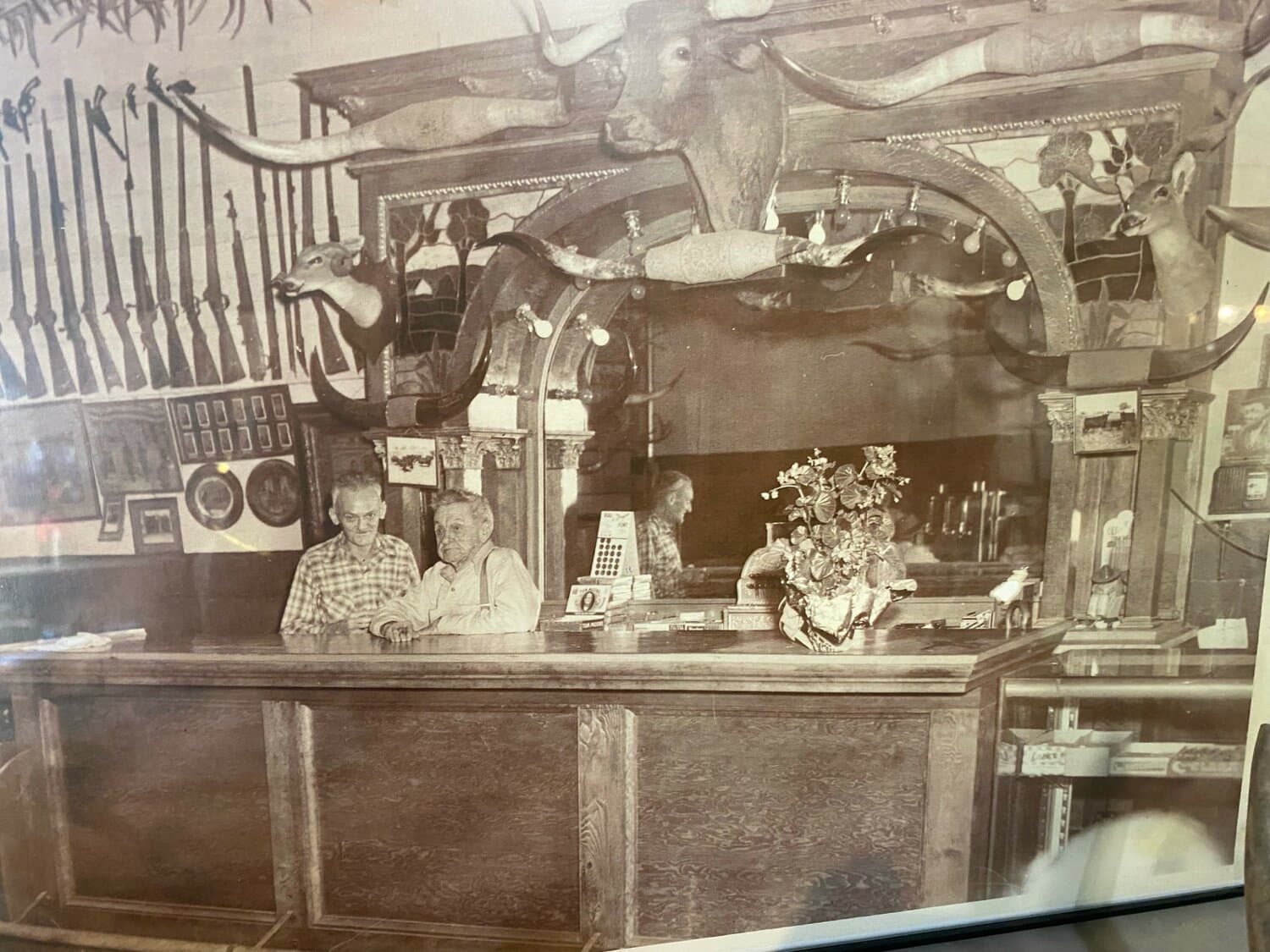
Inside the Coryell Museum and Historical Center, the back section brings one of Coryell County’s most distinctive landmarks back into view. A replica of the old Buckhorn counter stands as a reminder of the saloon and museum that once sat on the south side of the courthouse square in Gatesville, where hundreds of antlers hung around the bar and from the ceiling.
That image still matters because the Buckhorn was never just a building. It became part of the county’s identity, a place where ranching, frontier memory, and local curiosity all met in one room. Even after the original contents were auctioned in 1992, the story did not leave town. It simply moved into the museum that now carries the memory forward.
How Baine Allen built a local institution
The Buckhorn traces back to Baine Allen, a Coryell County rancher who started it as a place to display his growing collection of game trophies and local memorabilia. Allen wanted the exhibit to stay rooted in the area, so everything on display had to be of local interest. That gave the Buckhorn a different character from a typical saloon or roadside curiosity stop.
His collection drew from Central Texas history in a way that reflected both the land and the people who lived on it. Allen gathered arrowheads tied to Central Texas tribes such as the Comanche and Tonkawa, along with artifacts that spoke to the county’s frontier and ranching past. Among the items said to be on display were a human skull, cowboy boots, grinding stones, leg irons, World War II rifles, handcuffs for prisoners, and other pieces that would have fascinated visitors looking for a direct link to the region’s past.
A 1980 clipping in the Gatesville Messenger described Allen as a rancher and philanthropist who owned and operated the Buckhorn from 1920 until his death in 1964. Another archival source identifies him as Robert Bain Allen, born July 8, 1881, in Gatesville and dying March 24, 1964, in Gatesville at age 82. However his name appears in a given source, the record is clear on one point: he spent decades shaping a collection that became inseparable from Gatesville itself.
A saloon, a museum and a photo that captured the atmosphere
A historical photograph preserved by University of North Texas Libraries through The Portal to Texas History helps explain why the Buckhorn still sticks in local memory. It shows Bain Allen and Bud Henderson behind the counter at the Buckhorn Saloon in Gatesville, with deer antlers covering the ceiling and firearms displayed on the wall. The scene makes the place feel less like a standard bar than a dense display of ranch life, hunting culture and local pride.
That visual record matches the way longtime residents remember the Buckhorn: crowded, unusual and unmistakably tied to Coryell County. The hundreds of antlers around the counter gave the place a kind of theatrical personality, but the deeper significance was in what the collection represented. Allen was preserving local objects, local stories and local identities at a time when many such things could easily have been lost or scattered.
A 1980 newspaper clipping later described the Buckhorn as Allen’s legacy to Gatesville, a telling phrase because it captures how the place outlived its original owner in the public imagination. After Allen died in 1964, his nephew Jim Miller continued adding to the collection, keeping the Buckhorn alive for another chapter before the contents were eventually auctioned in 1992.
Why the Buckhorn drew attention beyond one generation
The Buckhorn’s draw was not limited to people who lived nearby. During Coryell County’s centennial celebration, the collection helped define the county’s story for a wider audience. The centennial ran in Gatesville from May 6-9, 1954, and was organized by the Gatesville Chamber of Commerce. Allen reportedly spent more than $25,000 building the collection, a large investment for the time and a sign of how seriously he treated the idea of a local museum.
That centennial moment matters because it shows the Buckhorn was already more than a private hobby. It had become a public attraction and a symbol of what Gatesville wanted to present about itself. Visitors came for the spectacle of the antlers and trophies, but they also encountered a curated version of Coryell County history, one grounded in ranch work, frontier relics and the everyday material culture of the region.
The continuing interest in the Buckhorn also says something broader about how communities hold onto memory. Landmarks do not stay alive only through the original structure or the original collection. They survive when people keep retelling the story, preserving photographs, and finding ways to carry the idea into the present. In Gatesville, that work now happens at the Coryell Museum and Historical Center.
What remains at the Coryell Museum and Historical Center
Today, the museum at 718 E. Main St. gives the Buckhorn a second life through a replica of the old counter, a large spur collection and guided tours. The museum’s official site highlights the Mitchell Spur Collection as the world’s largest spur collection, which fits naturally with the Buckhorn story because both collections reflect the region’s ranching identity and its strong attachment to working history.
The museum is open Wednesday through Saturday from 10 a.m. to 4 p.m., and it lists a contact phone number of (254) 865-5007. Admission is free, and the museum encourages donations as well as school and group tours. Those details matter because they make the collection accessible to newer residents, students and families who may never have seen the original Buckhorn but can still understand what it meant.
That accessibility is part of the story’s public value. A landmark like the Buckhorn can easily become a nostalgic anecdote, remembered only as a quirky old place with antlers on the wall. At the Coryell Museum and Historical Center, it becomes something more useful: a local teaching tool, a point of pride, and a concrete link between present-day Gatesville and the county’s ranching and frontier past.
A legacy that still belongs to Coryell County
The Buckhorn’s significance rests in the way it blended spectacle with local history. Baine Allen built it from objects tied to Coryell County and Central Texas, then turned it into a destination that could hold the attention of tourists, students and longtime residents alike. The original collection may be gone, but the memory has been preserved with care.
In Gatesville, that means the Buckhorn is still part of the landscape, not just the past. The replica counter, the spur collection and the museum’s free access keep the story in everyday circulation, where it can continue to shape how Coryell County sees itself.
This article was produced by Prism’s automated news system from verified source data, official records, and press releases, then run through automated quality and moderation checks before publishing. The system is built and supervised by the people who set the standards it runs under. Read our full AI policy.
Did this article answer your question?