Fort Station’s 1839 outpost shaped early Coryell County settlement
A forgotten 1839 fort gave Station Creek its name and helped shape Coryell County’s first settlement pattern, from roads to churches to county memory.
Fort Station and the first line of defense
Long before Gatesville became the county seat, a frontier outpost in what is now southeastern Coryell County helped set the pattern for where people later lived, traveled, and worshiped. Fort Station was established in 1839 and maintained by Texas soldiers under George B. Erath, at a moment when the Republic of Texas was still trying to push its defenses farther west.
That timing matters. Mirabeau B. Lamar’s administration wanted a chain of forts and a military road across the frontier, but by December 1839 the Republic of Texas Army still had only five companies along the frontier, far too few to staff every planned post. Fort Station was part of that unfinished defense system, and its location became a durable marker even after the fort itself vanished.
The clash that pushed the frontier west
The story of Fort Station is tied to the violence of 1839, especially the Bird’s Creek Indian Fight. On May 26, 1839, near present-day Temple, a ranger force of 34 men under Capt. John Bird encountered more than 200 Caddo, Kickapoo, and Comanche Indians. Bird was killed in the fight, and a Comanche chief was also killed, underscoring just how unstable the frontier remained.
After Bird was killed in Bell County, the pursuit continued into present-day Coryell County, where Erath created and maintained the new station. Some accounts have described the place as a Texas Ranger post, but the Texas State Historical Association places it in the hands of Texas soldiers under Erath’s command. That detail matters because it shows Fort Station as part of a larger military and settlement strategy, not just a lone outpost on the edge of nowhere.
How Fort Station became Station Creek
Even though no physical trace of the fort remains, the landscape still remembers it. Station Creek was named for old Fort Station, and the creek rises about twelve miles east of Gatesville, putting the place squarely in the geography that early settlers would have known. Names like that do quiet work over generations: they keep a vanished site attached to the county map long after the original structures are gone.
The community that later took shape at Station Creek followed the same pattern. In 1855, a post office was established there with Jouett Harbert Davenport as postmaster, and a Methodist church organized that same year was said to be the first Methodist church in Coryell County. Those are not small details. A post office and a church usually signal that a place had moved beyond a military marker and into the everyday life of families, mail routes, and local institutions.
What remains on the modern landscape
Station Creek sat on Farm Road 107, about fifteen miles southeast of Gatesville, which helps explain why the site still fits into county history even though it no longer functions as a town. The post office later moved to Eagle Springs in the late 1860s or early 1870s, and by 2000 only the cemetery marked the community on county highway maps. That kind of disappearance is part of the story too: the settlement faded, but the place name survived in the creek, the road network, and local memory.
For Coryell County, that loss is more than sentimental. It shows how land use changed as military outposts gave way to church communities, postal stops, and eventually a more settled rural county. If Fort Station helped define the first frontier line, Station Creek shows how that line became a lived-in place, with families, burial grounds, and institutions that outlasted the fort.
Erath’s wider influence on Texas towns
George B. Erath’s role at Fort Station was only one chapter in a much larger career that linked frontier defense to town making. Born in Vienna in 1813, he came to Texas in 1833, joined John H. Moore’s ranger company in 1835, and fought at San Jacinto in 1836. He later platted Caldwell in 1840 and represented Milam County in the House of Representatives of the Republic of Texas from 1843 to 1845.
After statehood, Erath returned to surveying and helped lay out Waco and Stephenville. That matters for Coryell County readers because it places Fort Station inside a broader pattern of Texas development: men who first defended the frontier often became the ones who mapped, measured, and organized the towns that followed. In that sense, Erath was not only a military figure but also a builder of the civic geography that still structures central Texas.
Why Fort Station still matters to Coryell County
Coryell County itself covers 1,031 square miles and borders Hamilton, Bosque, McLennan, Bell, and Lampasas counties. TSHA says the area has supported human habitation for at least 12,000 years, and that Tonkawa peoples were established along the Leon River by 4500 B.C. Few Anglo settlements existed there before the late 1840s, which makes Fort Station an early and important hinge between older Indigenous landscapes and later county settlement.
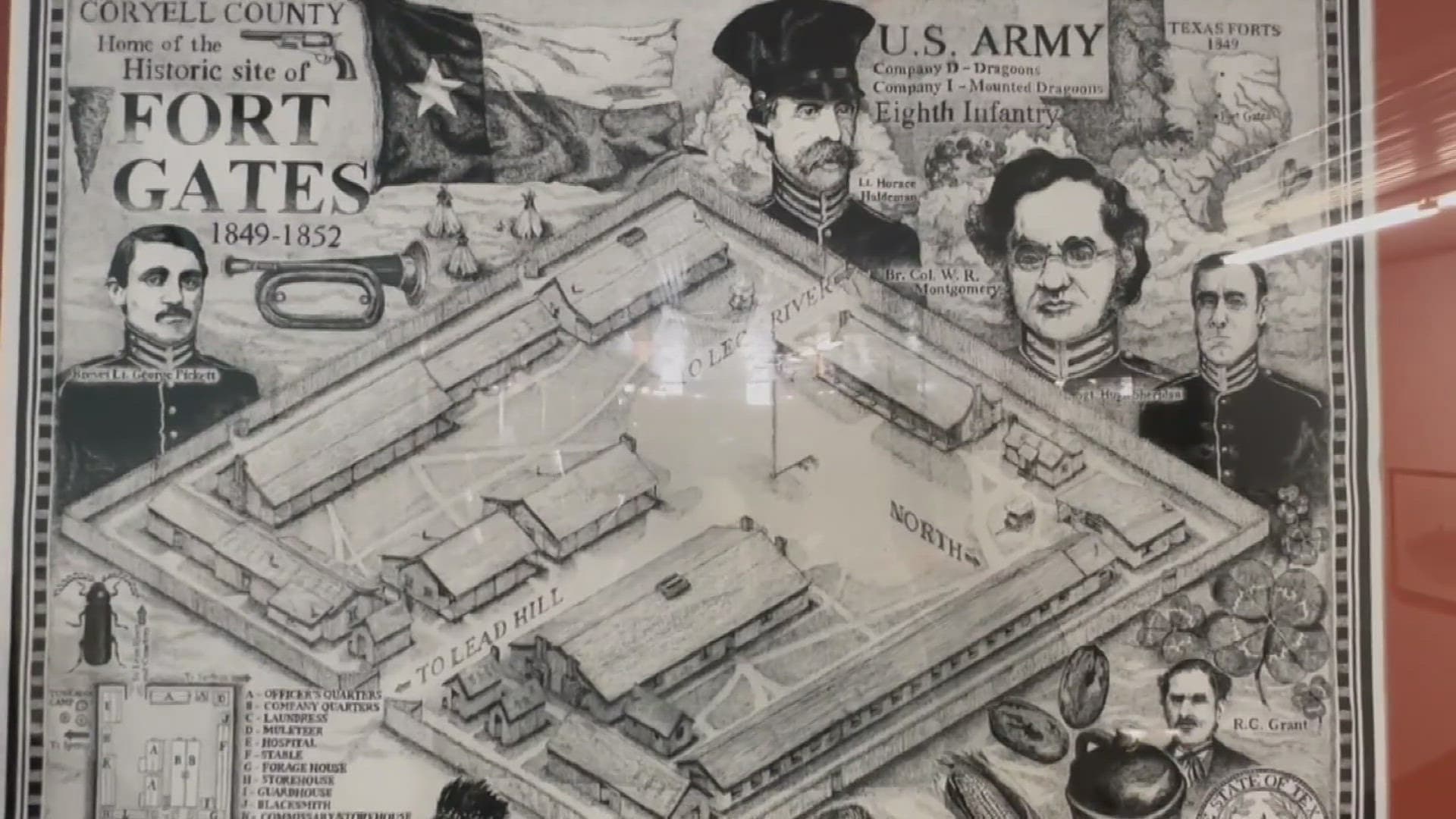
Fort Gates, established in 1849, became the first settlement in Coryell County and eventually gave Gatesville its name. Seen in that sequence, Fort Station was not a separate footnote but the opening chapter in a county-wide story about where defense, travel, and settlement took root. Today, the fort survives only through Station Creek, old maps, and local memory, but those traces still shape how Coryell County understands its own beginning.
Know something we missed? Have a correction or additional information?
Submit a Tip