San Jacinto veteran’s grave in Coryell County marked with historical marker
A San Jacinto veteran rests in Bee House Cemetery, tying Coryell County directly to Texas independence through a grave, a marker and a family still rooted here.
A San Jacinto trail in Bee House
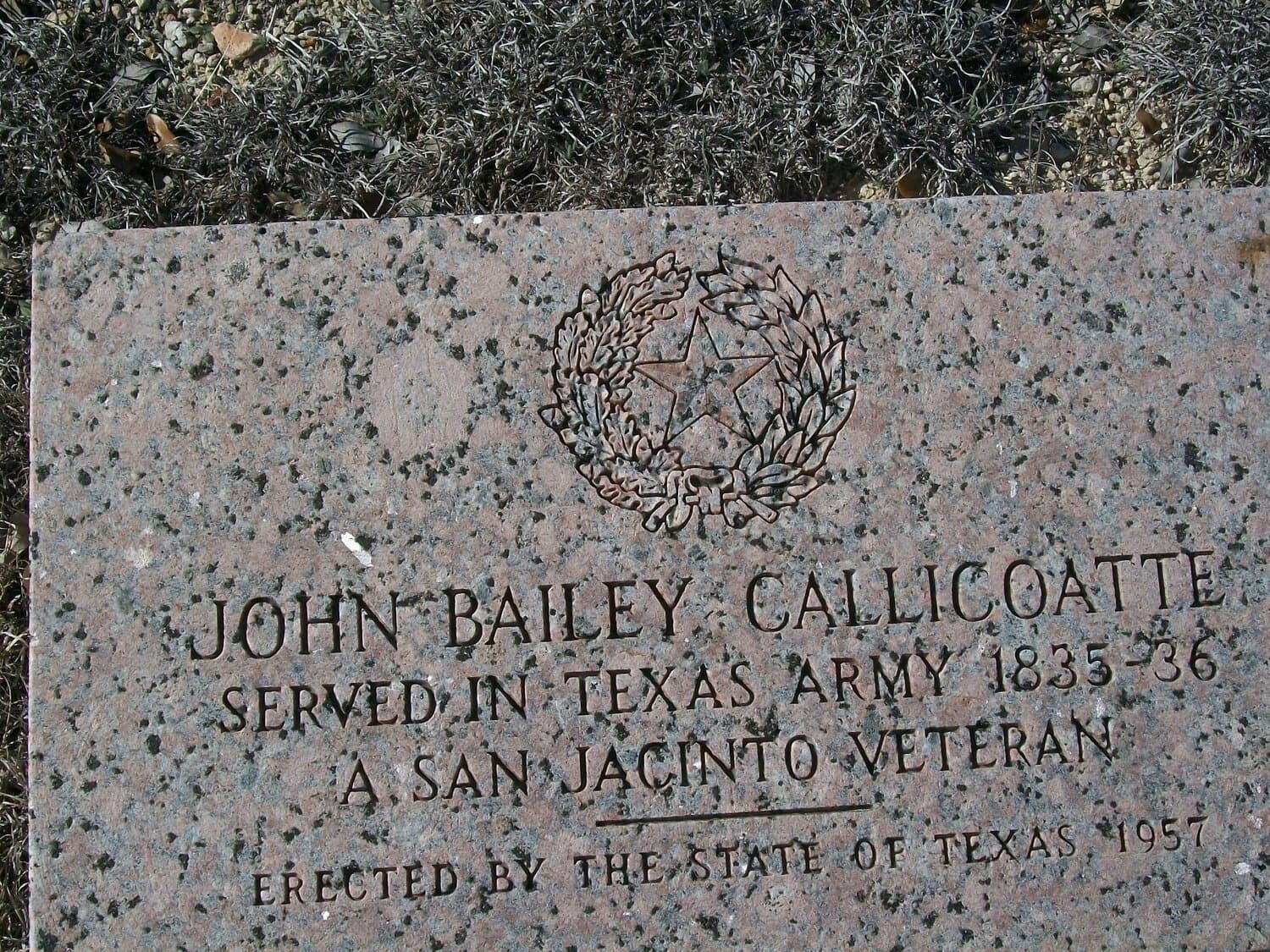
A grave in western Coryell County turns Texas independence from a distant state story into something you can stand beside. In Bee House Cemetery, just 11 miles west of Gatesville, the marker for John Bailey Callicoatte links one of the most famous battles in Texas history to a family line and a place that still carry local memory.
Callicoatte was not a famous general or politician. He was a private in Captain Thomas H. McIntire’s company, one of the men who helped carry the Texas Revolution to its final military chapter at San Jacinto. He later died on March 28, 1906, at age 91, and was buried in the Price family lot at Bee House Cemetery, where the Texas State Historical Commission placed a historical marker in 1957.
Why San Jacinto still matters here
The Battle of San Jacinto was fought on April 21, 1836, and it ended the Texas Revolution. Sam Houston’s army had retreated from Gonzales on March 13, crossed the Colorado River on March 17, and had grown to about 1,200 men by March 20. Houston’s scouts reported Mexican forces west of the Colorado River at about 1,325 men, and the Texans learned of Fannin’s defeat at Goliad on March 25. Then came the battle itself, followed by the capture of Antonio López de Santa Anna the next day.
That history matters in Coryell County because it is not only preserved in books and battlefield museums. It is also preserved in a cemetery, in a family lot, and in a small community that has kept its own place in the county’s story for generations. The marker at Bee House gives residents a local point of contact with a war that shaped the state’s borders, politics and identity.
Who John B. Callicoatte was
The San Jacinto veteran bio identifies him as John B. Callicoatte, with the alternate spelling “Coliant” appearing in the 1836 rolls. It says he was born on December 5, 1814, in Montgomery County, North Carolina, came to Texas in 1835 and also fought at Bexar. He worked as a storekeeper, but the larger arc of his life shows the restless reach of the frontier era: he followed Sam Houston’s recruiting call in New Orleans, then later took part in the California Gold Rush and spent time in Alaska.
That biography helps explain why a man who crossed so much of the early American West ended his life in Coryell County. Bee House was more than a burial place for him. It was a community tied to relatives, especially his sister Agatha Callicoatte Price, who lived nearby, and to descendants who still remain in the area today.
Bee House as a Coryell County landmark
Bee House itself gives the story even deeper local roots. The community sits on Farm Road 183 in western Coryell County and began in the 1850s as Boyd’s Cove. In 1884, residents asked for a post office named Bee Hive because of the bees in nearby cliffs and caves, but the postal service issued the name Bee House instead.
By the mid-1890s, Bee House had a general store, a corn mill, four churches and about 150 residents. From the mid-1880s until 1916, a Masonic lodge met on the upper floor of the two-story schoolhouse, and in 1904 the Bee House school had 78 students and two teachers. Those details matter because they show a place that was small but organized, with civic life, worship, education and community memory layered into the same landscape where Callicoatte is buried.
How the marker program helps tell the story
The marker at Bee House Cemetery is part of a broader state effort to document places like this. The Texas Historical Commission was created in 1953 as the Texas State Historical Survey Committee, and the Official Texas Historical Marker Program was formed in 1962 to record historic sites in all 254 counties. Texas historical markers are meant to commemorate events, places and individuals significant to state history, which is exactly what happens at Callicoatte’s grave.
That statewide system is why a veteran’s burial site in Coryell County can carry meaning beyond the county line. The marker does not just identify a grave. It places Callicoatte inside the sweep of Texas history while keeping him anchored in a specific family lot, a specific cemetery and a specific community.
What readers see when they visit the site
A visit to Bee House Cemetery is a reminder that history in Coryell County often survives in ordinary places. The site ties together San Jacinto, Bexar, a North Carolina birth record, a Texas burial and a local family network that still reaches into the county today. It also shows how community memory can move from oral tradition and genealogy into an official historical marker that endures beside the grave.
For Coryell County, the significance is not abstract. Callicoatte’s resting place connects local land, local families and the state’s founding conflict in one small space west of Gatesville. In a county where old schoolhouses, church grounds and cemetery lots still hold the record of who lived here and why, Bee House Cemetery stands as a visible inheritance of the Texas Revolution.
This article was produced by Prism’s automated news system from verified source data, official records, and press releases, then run through automated quality and moderation checks before publishing. The system is built and supervised by the people who set the standards it runs under. Read our full AI policy.
Know something we missed? Have a correction or additional information?
Submit a Tip