Filmmaker shoots Mary Treat documentary across Vineland and Pine Barrens
Mary Treat’s life is being filmed across Vineland and the Pine Barrens, turning Cumberland County’s landscape into the center of a larger scientific story.
A Vineland story filmed where it happened
The new documentary on Mary Treat is using Vineland and the New Jersey Pine Barrens as more than a backdrop. Helga Merits’ project, *Mary Treat: A Love Letter to Nature*, ties one of Cumberland County’s best-known scientific figures to the land she studied, the community she lived in, and the regional ecology that shaped her work.
That matters because Treat was not an imported subject or a distant historical name. She was an early Vineland resident whose observations of plants and insects helped put this corner of South Jersey into the scientific record. By filming in recognizable local spaces, including the Vineland Historical Museum and wooded areas in the Pine Barrens, the production gives Cumberland County residents a chance to see their own landscape treated as culturally and scientifically significant.
Why Mary Treat still matters in Vineland
Mary Treat was born Mary Lua Adelia Davis on September 7, 1830, and died on April 11, 1923. She moved to Vineland in 1868 or 1869 with her husband, Joseph Burrell Treat, and the two separated in 1874. Over time, she became recognized as an American naturalist, writer, botanist, and entomologist whose work on carnivorous plants and insects drew the attention of major scientific figures in the 19th century.
Her importance is not just local nostalgia. Treat wrote books including *Home Studies in Nature* and *Injurious Insects of the Farm and Garden*, and multiple plants and animals were later named for her. Her research helped establish Vineland and the Pine Barrens as places worth studying, not just passing through, which gives the film a built-in tension: it is documenting a woman whose legacy was built by paying close attention to a place many outsiders still misunderstand.
Darwin, Asa Gray, and a scientific reputation that reached far beyond Cumberland County
Treat’s connection to Charles Darwin gives the documentary a wider historical reach. The Darwin Correspondence Project says she exchanged 15 letters with Darwin between 1871 and 1876, more than any other woman naturalist. That correspondence began at the request of Asa Gray, who believed Darwin would be interested in Treat’s observations on Drosera, or sundew.
Darwin later acknowledged her contribution in his 1875 book *Insectivorous Plants*. For today’s viewers, that detail does more than add prestige. It shows how a Vineland resident’s fieldwork and persistence entered a global conversation about science, plants, and the natural world. In a county that often sees its stories narrowed to local geography, Treat’s life offers a reminder that Cumberland County has long produced knowledge with reach.
The places and people on screen
The first round of filming used various locations in Vineland and the Pine Barrens, which gives the documentary a strong sense of place. The Vineland Historical Museum served as a key interview site, grounding the project in an institution that already holds local memory and history. That choice makes the production feel rooted in the community rather than extracted from it.
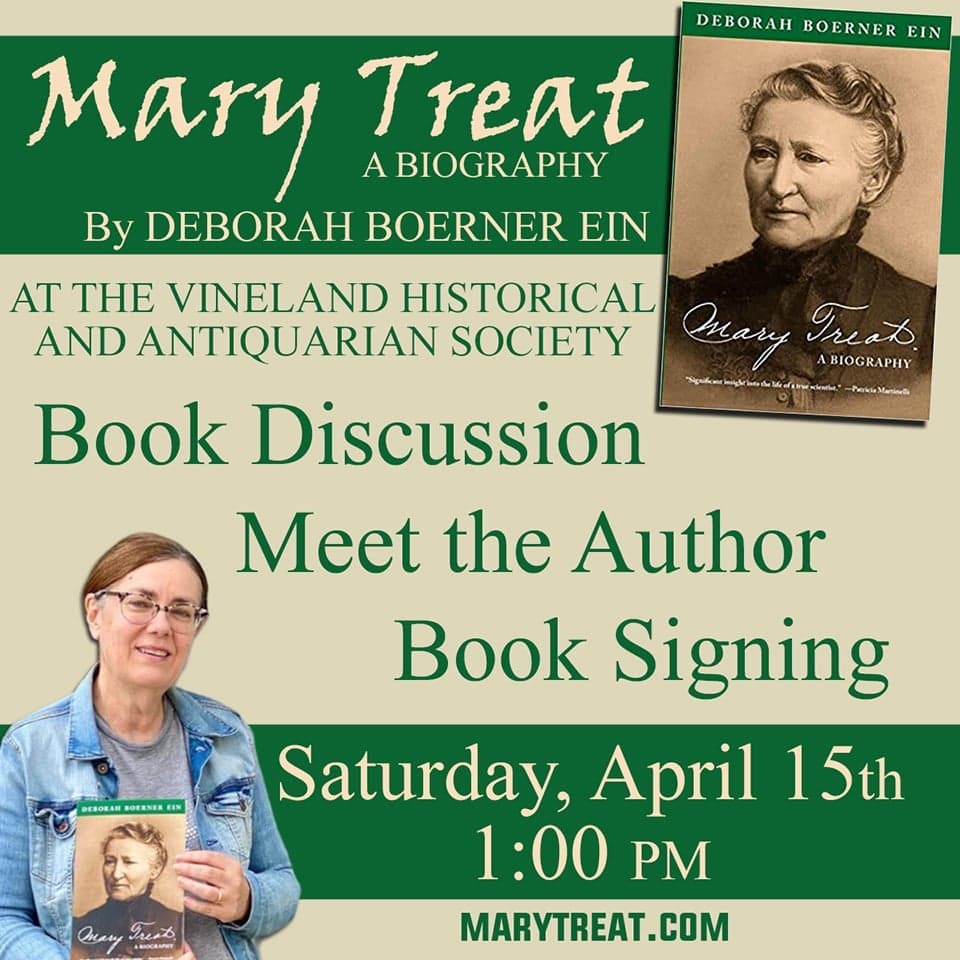
The film also brought together a mix of historical and scientific voices. Interviews were recorded with Valerie Neuber of the Vineland Historical and Antiquarian Society and Deborah Boerner Ein, who wrote a biography of Mary Treat and serves as an editor at SNJ Today. Field interviews in the Pine Barrens included Stockton University geology professor Mark Demitroff, graduate student Jamie Lubov, retired Academy of Natural Sciences curator Jon Gelhaus, University of Delaware entomology professor Douglas Tallamy, and naturalist Pat Sutton.
That lineup tells its own story. The project is not just celebrating a historic figure; it is connecting Treat’s legacy to current research, education, and conservation work. It also pulls together local institutions, academic expertise, and natural history in a way that makes the film feel firmly tied to Cumberland County rather than merely filmed here.
What the Pine Barrens adds to the story
The Pine Barrens are not a generic woodland setting. In this documentary, they function as evidence of Treat’s scientific world and as a living symbol of the ecology she studied. Her work on carnivorous plants and insects fits naturally into a landscape known for its distinctive habitats, and filming there gives the audience a direct visual connection to the environment that shaped her observations.
That connection gives Vineland and the broader county something valuable: a story that links identity, ecology, and heritage in one frame. When a production uses local woods, museum archives, and homegrown expertise to tell a story, it makes the region legible in a new way. The land itself becomes part of the argument for why Treat mattered then and why she still matters now.
A project with reach beyond Cumberland County
Merits is not stopping in South Jersey. Additional filming is planned for Boston, New York, and Kew Gardens in England, signaling a larger narrative that stretches well beyond Vineland. Those locations suggest that Treat’s life will be placed in conversation with wider scientific and historical networks, not confined to a single hometown biography.
That broader scope could help raise Cumberland County’s cultural profile. If the documentary lands well, Vineland will appear not as a peripheral stop but as the place where a major scientific story took root. For a county that often has to fight for attention, that kind of visibility matters. It positions local history as exportable cultural capital, with the Pine Barrens and Vineland standing in for a deeper South Jersey identity.
Local support and why it signals staying power
The Vineland Historical and Antiquarian Society has already publicly supported the project and hosted a meet-and-greet with Merits on April 17, 2026. That local backing matters because it shows the documentary is not arriving from outside and leaving the same way. It is being welcomed by the very institutions charged with preserving the area’s memory.
Merits was also in the United States in late March and April 2026 for screenings of her documentary *The Paradox of Seabrook Farms*, which gives her an existing regional connection and a track record with South Jersey stories. Taken together, the museum interviews, the Pine Barrens filming, and the society’s support suggest a project with enough local buy-in to resonate beyond the usual documentary audience.
For Cumberland County, the larger significance is simple: Mary Treat’s story is being filmed where her life actually unfolded. That makes the landscape part of the narrative, and the narrative part of the county’s public identity.
This article was produced by Prism’s automated news system from verified source data, official records, and press releases, then run through automated quality and moderation checks before publishing. The system is built and supervised by the people who set the standards it runs under. Read our full AI policy.
Did this article answer your question?