Kirkwood-Cohansey Aquifer Supplies Drinking Water, Farms, and Wetlands Across Cumberland County
Vineland City Water draws your tap water from 160 feet underground; now a 2.6-million-square-foot AI data center rising above the same aquifer is testing how carefully Cumberland County guards it.
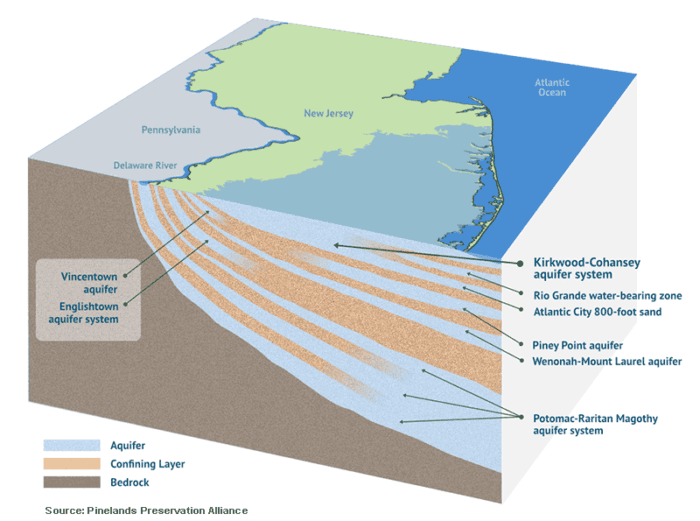
Turn on a tap in Vineland and the water that runs cold from your faucet traveled upward from roughly 160 to 200 feet underground, pushed through layers of sand and gravel that have been filtering and storing it since the last rainfall soaked into South Jersey's sandy soil. That same geology, the Kirkwood-Cohansey aquifer, also feeds the Cohansey River, keeps thousands of acres of Pinelands wetlands alive, and supplies the irrigation wells that sustain agriculture across the Cohansey River Basin and the Menantico Creek subbasin. Now, with a 2.6 million-square-foot data center rising in Vineland directly above it, the aquifer has moved from the background of daily life in Cumberland County to the center of a charged public argument about who controls the region's water future.
What the Kirkwood-Cohansey Aquifer Actually Is
The Kirkwood-Cohansey is what hydrogeologists call an unconfined, water-table aquifer: it sits at shallow depth in permeable sand and gravel rather than sealed under pressure by an impermeable cap, which means groundwater levels rise and fall in direct response to rainfall, surface-water interaction, and pumping. Its two named geologic units explain its character. The Cohansey formation on top is mostly sand, highly permeable and quickly recharged by rain. The Kirkwood formation below contains both silt and clay, forming a partial confining layer that slows deeper movement. That architecture makes the system simultaneously bountiful and brittle: recharge is fast, and contamination can move fast too.
At 360 feet deep, the aquifer is prolific in wells and springs, with almost 1,000 high-capacity wells that yield on average 400 gallons per minute of groundwater. The Kirkwood-Cohansey aquifer contains 17.7 trillion gallons of water, enough to cover New Jersey in 10 feet of water. Despite that enormous volume, the system's shallow and unconfined nature means concentrated local pumping can produce measurable declines in groundwater levels and stream flows within weeks.
Who Drinks From It, and Who Farms With It
In addition, municipal public-supply wells from nine municipalities in the Cumberland County study area pump from the Kirkwood-Cohansey aquifer system. Vineland City Water is among the most significant of those systems. Vineland City Water, a public utility, provides safe drinking water to Vineland, New Jersey, drawing from the Kirkwood-Cohansey aquifer, which lies 160-200 feet below the surface and holds an estimated 17 trillion gallons of water.
Beyond the city mains, a significant share of Cumberland County residents — particularly those in rural zones — rely entirely on private shallow wells that tap the Kirkwood-Cohansey with no treatment beyond whatever a homeowner installs. These households bear the most direct exposure to both water-level declines and quality changes, because there is no municipal treatment plant standing between the aquifer and their kitchen sink.
Agriculture adds another substantial layer of demand. Several agricultural-irrigation wells and a number of public-supply wells are within the Cohansey River Basin and the Menantico Creek subbasin. The USGS, working with the NJDEP, modeled the combined effects of agricultural and public-supply withdrawals on both groundwater levels and stream baseflow across Cumberland County, a recognition that no single user can be assessed in isolation. Every well influences every other.
When Levels Drop: Saltwater, Contaminants, and Dry Wells
Three consequences concern public-health officials most when water-table levels decline.
The first is saltwater intrusion. Saltwater intrusion may occur seasonally in low-lying areas where shallow aquifers are hydraulically connected to Delaware Bay or other saltwater estuaries. Contamination problems have been reported in several shallow wells from several sources in Cumberland County. For residents on private wells in Downe Township or Lawrence Township, a depressed water table is not an abstract risk: it can mean brackish water from a tap they assumed was clean.
The second risk is chemical concentration. Because the aquifer recharges directly through topsoil and subsoil, fertilizers, pesticides, industrial spills, and road runoff pass through the same sandy layers that filter drinking water. More than 75 percent of the freshwater supply in the New Jersey Coastal Plain comes from groundwater. When the water table drops, pollutants in the soil zone above it become more concentrated in the remaining groundwater. Iron is already a documented quality issue locally; several aquifers in New Jersey's Coastal Plain show iron concentrations far above drinking-water standards, which translates directly into higher treatment costs for municipal systems and undetected risk for private-well owners who have not recently tested their water.
The third consequence is straightforward well failure. If regional water-table levels fall significantly through sustained overpumping, shallow private wells can go dry. Deepening or replacing a well can cost thousands of dollars, an expense that falls entirely on the individual homeowner.
The DataOne/Nebius Data Center and the Permitting Question
The project in Vineland, already under construction, is being developed by DataOne for the Nebius Group to support AI infrastructure as part of a $17 billion deal with Microsoft. The facility plans to generate 85% of its own energy with natural gas accessed through a pipeline that runs from the facility.
DataOne CEO Charles-Antoine Beyney described the process using the word "fast" at the January 21, 2026 town hall, which the Pinelands Alliance dubbed "too late." Beyney said that "other than an initial injection of millions of gallons of water" from the city's supply to get the system started, the data center would be generating its own water for use. That claim is precisely what environmental advocates are pressing for documentation on: what volumes are involved, where they originate, and how cumulative demands from this and similar projects interact with the aquifer's capacity over time. Dozens of similar hyperscale data centers are being proposed across the region, and residents increasingly voice concerns about the impact on electricity bills, air quality, and water usage.
What the Pinelands Commission Changed in 2023
The Pinelands Commission amended the Comprehensive Management Plan in 2023 to better protect the Kirkwood-Cohansey Aquifer. Major features of the rules include limiting groundwater withdrawals to 20% of minimum ecological flow, a stricter standard than NJDEP's 25%, to provide a buffer for climate change and account for unregulated agricultural use. The Commission also lowered the permitting threshold from 100,000 to 50,000 gallons per day, meaning more proposed facilities now require formal review, cumulative-impact analysis, and public scrutiny before they can begin drawing from the aquifer.
Those rule changes apply directly to the DataOne project and to any future industrial development proposed in Cumberland County. The lower threshold closes a gap that previously allowed mid-scale withdrawals to proceed without comprehensive hydrogeologic review.
What to Watch, and What You Can Do
For residents tracking this issue, several concrete steps matter:
- Test your well water. NJDEP and the New Jersey Geological and Water Survey recommend private-well testing at least annually. Test for coliform bacteria, nitrates, iron, and, in coastal zones, chloride levels that signal saltwater intrusion. The Cumberland County Health Department can refer you to certified labs.
- Check pending permits. The NJDEP and Pinelands Commission maintain public records on groundwater withdrawal applications. Any project proposing to draw 50,000 gallons per day or more in Pinelands-jurisdiction areas now requires a formal application. Monitor the commission's agenda for Cumberland County entries.
- Demand cumulative-impact modeling. When any large water user proposes a new or expanded withdrawal, ask whether the environmental review accounts for all existing users in the same hydrogeologic zone, not just the project in isolation. USGS has published groundwater-flow simulations for the Maurice and Cohansey River Basins that provide a scientific baseline; those models should inform every significant permit decision.
- Conserve at home. Low-flow fixtures, efficient irrigation scheduling, and eliminating outdoor waste all reduce demand on municipal production wells, which in turn relieves pressure on the shared water table.
- Support baseline monitoring. Groundwater-level and water-quality monitoring before major industrial projects begin, and sustained after they open, is the only mechanism for catching trends before they become crises. Advocate for monitoring wells near any newly permitted high-capacity facility.
Environmental groups say a giant energy-hungry complex operating above the Kirkwood-Cohansey aquifer, one of South Jersey's most important sources of drinking water, raises serious concern. The 2023 rule changes gave regulators sharper tools than they have had in decades. Whether those tools get applied with sufficient rigor to the data center and the wave of similar projects following behind it depends, in large part, on how closely Cumberland County residents hold their elected officials and the Pinelands Commission accountable to the science already on the table.
This article was produced by Prism’s automated news system from verified source data, official records, and press releases, then run through automated quality and moderation checks before publishing. The system is built and supervised by the people who set the standards it runs under. Read our full AI policy.
Did this article answer your question?

