Levoy Theatre Celebrates Over a Century of Arts in Millville
A Wilson Opera House fire in the 1890s set the stage for Millville's Levoy Theatre, which has endured for over a century as South Jersey's cultural anchor.
Fire started it all. When a blaze reduced the Wilson Opera House at High and Sassafras Streets to smoldering ash sometime in the 1890s, Millville lost its largest 19th-century performing arts venue and was left without a cultural home. That void lasted roughly a decade until an entrepreneur from Atlantic City and Somers Point named William "Pop" Somers arrived in town around 1908, spotted an opportunity, and built what would become one of Cumberland County's most enduring institutions: the Levoy Theatre, at 126-130 North High Street.
Somers was no ordinary businessman. According to historical accounts, he was among the early designers of the Ferris wheel in 1893, predating the ride's eventual namesake. Only after a lengthy legal dispute between Somers and George Ferris did the famous rotating attraction become known by the Ferris name rather than the Somers name. Whether building amusement rides or anchor theaters, Somers had a talent for identifying what a community needed. Millville was his next canvas.
Born in 1908, Shaped by Three Eras
The original Levoy Theatre opened in 1908, filling what one historical account calls "a ten-year void" left by the Wilson Opera House fire. The building did not stay static for long. Expansions followed in 1912 and again in 1927, each one layering new architectural ambition onto the structure. The design reflects that accretion of eras: the Levoy incorporates Classical Revival, Late Gothic Revival, and Art Deco elements, a blend attributed to architect William Wrifford. The result is a building that carries the aesthetic fingerprints of early 20th-century American entertainment culture, when theaters were civic landmarks as much as entertainment venues.
For decades the Levoy served Millville and the broader South Jersey region as exactly that. Then, in 1974, the doors closed. The building sat dormant for nearly four decades, a familiar story for mid-century American theaters that fell victim to suburban sprawl, multiplex cinema, and changing entertainment habits.
From the Historic Register to Renovation
Recognition came before restoration. On August 14, 1998, the Levoy Theatre was added to the National Register of Historic Places under reference number 98001064, an acknowledgment of its architectural and historical significance to the region. That listing was later removed on July 17, 2013, the reasons for which remain worth investigating through the National Register or New Jersey's State Historic Preservation Office.
The physical work of bringing the Levoy back began in earnest in May 2011, when renovation crews started what would become a 16-month project. When it was completed by September 2012, the theater had been transformed into what its operators described as a "new 696-seat, state-of-the-art" performing arts center. Every decision during the renovation was made with dual intent: honor the building's past while equipping it for a modern audience. The project included a new mezzanine, a new chandelier, and a permanently installed Millville history cyclorama. Perhaps the most visible symbol of that historical reverence was the replacement of the 1970s marquee with a faithful reproduction of the 1920s peacock marquee, restored to its original purpose of illuminating High Street and announcing to the city that something worth attending was happening inside.
Reopening Night: A Deliberate Echo
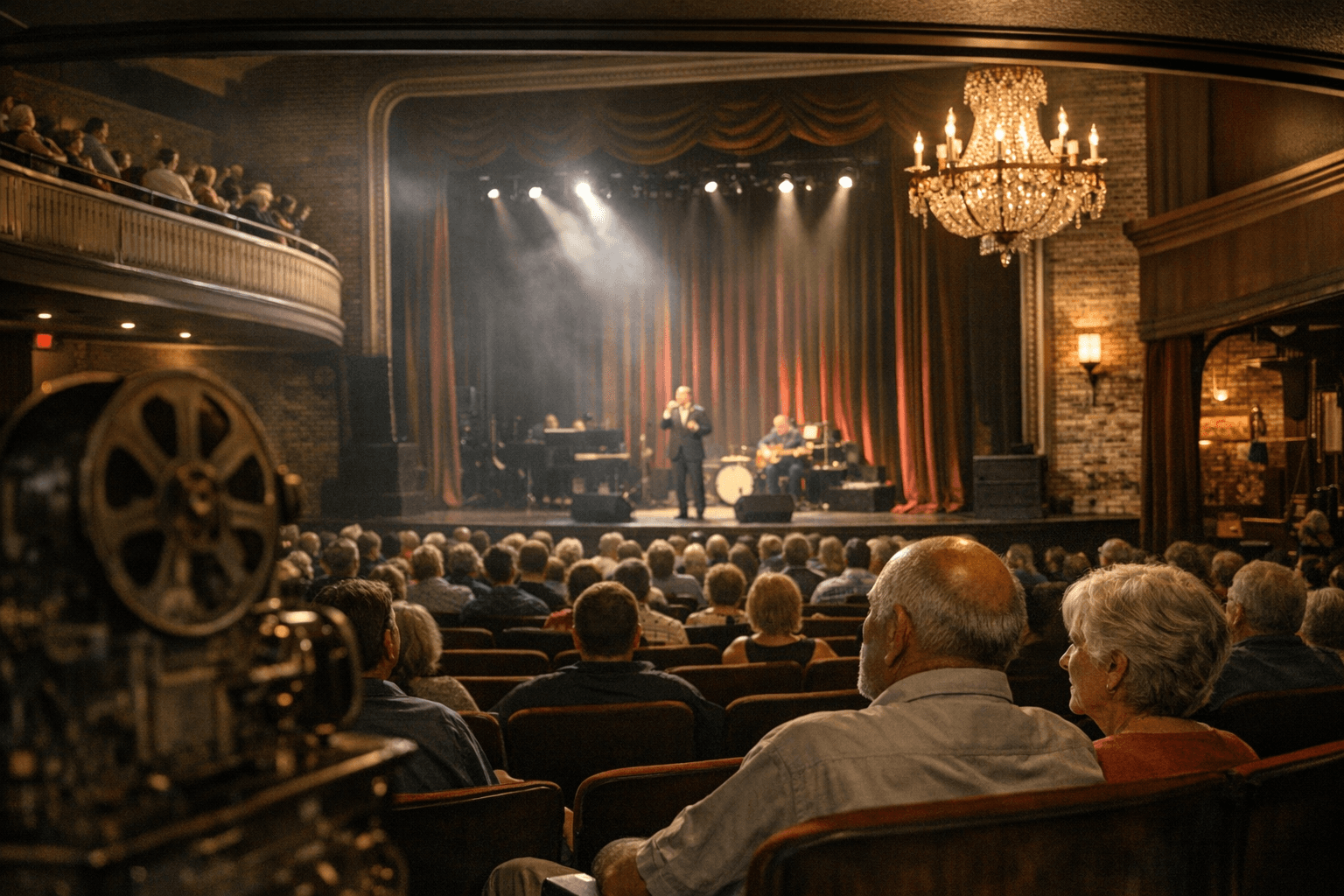
On September 9, 2012, the Levoy reopened with a program chosen for its resonance with the building's origins. The 696-seat house filled for a silent film underscored live by the Peacherine Ragtime Orchestra, a format that mirrored, as the theater's own account notes, "the programming when the Levoy first opened" more than a century earlier. It was a self-conscious act of continuity, a way of threading the 1908 Levoy to its 2012 successor without pretending the intervening decades hadn't happened.
The official grand opening gala, held September 22, featured a reception in the new mezzanine beneath the chandelier and the Millville history cyclorama, followed by the premiere of the play "Roundabout, A New Amusement." The play's full authorship credit was not available in documentation reviewed for this article.
What the Levoy Is Today
The Levoy Theatre Preservation Society, the not-for-profit organization that oversees the theater, frames its mission in expansive terms. Its stated purpose is "to meet and exceed the needs of an active and vibrant arts community through state-of-the-art technology, historic interpretation, culturally diverse programming and performing arts education for all ages and abilities." Beyond the arts, the society positions the Levoy explicitly as "an economic, educational, cultural and entertainment catalyst for the people of Millville and greater South Jersey."
That economic framing matters in a city like Millville, where North High Street's cultural anchor carries weight beyond ticket sales. The Levoy is designed to be accessible: its mission explicitly encourages "people of all economic levels to celebrate the rich history of the building, attend a diverse mix of entertainment and educational programs, and grow or enhance an appreciation of the performing arts."
Programming spans concerts, touring theatrical performances, screen arts, and educational events for all ages. The theater serves not just Millville but positions itself as a regional destination for Southern New Jersey and surrounding areas, a distinction that matters in a part of the state where large-scale performance venues are not clustered as densely as they are in the Philadelphia suburbs to the north or Atlantic City's entertainment corridor to the east.
A Building That Outlasted Its Critics
What the Levoy represents in 2026, more than 118 years after William "Pop" Somers first recognized Millville's need for a performing space, is the durability of civic investment in culture. The theater closed in 1974 and sat empty long enough that its future seemed genuinely uncertain. Its return required not just money and construction work but a sustained belief, embodied by the Levoy Theatre Preservation Society, that a century-old performing arts center at 126-130 North High Street still had a role to play in Cumberland County's civic life.
The peacock marquee back on High Street is the most legible argument that it does.
This article was produced by Prism’s automated news system from verified source data, official records, and press releases, then run through automated quality and moderation checks before publishing. The system is built and supervised by the people who set the standards it runs under. Read our full AI policy.
Did this article answer your question?