Decatur County Boaters Should Know These Tennessee River Safety Rules
Every Decatur County boater needs to know these Tennessee River safety rules before launching this season.

The Tennessee River traces Decatur County's western edge with quiet authority, drawing anglers, recreational boaters, and tourists to its banks year after year. That same water fuels local businesses, supports the county's tourism economy, and connects communities up and down the shoreline. But the river demands respect, and Tennessee law backs that up with a clear set of rules every boater operating in these waters is expected to follow.
Who Must Complete Boater Education
Tennessee requires boater education certification for anyone born on or after January 1, 1989, who operates a motorized vessel on public waters. That cutoff captures a large share of today's active boaters, including most adults under 40. The Tennessee Wildlife Resources Agency (TWRA) administers the requirement, and boaters must carry proof of certification on the water at all times when the law applies to them.
The approved course covers navigation rules, right-of-way, emergency procedures, and equipment requirements. Both in-person and online options are available through TWRA-approved providers. Completing the course before your first launch of the season is strongly recommended, as enforcement patrols are active on the Tennessee River throughout the warmer months.
Required Safety Equipment
Tennessee law sets minimum equipment standards for all vessels, and the Tennessee River's width and vessel traffic make compliance especially important near Decatur County's access points.
Every boat must carry:
- A U.S. Coast Guard-approved personal flotation device (PFD) for each person on board, with children under 13 required to wear one at all times while underway on a vessel under 26 feet
- A throwable Type IV flotation device on vessels 16 feet and longer
- A working fire extinguisher on any motorized vessel with an enclosed engine compartment
- Navigation lights for operation between sunset and sunrise or in restricted visibility
- A sound-producing device, such as a horn or whistle, for all vessels
Flares or other visual distress signals are required on vessels operating on waters classified as navigable by the U.S. Coast Guard, which includes the Tennessee River. Keeping this equipment accessible rather than buried under gear in a storage compartment is a basic safety habit that can make a critical difference in an emergency.
Speed and No-Wake Zones
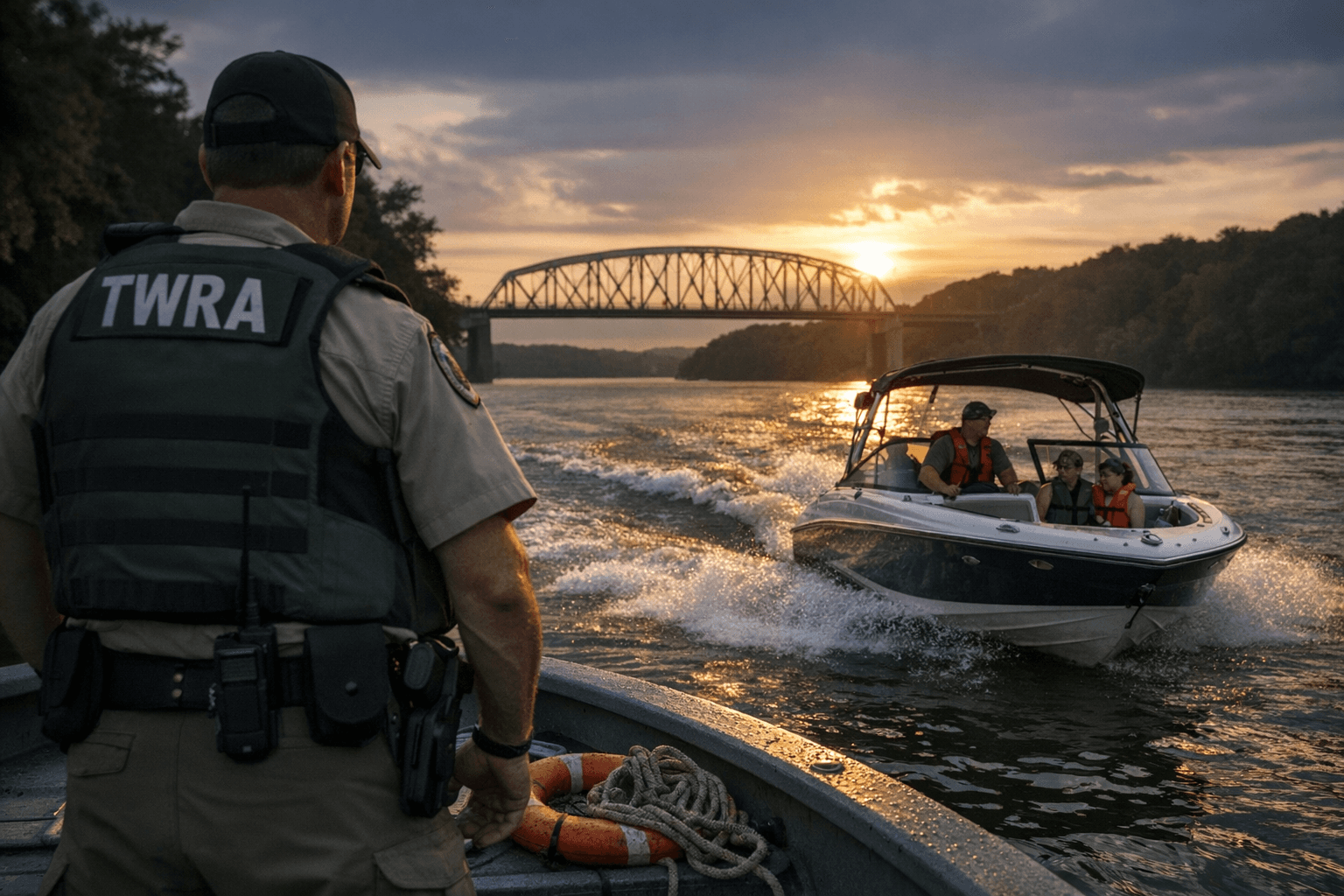
The Tennessee River through this region includes designated no-wake zones near boat ramps, marinas, and areas with heavy shoreline development. Violating no-wake restrictions is one of the most common citations issued by TWRA officers and local marine patrol units, and the fines are not trivial.
No-wake speed is generally defined as the slowest speed at which a vessel can maintain steerage and headway. Buoys and posted signs mark most restricted zones, but boaters should also reduce speed whenever approaching a dock, launch ramp, or area with visible swimmer activity, regardless of whether a formal zone is marked.
On open stretches of the Tennessee River, reckless operation carries separate penalties. Operating at excessive speed in a manner that endangers life or property is a Class A misdemeanor under Tennessee law.
Registration and Titling
All motorized vessels and sailboats over a certain length operated on Tennessee waters must be registered with TWRA. Registration must be renewed annually, and the registration decal must be displayed on both sides of the bow. The vessel's registration card must be kept on board.
Boats purchased from a dealer are typically titled through the dealership, but private sales require the new owner to handle the title transfer through a county clerk's office. Decatur County boaters completing private purchases should process that paperwork before operating the vessel to avoid issues during a routine stop on the water.
Alcohol and Boating
Tennessee's boating under the influence law mirrors its driving statute in important ways. Operating a vessel with a blood alcohol concentration of 0.08 percent or higher is illegal, and TWRA officers and sheriff's deputies both have authority to enforce it on the Tennessee River. A first offense carries potential jail time, fines, and a boating privilege suspension.
The open water environment can amplify alcohol's effects. Sun exposure, wind, noise, and the constant motion of a boat increase fatigue and accelerate impairment compared to the same amount of alcohol consumed on land. Afternoon patrol activity tends to increase on warm weekends when the river sees its heaviest recreational traffic.
Interacting With Commercial Traffic
The Tennessee River is a working waterway. Towboats pushing barge tows operate through Decatur County waters on a regular schedule, and these vessels have extremely limited maneuverability and long stopping distances. A loaded barge tow can require more than half a mile to stop.
Recreational boaters must stay clear of commercial traffic and should never attempt to cross in front of a moving tow. Pass behind a tow whenever possible, and be aware that the wake from a large vessel can be significant even after it has moved well past your position. VHF marine radio channel 16 is the standard hailing and distress frequency, and monitoring it while underway gives boaters advance awareness of commercial traffic in the area.
Fishing and License Requirements
Many boaters on this stretch of the Tennessee River are primarily there to fish, and Tennessee fishing licenses are required for anyone 13 or older. Residents and non-residents pay different rates, and a variety of annual, short-term, and combination licenses are available through TWRA's online licensing system or local retailers.
Creel limits, size minimums, and gear restrictions apply to specific species in Tennessee River waters. Crappie, bass, catfish, and spiked drum are common catches in this region. Checking the current TWRA Fishing Guide before heading out ensures you are current on any regulation changes that took effect with the new license year.
Reporting Accidents
Tennessee law requires the operator of a vessel involved in an accident to file a written report with TWRA within 10 days if the incident results in a death, disappearance, or injury requiring medical treatment beyond first aid, or if property damage exceeds $2,000. Failure to report is a separate violation from the accident itself.
In the event of a life-threatening emergency on the Tennessee River, call 911. TWRA and the Decatur County Sheriff's Office both respond to marine emergencies in these waters. Having a charged phone in a waterproof case, or a handheld VHF radio as a backup, gives you reliable communication options when conditions deteriorate quickly.
Knowing the rules before you launch is not just a legal obligation; it is the foundation of every safe day on the water.
This article was produced by Prism’s automated news system from verified source data, official records, and press releases, then run through automated quality and moderation checks before publishing. The system is built and supervised by the people who set the standards it runs under. Read our full AI policy.
Did this article answer your question?