Decatur County marker honors four local Tennessee senators
A courthouse marker on East Main Street puts four Decatur County senators in plain view, and it reveals how a small county kept a foothold in Nashville.
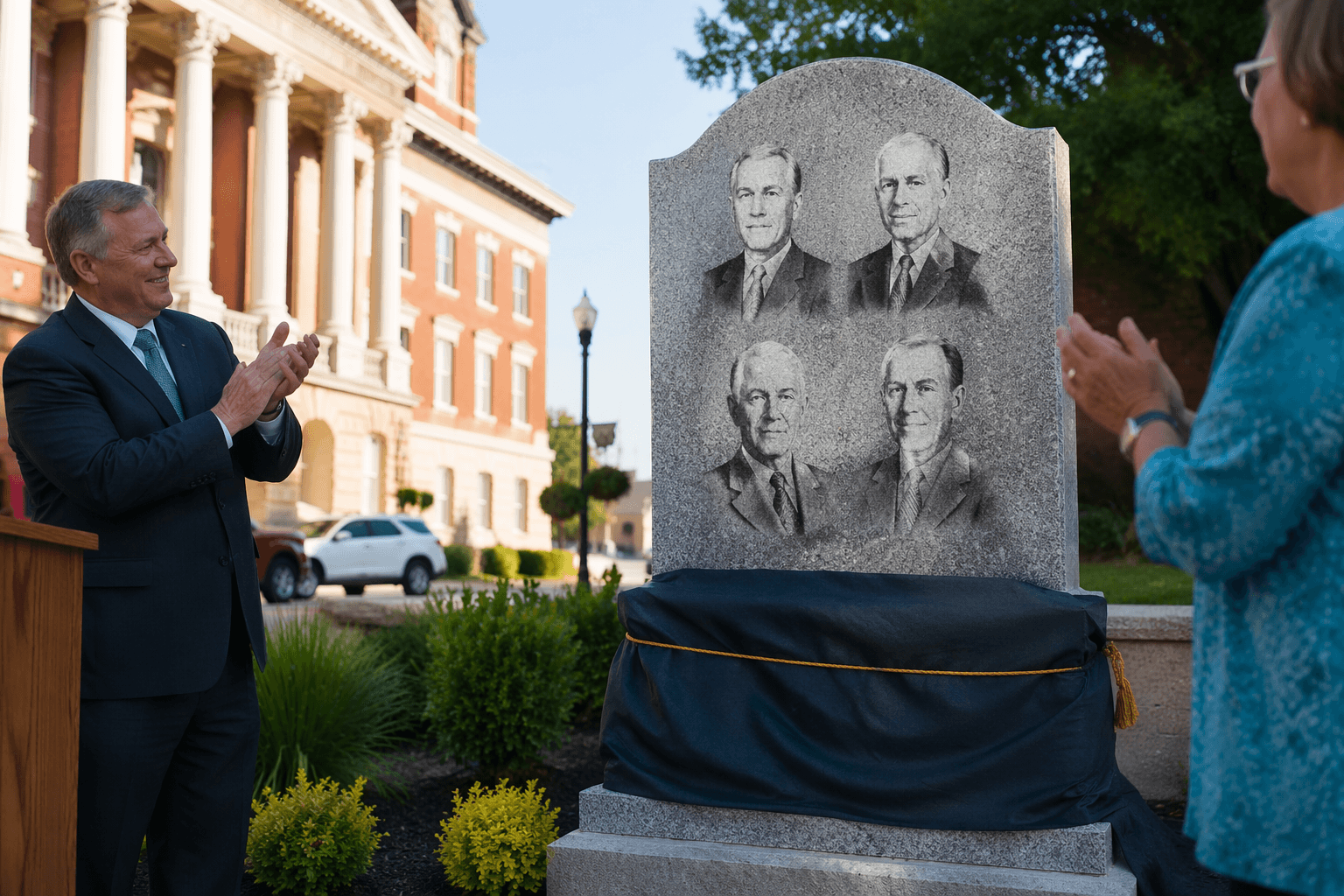
On the side of the Decatur County Courthouse, a marker on East Main Street turns a small stretch of Decaturville into a ledger of political history. It names four local men who served in the Tennessee Senate, and it quietly shows how much state power once passed through the county seat.
A courthouse marker with a county story
The marker stands where Decatur County’s civic life is already concentrated: on the courthouse block in Decaturville, the county seat established in 1847. Decatur County itself dates to 1845, when it was created from Perry County, which gives the courthouse area a natural claim as the center of local memory and government. The marker was erected by Concerned Citizens of Decatur County, and its location on the side of the courthouse makes it part of the everyday landscape rather than a distant museum piece.
The spot is precise enough to find without guesswork. HMdb lists the marker at 35° 35.064′ N, 88° 7.199′ W, right in the walkable courthouse area that still serves as a backdrop for community events throughout the year. Decaturville is small, with a population of 867 in the 2010 census, so the courthouse block carries more than ceremonial weight. In a town this compact, public memory sits where people actually pass it.
The four names on the stone
The marker honors four Decatur Countians who reached the Tennessee Senate: James Lemuel Jones, William Riley Tuten, James Tate Rogers and James Kirk Vise. Each name is tied to a specific General Assembly, which is important because the marker is not just celebrating service in the abstract. It is pinpointing when these men sat in Nashville and how Decatur County was represented at the state level.
James Lemuel Jones appears on the marker for the 46th General Assembly, 1889 to 1891. Biographical records show that he represented Decatur, Benton and Carroll counties and was a Democrat. That detail matters because it shows the county’s voice was part of a broader multi-county district, not a single-county seat, and that local voters were choosing someone who would speak for several West Tennessee communities at once.
William Riley Tuten is listed for the 51st General Assembly, 1899 to 1901. The marker gives his name and session dates, while biographical records place his birth on May 29, 1850, in Tennessee and his death on March 18, 1920. James Tate Rogers is tied to the 57th General Assembly, 1911 to 1912. He was born on January 10, 1835, in Henderson County, died on January 18, 1912, in Decatur County, and was buried in Decaturville City Cemetery, which ties his public service directly back to the county seat.
James Kirk Vise is the latest of the four, appearing on the marker for the 71st General Assembly, 1939 to 1941. He served representing Benton, Decatur, Hardin, Hardeman and McNairy counties. Later, he is identified as a Decaturville merchant who moved to Memphis, a reminder that local public figures often moved between county life and wider regional commerce.
Why the session numbers matter
The marker uses General Assembly numbers, not just calendar years, and that is more than a stylistic choice. Tennessee’s Acts of the General Assembly record dates back to the first General Assembly in 1796, and new records are added at the conclusion of each two-year General Assembly. That system is why the marker can place Jones in the 46th, Tuten in the 51st, Rogers in the 57th and Vise in the 71st, linking each man to a specific place in the state’s legislative timeline.
That numbering also helps explain the scale of the achievement. The Tennessee State Library and Archives says 1,764 men and women have served in the Tennessee General Assembly as state senator. Against that long statewide roll, the four names on the Decaturville marker represent a very small local subset, which is exactly why the marker exists: to make sure county-level political history does not vanish inside the larger state record.
What their service meant for local residents
A county senator’s work did not stay in Nashville. For Decatur County, representation in the Senate meant a local voice inside the body that shaped state law, set priorities for government, and affected how counties fit into Tennessee’s public institutions. Even when the marker does not name specific bills, the office itself mattered because it connected Decatur County to the rules and decisions that reached the courthouse, the county seat and the broader machinery of state government.
That is the hidden part of the story most passersby will miss. The stone lists names and dates, but it does not explain that each of those men was part of the state’s lawmaking chain, or that their service reflected who had influence in the county during different eras. Jones’s multi-county district, Rogers’s burial in Decaturville City Cemetery and Vise’s later move to Memphis all show how local political identity stretched beyond one square block while still returning to the courthouse as a place of recognition.
A compact memory of Decatur County politics
The marker is accurate as a roll call, but it is also selective, which is part of its value. It does not tell the whole story of who shaped Decatur County’s political life, who voted for these men, or how state decisions filtered into daily life at the county level. What it does do is place four senators in a visible civic setting, one where residents and visitors can see how Decatur County has been tied to the Tennessee Senate across more than half a century of change.
That is why the courthouse marker works as more than decoration. It turns the side of a government building into a public record, and it gives Decaturville a compact history lesson in the same block where county business still happens.
This article was produced by Prism’s automated news system from verified source data, official records, and press releases, then run through automated quality and moderation checks before publishing. The system is built and supervised by the people who set the standards it runs under. Read our full AI policy.
Did this article answer your question?