Decatur County's older, owner-occupied population shapes local needs
Decatur County’s older, homeowner-heavy profile is shaping everything from school demand to broadband and transportation in a county split between town centers and thinly settled districts.
In West Tennessee, Decatur County looks like one county on paper, but its numbers split it into two realities: small courthouse towns around Decaturville and Decatur, and broad rural districts where neighbors can be miles apart. The county’s 2024 median age was 45.8, compared with 38.9 in Tennessee and the United States, and 74.3% of homes were owner-occupied. That combination helps explain why local needs tilt toward aging in place, reliable roads, school transportation, and broadband that reaches the county’s far edges.
Two realities inside one county
The Sycamore Institute described Decatur County as 100% rural in 2019, with 24.1% of residents age 65 or older and 20.7% under 18. Those figures point to a county where older adults form a larger share of daily life than in many fast-growing places, while children still make up enough of the population to keep schools, buses, and family schedules central to the county’s rhythm. The result is a service profile built less around suburban expansion and more around healthcare access, senior transportation, and the upkeep of long-standing local institutions.
That age mix matters because it shapes demand across generations. A county with nearly one in four residents age 65 and older has to think about mobility, home maintenance, and access to care alongside the needs of students and working families. In a place this rural, the distance between a home, a school, a clinic, or the courthouse can be as important as the number of people who live there.
Housing that rewards staying put
The housing stock reinforces that stability. Census Reporter’s 2024 ACS profile lists 6,663 housing units and 4,568 households in Decatur County, with an owner-occupied housing rate of 74.3% and a median owner-occupied home value of $139,600. Decaturville tracks closely, with Data USA reporting a 2024 median property value of $135,000 and a homeownership rate of 73.7%.
That is a county of long-term attachment, not quick turnover. When roughly three out of four occupied homes are owner-occupied, residents tend to have deeper investments in roads, schools, drainage, and the condition of neighborhood streets. The same pattern can also make property taxes, roof repairs, and aging utility systems more consequential for older homeowners on fixed incomes, especially when the home itself is part of a family’s long-term plan.
Courthouse towns and wide-open districts
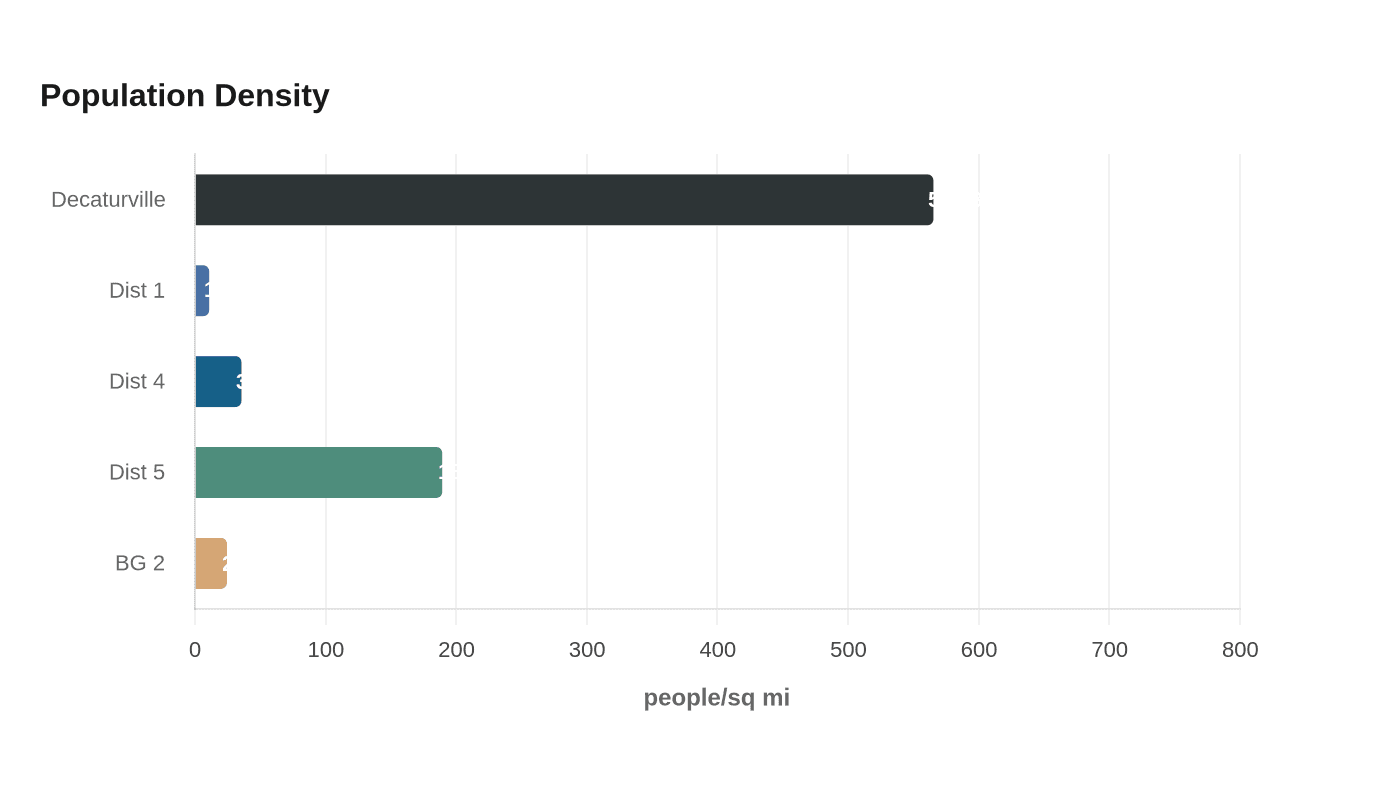
Census Reporter’s local profiles show just how different life can look from one part of Decatur County to another. Decaturville, the county seat, had 934 residents across 1.7 square miles, a density of 565.3 people per square mile, and a median age of 45.1. The city of Decatur had 1,898 residents over 3.8 square miles and a median age of 42.4. Both towns are compact enough to support a more concentrated local service pattern, with county offices, schools, stores, and churches closer together than they are in the countryside.
The rural districts are a different story. District 1 had 831 residents spread across 76.3 square miles, or 10.9 people per square mile, and a median age of 57.5, making it the oldest of the subareas noted here. District 4 had 1,610 residents over 45.2 square miles, or 35.6 people per square mile. District 5 had 1,178 residents across just 6.2 square miles, a much denser 189.3 people per square mile. BG 2 in Tract 9551.01 had 530 residents over 21.6 square miles, or 24.5 people per square mile.
Those contrasts matter in daily life. In the towns, a trip to the courthouse or a local office can be short and routine. In District 1, where 10.9 people live in each square mile, every errand is more likely to involve a longer drive, more fuel, and more dependence on a reliable vehicle. That is why road quality, school bus routes, and county service hours matter so much more in a county whose population is spread across 333.9 square miles.
What the numbers mean for schools, commuting, broadband, and services
A county with 20.7% of residents under 18 still has real school needs, even if the child share is smaller than the senior share. That balance pushes local leaders to manage transportation and school access carefully, because families in the low-density parts of the county are farther from town centers than families in Decaturville or Decatur. It also means after-school care, parent pick-up times, and extracurricular travel can be shaped as much by distance as by the school calendar itself.
The same geography raises the stakes for broadband. In a county this rural, internet access is not just about convenience; it affects telehealth appointments, schoolwork, county services, and the ability to avoid another long drive. For older residents, broadband can help substitute for some trips, but only if service reaches the farthest tracts and districts. That is why rural internet access, senior transportation, and local health delivery belong in the same policy conversation.
A county built around Decaturville
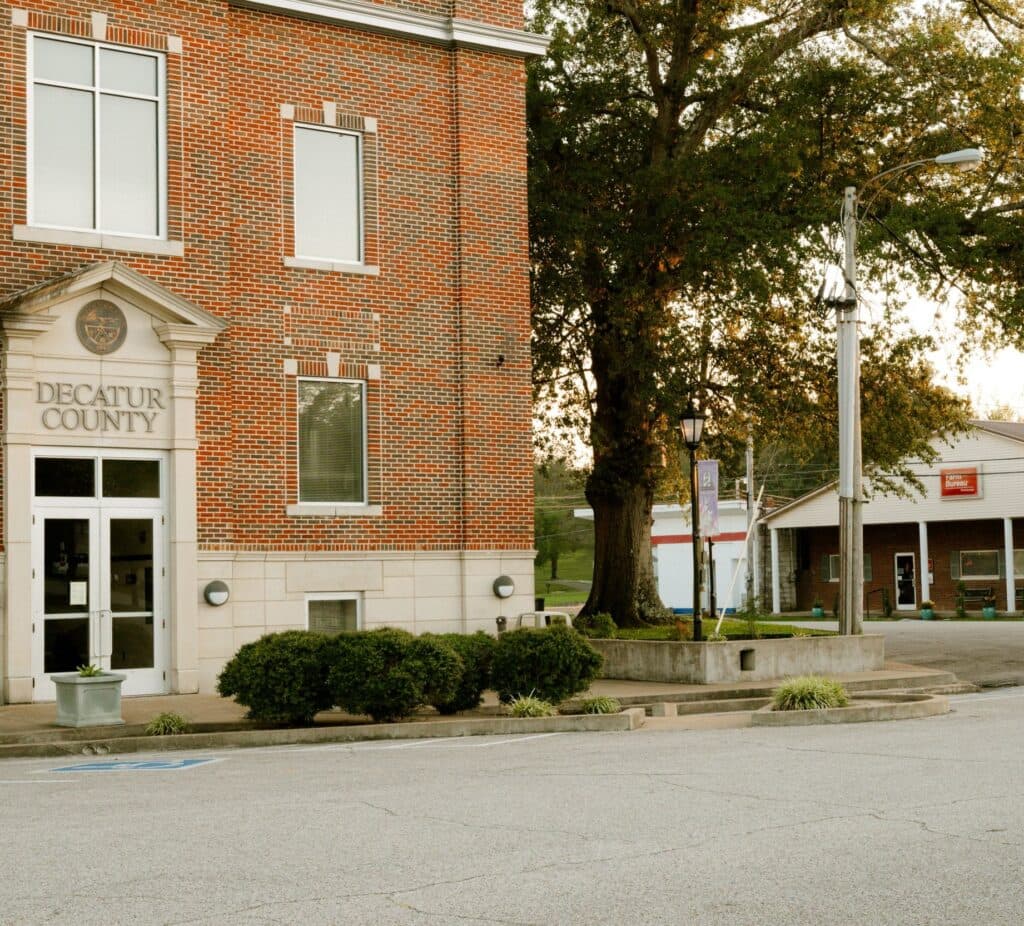
Decatur County’s identity is rooted in the courthouse town. The Tennessee Secretary of State says the county was formed in 1845 from Perry County under Acts of Tennessee 1845-46, Chapter 7, and identifies Decaturville as the county seat. The same fact sheet notes courthouse fires in 1869 and 1927, a reminder that the county’s civic center has had to rebuild more than once.
A TNGenWeb account compiled by Brenda Kirk Fiddler says the Decaturville courthouse was entirely destroyed by fire on March 25, 1927, between 1 and 2 o’clock. That history still matters because the courthouse remains a defining local landmark, and the county’s present-day service map still turns around it. The Tennessee Encyclopedia’s county materials treat the courthouse in Decaturville as a central marker of county identity, not just a building.
A steady county, not a boom county
Recent population estimates show a county that is growing, but not rapidly. The U.S. Census Bureau lists a population estimates base of 11,434 on April 1, 2020 and a 3.4% increase by July 1, 2025. Tennessee’s economic development agency lists 11,433 residents in 2020 and 11,579 in 2024. USAFacts places the county at about 11,800 residents in 2025, ranks it as the 87th-most populous county in Tennessee, and says about 2,800 residents are age 65 or older. Apple Maps’ county profile gives a 2020 census population of 11,435 and also names Decaturville as the county seat.
Taken together, those figures show why Decatur County does not fit a single profile. It is older than the state and the nation, more likely to own than rent, more rural than suburban, and more dependent on long-established institutions than on rapid new development. The county’s future will depend on how well it keeps a widely scattered, aging population connected to schools, roads, homes, broadband, and the courthouse-centered services that still hold the county together.
This article was produced by Prism’s automated news system from verified source data, official records, and press releases, then run through automated quality and moderation checks before publishing. The system is built and supervised by the people who set the standards it runs under. Read our full AI policy.
Did this article answer your question?