How Parsons grew around a railroad depot in Decatur County
Parsons still wears its railroad origin on the map: the depot site, street grid, and downtown lots all trace back to the Tennessee Midland’s 1889 arrival.
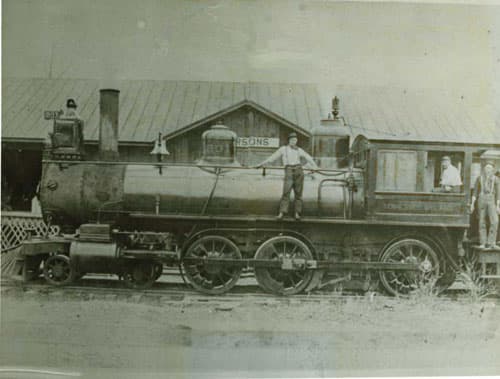
Parsons looks the way it does because a railroad company decided where the town should sit, where its streets should run, and where its center of gravity should be. The old depot site is now a BP station, a former railroad tie yard is now Community South Bank, and the wide sweep of Tennessee Avenue still follows a rail-era plan that turned a stop into Decatur County’s largest town.
The railroad drew Parsons into being
The Tennessee Midland Railway Company was chartered on December 29, 1886, with a plan to build from Memphis toward the Virginia state line. By 1889, it had laid 135.6 miles of track to Perryville, Tennessee, where the line stopped for lack of funds. That unfinished push mattered locally because the railroad missed Partinville by about a mile to the south, then settled on a depot site about a mile east of the earlier settlement on land deeded by Henry Myracle.
Myracle transferred 143 1/3 acres to the Tennessee Midland Railroad Company on April 11, 1889, to start Parsons. The city’s origin was not a vague growth pattern around a rail stop. The railroad land became the town site, the lots and streets were laid out from that land, and the depot became the anchor for the new community. Even the town’s earliest identity shows up in the historical name Parsons Flat, a reminder that the map changed before the civic name settled.
Tennessee Avenue remains one of the clearest signs of that design. The historical society says it was laid out 100 feet wide, a scale that reflects deliberate town-building rather than an accidental cluster of buildings. The street’s width still signals that Parsons was planned around movement, access, and the depot economy that came with a railroad center.
How Partinville shifted into Parsons
Before Parsons took over, Partinville was the earlier community, named for George W. Partin. Partin had come to Decatur County from Georgia in 1880, settled near Bear Creek, and served as the first postmaster there. When the Tennessee Midland chose the new depot site, he moved with the rail line rather than against it.
Partin bought the first lot in Parsons on April 20, 1889. Later that same year, he moved his general merchandise store and post office from Partinville to Parsons. That move did more than relocate a business address. It pulled commerce, mail, and daily traffic to the new railroad town, effectively shifting the county’s commercial center toward the depot.
The post office name was officially changed from Partinville to Parsons in 1893, and one county historical account says the post office moved to Parsons on May 7, 1897. Taken together, those milestones show how quickly the old settlement lost its role once the railroad site took hold. Partinville did not vanish all at once, but the new rail town absorbed its public life, its postal identity, and much of its business activity.
The depot turned rail logistics into local leadership
Will H. Neely is one of the best examples of how deeply the railroad shaped Parsons. He was the first depot agent at Parsons, and later became the town’s first mayor because the 1913 charter required a mayor to be named initially rather than elected. Neely worked for the railroad for more than 30 years and taught himself Morse code, a detail that captures how technical railroad work was at the center of the town’s early life.
Parsons itself was chartered in 1913 by an act of the Tennessee General Assembly, giving the railroad settlement a formal municipal structure after a quarter-century of growth. That charter did not create the town from scratch. It recognized what the railroad had already built: a depot-centered community with a business district, a mail system, and a local leadership class tied to rail operations.
That history still matters because it explains why Parsons grew as a town with a strong downtown core instead of a spread-out settlement. The depot was not on the edge of town. It was the center, and the people who ran it helped run the town.
What the rail origin still changes today
The most visible reminder of Parsons’ railroad origin is its geography. The depot stood where the BP station is now, so anyone standing there is already standing on the town’s original rail hub. A commercial lot that once served as a tie yard now holds Community South Bank, which shows how railroad land was later reused rather than erased.
That pattern still affects how Parsons functions. The town’s center is compact because its earliest commercial life was built around rail access, not later suburban expansion. The streets, lot lines, and landmark buildings trace back to the 1889 decision to shift the community east of Partinville and cluster activity around the depot. Even now, the town’s identity is tied to a map that was drawn for trains first and cars second.
The change from rail to highway also explains why the railroad story is not just local color. The broader historical record says the railroad later lost money after a new highway and bridge over the Tennessee River changed travel patterns. Local historical material describes that loss as a blow to Parsons and Decatur County. In other words, the same transportation system that made the town also helped diminish the rail economy that built it.
Why this history still defines Parsons
Parsons remains the largest town in Decatur County, and the 2020 census counted 2,100 residents. That size makes the town small enough that its origin story is still visible, but large enough that the railroad-era layout continues to shape everyday movement, downtown identity, and the reuse of key parcels. This is not a town that grew away from its depot. It is a town that still occupies the footprint the railroad left behind.
That is why Parsons is best understood on a map. The railroad did not merely pass through; it chose the center, redirected commerce from Partinville, fixed the street grid, and left behind a downtown whose landmarks still mark where the depot once stood.
This article was produced by Prism’s automated news system from verified source data, official records, and press releases, then run through automated quality and moderation checks before publishing. The system is built and supervised by the people who set the standards it runs under. Read our full AI policy.
Know something we missed? Have a correction or additional information?
Submit a Tip