Colorado's New Wildfire Resiliency Code Explained for Southwest Communities
Homeowners building or renovating in Dolores County face a hard July 1 compliance deadline under Colorado's new wildfire building code, and insurance coverage may hinge on it.
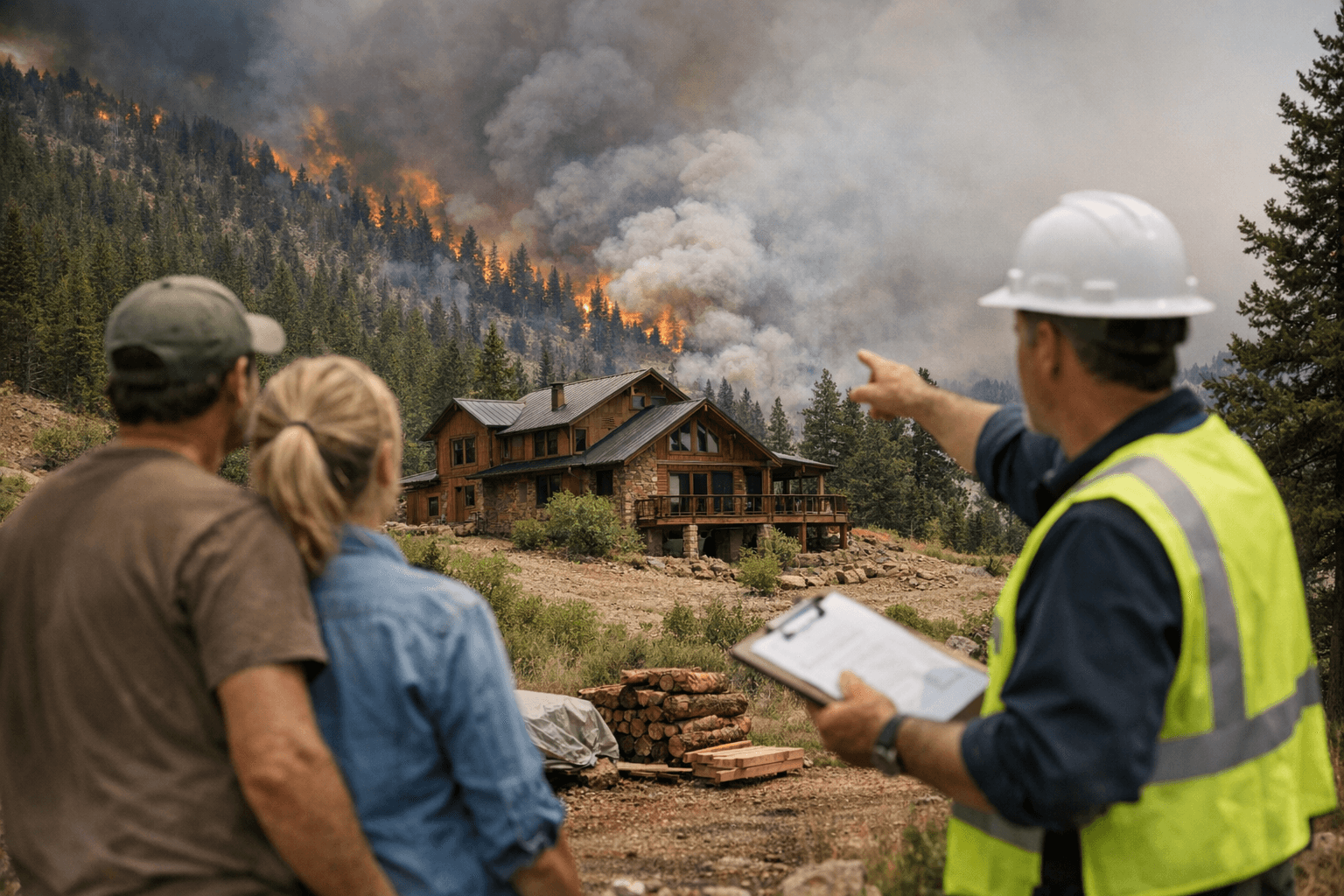
Insurance pressures and two decades of mounting fire losses are what finally pushed the Colorado legislature to act. "Colorado has been experiencing wildfires over the last 20 years that have done significant damage to homes, to lives, and it's also currently really affecting people's ability to get homeowners insurance here in this state. And that was a lot of what prompted the state legislature to come up with the new Wildfire Resiliency Building Codes." The result is the Colorado Wildfire Resiliency Code, a statewide standard that directly affects every county across southwest Colorado, including Dolores, and its deadlines are now weeks away.
What the Code Is and Where It Comes From
Senate Bill 23-166 set up the Wildfire Resiliency Code Board (WRCB) in the Division of Fire Prevention and Control to help enhance community safety and resiliency from wildfires through the adoption of codes and standards. The WRCB's mandate, as stated in its mission, is specific: "The mission of the Board is to ensure that Colorado communities are safer from and more resilient to wildfires by reducing the risk to people and property through the adoption of statewide codes and standards based on best practice approaches to hardening structures and reducing fire risk in the defensible space surrounding structures in the wildland-urban interface in Colorado."
On July 1, 2025, the Colorado Wildfire Resiliency Code (CWRC) was enacted, establishing minimum requirements for new construction and additions within designated Wildland-Urban Interface (WUI) areas. The code is formally codified at 8 CCR 1507-39. The CWRC is the first state-wide building code that establishes minimum standards for construction in Colorado WUI areas. Prior to its adoption, building codes varied by county, which created confusion for residents and professionals.
The Wildfire Resiliency Code is a model code for jurisdictions within the wildland urban interface to either adopt by reference or adopt by exceeding the expectations of the code. It aims to protect the loss of life, structures, homes, and businesses within the state while preserving economic vitality and insurance coverage.
The Deadlines That Matter Now
The CWRC runs on a three-date clock that every local government and homeowner in southwest Colorado should know:
1. July 1, 2025: The CWRC was officially adopted by the Wildfire Resiliency Code Board.
2. April 1, 2026: All municipalities and counties in a WUI zone with the authority to adopt building or fire codes must adopt the CWRC as a minimum standard.
3. July 1, 2026: Once adopted, the period to comply will follow the rules of the governing body or occur within three months of adoption, whichever is sooner.
Pagosa Springs plans to adopt the code April 1st with implementation July 1st. Those are hard-set deadlines that the Colorado Wildfire Resiliency Code Board has set. Pagosa Springs, in neighboring Archuleta County, serves as a concrete example of what local adoption looks like in practice across this corner of the state.
Jurisdictions may also choose to enforce even stricter requirements than the CWRC minimum, giving counties and municipalities room to exceed the state floor if local risk conditions warrant it.
How the WUI Map Classifies Your Property
The CWRC does not apply uniformly to every parcel. It is triggered by where a property sits on the state's Wildland-Urban Interface map, which was developed by the Colorado Division of Fire Prevention and Control (DFPC) and the Colorado State Forest Service (CSFS). The map identifies fire intensity, meaning expected flame lengths and rate of spread, in the WUI by analyzing vegetation and fuels, slope and topography, and weather history.
The result is a tiered classification system. The code introduces two classes of structure hardening, Class 1 and Class 2, based on fire intensity classification of low, moderate, and high, outlining specific requirements for building materials, defensible space, and site features. In practical terms: properties in low fire intensity zones fall under Class I requirements, while properties in moderate or high fire intensity zones carry Class II requirements. Class 1 requirements tend to focus on the crown of the home, including Class A roofing assembly standards, gutters, and vent protection. Class 2 requirements expand to the shell, including non-combustible siding, windows, doors, decking, and exterior wall details designed to reduce ember entry and flame spread.
Low intensity is shown in yellow on the CWRC map, moderate intensity in orange, and high intensity in red. Dolores County residents can check their property's classification using the 2025 Colorado Wildfire Resiliency Code Map, maintained by the DFPC.
What the Code Requires: Materials and Defensible Space
The CWRC focuses on two overlapping strategies: what a structure is built from, and what surrounds it. Structure hardening involves the use of materials and systems in the design and construction of a building to safeguard against the spread of fire within a building and the spread of fire to or from buildings to the wildland-urban interface area.
A significant alteration or addition to an existing structure greater than 500 square feet may also trigger the need for compliance with the CWRC, meaning the code is not limited to brand-new builds. If more than 25% of a roof is replaced, or more than 25% of an exterior wall covering is replaced, the CWRC may require the entire roof assembly or exterior wall assembly to meet ignition-resistant requirements. Existing homes with no planned construction are not directly affected at this stage.
Compliant Building Materials: A Practical Comparison
For builders, contractors, and homeowners planning new construction or major renovations in Dolores County, material selection is the most consequential decision. Industry guidance compiled for trade professionals outlines how the most common exterior wall options compare under the CWRC:
- Fiber cement siding: "Fully compliant and won't contribute fuel to a fire. It is already a trusted material used on thousands of homes in Colorado each year."
- Fire-Retardant-Treated Wood (FRTW): "While compliant, this material will contribute fuel to a fire. It can also lead to increased costs over the life of the home due to material and maintenance needs."
- Vinyl with 1-Hour Fire-Rated Assembly: "This option is compliant but requires additional fire-rated components, which increases the complexity and cost of achieving compliance. It will also contribute fuel to a fire."
- Brick, Stone, or Stucco: "These materials are compliant and won't contribute fuel to a fire, but they are often more expensive and labor-intensive."
It has been speculated that the cost increase for building a new home under this code will be anywhere from five to 20%, though it is still the biggest unknown right now. Local builders and contractors are the best resource for current material availability and pricing in the Four Corners area.
Southwest Colorado's 23-Year Head Start
Dolores County is not starting from scratch. "For the last 23 years, wildfire adapted partnership have been the main impetus to try and develop fire adapted communities here in this corner of Southwest Colorado, across Archuleta, La Plata, Montezuma, Dolores, and San Juan Counties."
Wildfire Adapted Partnership (WAP) is a 501(c)(3) nonprofit grassroots organization dedicated to helping homeowners understand their wildfire risk and what they can do to reduce that risk. WAP staff will come out to your property and discuss defensible space and home hardening. If you are within grant geography, WAP may be able to help offset the cost of wildfire vegetation mitigation through its Cost Share Program.
Critically, organizations like Wildfire Adapted Partnership offer free property assessments to help homeowners reduce their risk, even if the code does not apply to them yet. This matters for the majority of existing Dolores County homeowners whose current structures are not subject to the new code but who still face wildfire risk and potential insurance scrutiny. As one community voice summarized the underlying logic: "On a community level, it takes a lot of people working together on things to change things, but it starts with each individual home. The more individual homes we protect, the more we're protecting the whole community."
In 2024, WAP completed over 300 free Wildfire Risk Site Assessments in the five-county area. WAP's mitigation incentive programs, including the Defensible Space Cost Share, Community Kickstart, and Chipper Rebate, offer financial incentives for creating defensible space, and last year those programs helped treat over 850 acres on private and shared property.
The Insurance Dimension
The connection between building standards and insurance availability is not incidental to the CWRC; it is central to why the law exists. Pagosa Springs is partnering with Wildfire Adapted and local insurance agencies to formulate a grassroots initiative through property certification programs, as a proactive measure to help preserve insurance for existing homes that the code might not directly apply to, but that insurance agencies might seek verification from. That model, combining code compliance with voluntary certification, is a template other southwest Colorado communities are likely to consider.
State Governance and How to Participate
The WRCB continues to meet publicly as the code is refined and implemented. The next scheduled board meeting is on April 10, 2026, from 9 a.m. to 3 p.m., held at CORE Electric Cooperative, 5496 N. US Hwy 85, Sedalia, CO 80135. The Board is committed to an open process and transparency as the code is developed. In-person attendance requires pre-registration: contact Deborah Rhodus at CORE Electric Cooperative by calling 719-510-7352 to be added to the WRCB Meeting Attendee List. A Zoom registration option is also available for remote participants.
For questions or to sign up for WRCB updates, contact the board directly at cdps_dfpc_wrcb@state.co.us. The full text of the 2025 Colorado Wildfire Resiliency Code is available through the DFPC under 8 CCR 1507-39, along with the interactive WUI classification map.
The April 1 adoption deadline for local jurisdictions and the July 1 compliance date are not contingencies. For Dolores County homeowners and the builders who serve them, the most practical next step is the same one Wildfire Adapted Partnership has been recommending for two decades: find out where your property sits on the map, know what your structure is built from, and start the conversation before a permit application forces it.
This article was produced by Prism’s automated news system from verified source data, official records, and press releases, then run through automated quality and moderation checks before publishing. The system is built and supervised by the people who set the standards it runs under. Read our full AI policy.
Did this article answer your question?