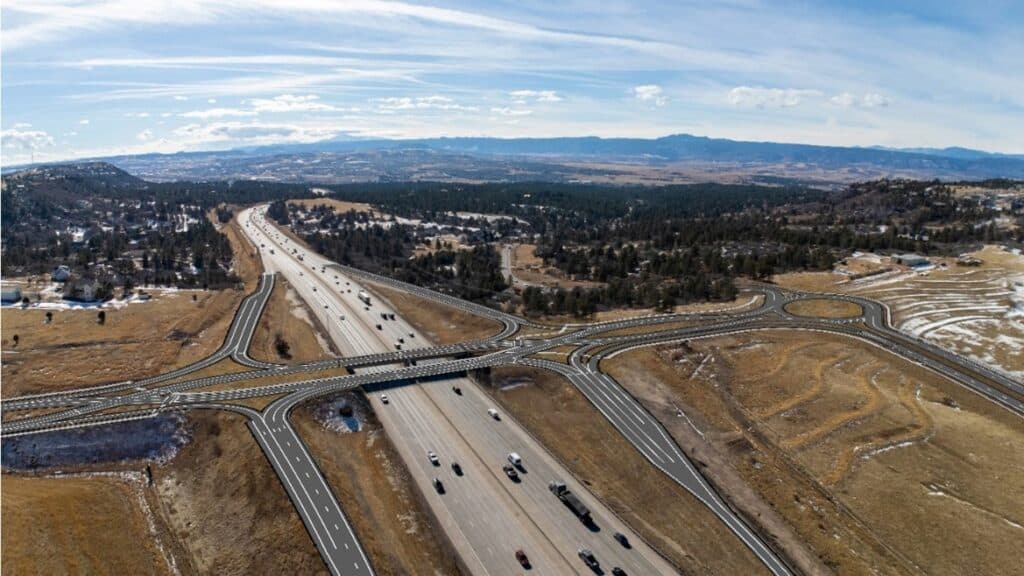
Douglas County approves $500,000 for Happy Canyon I-25 interchange design
Residents learn why the county allocated $500,000 for final interchange design and how the project advances congestion relief and planned southern growth.
1. Board approval of the amendment
The Board of County Commissioners voted during the Jan. 13 business meeting to approve an amendment committing $500,000 to the Happy Canyon Road / I-25 interchange project. That formal action moves the county from planning conversation to an active investment stage, signaling a political consensus to prioritize this corridor. For residents, the vote means visible progress on a long-discussed traffic pinch point that has impacted commutes and local access.
2. The $500,000 contribution and its purpose
The county’s approved contribution is $500,000 specifically earmarked for final design work on the interchange. This is a targeted capital investment intended to produce the technical plans and specifications necessary for the next funding and permitting steps. In practical terms, it pays engineers and planners to get the project to a "construction-ready" state, a key inflection point for securing larger grants.
3. Project identity: Happy Canyon Road / I-25 interchange
The funding applies to the Happy Canyon Road / I-25 interchange project, a transportation improvement designed around the state highway that is a backbone for regional travel. Improving an interchange at this junction addresses safety, capacity and mobility where local traffic meets a major regional corridor. For Castle Pines residents and travelers through Douglas County, the interchange is a strategic chokepoint whose upgrade can redistribute traffic flow and shorten commutes.
4. Location and local context: Castle Pines and southern Douglas County
The project sits in the Castle Pines area in the southern part of Douglas County, a portion of the county experiencing planned growth. That geographic context matters because new residential and commercial development is concentrated here, increasing daily trips onto I-25 and collector roads. Locally, the interchange upgrade is about protecting quality of life as southern neighborhoods expand, reducing pressure on main streets and improving emergency access.
5. Advancing final design toward construction readiness
County staff explained the purpose of the amendment is to advance the design to the point where the project can apply for construction funding. Achieving construction-readiness means having engineering, environmental assessments and cost estimates organized so state or federal funders can evaluate the project. For residents, this technical phase is when abstract plans become packageable proposals that can unlock larger dollars and a defined timeline.
6. Coordination with regional partners
The amendment will enable the county to better coordinate design work with Castle Pines, CDOT and other regional partners. Multijurisdictional alignment is critical on projects touching an interstate corridor because design decisions affect state highway operations and neighboring municipal infrastructure. Strong coordination reduces duplication, shortens permitting timelines and helps ensure that the final plans fit regional mobility and safety standards.
7. Funding source: prior project savings and budgeted transportation funds
Commissioners said the $500,000 comes from prior project savings and existing budgeted transportation funds, not a new tax levy. Using savings reflects a fiscal approach that reallocates surplus from completed work toward strategic priorities. For taxpayers, this means the county is redeploying available resources rather than creating new operating pressures in the short term.

8. Role in the county’s broader infrastructure strategy
The vote supports a broader Douglas County strategy to invest in targeted infrastructure that relieves congestion on key corridors. Interchange upgrades are a classic lever in that strategy: they improve throughput at critical nodes without requiring wholesale capacity expansion of entire highway segments. Locally, the strategy is designed to keep mobility reliable as population and development pressures increase.
9. Congestion relief on key corridors
By focusing on the Happy Canyon/I-25 node, county leaders aim to ease congestion not just at one spot but across adjacent corridors that feed into it. Reduced queuing at an interchange can cascade into fewer backups on feeder roads and arterial streets. Residents can expect incremental improvements in peak-period travel once design and construction are complete, though full benefits depend on coordinated regional work.
10. Enabling planned growth in the southern county
Investing in the interchange is explicitly tied to enabling planned growth in southern Douglas County, by creating the infrastructure capacity new neighborhoods and businesses need. Infrastructure readiness is often a precondition for responsible development; it shapes where, and how fast, growth occurs. For property owners and developers, clearer infrastructure plans reduce uncertainty; for neighbors, they offer reassurance that growth will be accompanied by mobility investments.
11. Next steps: proceed with design work
With the amendment approved, county staff will proceed with the contracted final design work so that the project reaches the necessary milestones. That typically includes detailed engineering, environmental documentation and cost refinement, which set the stage for grant applications. For residents, the immediate visible change may be staff briefings, public meetings and technical plans posted for review.
12. Continued coordination as funding and phases are pursued
Staff will continue coordinating with Castle Pines, CDOT and regional partners as the county pursues construction funding and subsequent project phases. That ongoing dialogue will shape grant applications, schedule phasing and any needed right-of-way or permit actions. Community members should watch for joint public outreach from multiple agencies as those phases approach to stay informed about timelines and local impacts.
13. What this means for residents and practical next steps
Practically, residents can expect a period of planning activity followed by grant-seeking and, eventually, construction phases that may bring temporary detours or utility work. Keep an eye on county notifications for public meetings and project updates to learn where input will be invited. Long term, the investment aims to reduce commute delays, improve safety, and align infrastructure with southern Douglas County’s growth, small inconveniences during construction for larger, sustained mobility gains.
This article was produced by Prism’s automated news system from verified source data, official records, and press releases, then run through automated quality and moderation checks before publishing. The system is built and supervised by the people who set the standards it runs under. Read our full AI policy.
Did this article answer your question?