Douglas County opens countywide water plan for public review
Douglas County’s water plan is now open for public review, giving residents a say in a 2050 blueprint that could shape growth, housing approvals and future water costs.

Douglas County has put its countywide water plan into public review, opening a debate that could shape where the county grows, how quickly homes are approved and how much future water infrastructure may cost local customers. The draft plan is the product of more than two years of formal work by the Douglas County Water Commission and now moves into town halls and an online engagement process before a future public hearing.
County officials advanced the draft on June 24, 2026, after the commission submitted its plan. A county agenda packet said the public engagement webpage was slated to launch in spring 2026, followed by an open house and then board adoption at a later public hearing in 2026. The county’s 2050 Comprehensive Douglas County Water Plan is intended to evaluate current supplies, analyze demand and identify strategies to meet future needs while maintaining quality of life and economic vitality.

The stakes are unusually high in Douglas County because the system is not a single utility. It is a patchwork of 31 water providers, and the three largest, Highlands Ranch Water, Parker Water and Sanitation District and Castle Rock Water, account for about 67 percent of municipal water demand. That concentration gives those providers outsized influence over the county’s long-term choices, especially in communities such as Highlands Ranch, Parker, Castle Rock, Lone Tree and Castle Pines, where water availability can affect development timing and density.
The plan also comes as county leaders confront a long-running dependency on the Denver Basin aquifer system, a source that helped fuel growth but is largely nonrenewable and recharges slowly. The Colorado Sun reported in 2022 that groundwater made up about 65 percent of the water used by Parker Water and Sanitation and Castle Rock Water, while Centennial Water used about 20 percent groundwater. More recent provider planning has pointed toward conservation, treatment plants, storage and new pipeline projects aimed at bringing in more renewable surface water, with Rueter-Hess Reservoir, which holds 75,000 acre-feet, playing a central role in long-term storage.
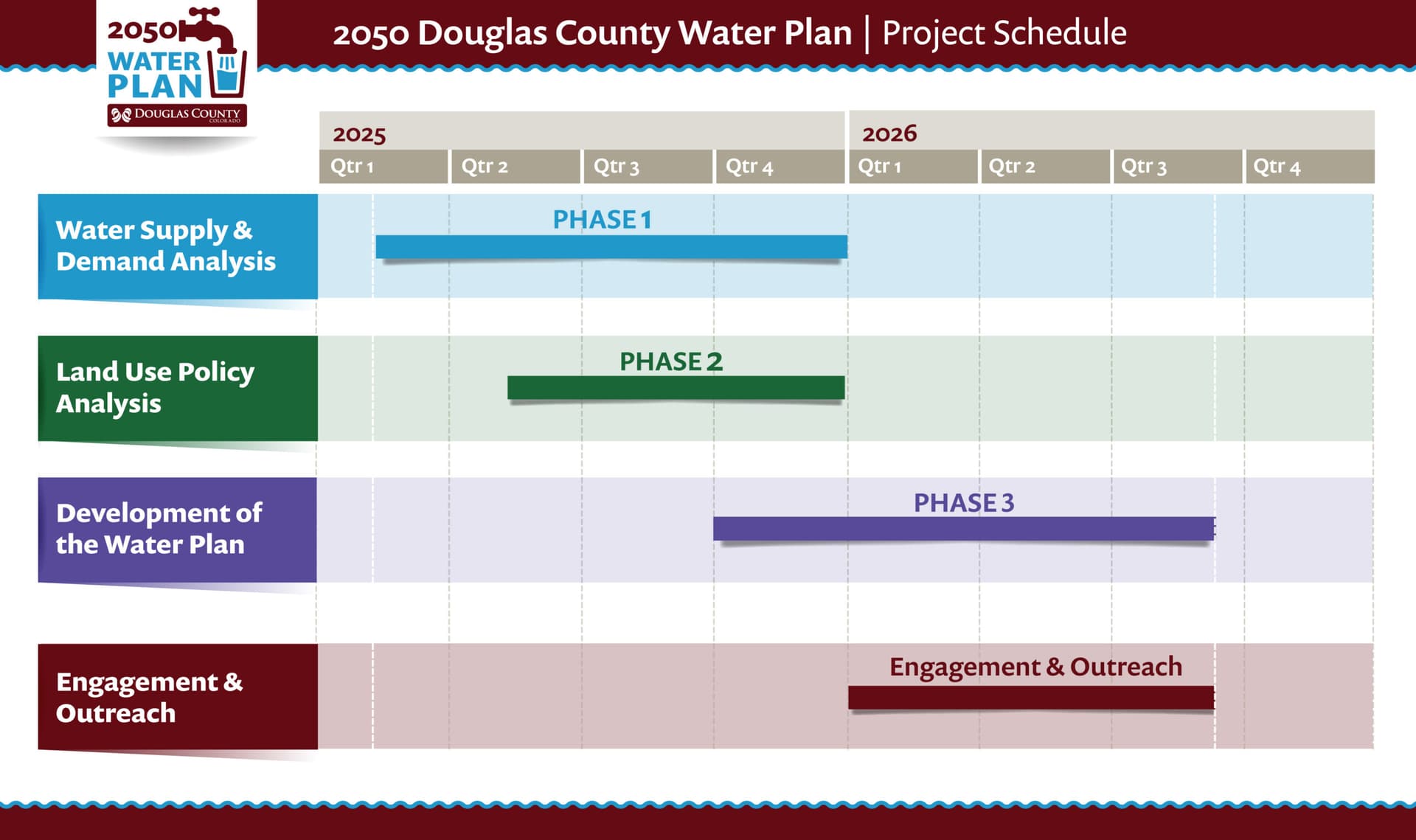
That shift has already shown up in day-to-day messaging to customers. In spring 2026, Castle Rock Water, Highlands Ranch Water and Parker Water & Sanitation District jointly urged residents to conserve after a warm, dry winter and below-average snowpack across Colorado. The county’s public review process now puts those tradeoffs in front of residents before the plan is finalized, with growth, drought resilience and infrastructure costs all tied to the decisions now on the table.
This article was produced by Prism’s automated news system from verified source data, official records, and press releases, then run through automated quality and moderation checks before publishing. The system is built and supervised by the people who set the standards it runs under. Read our full AI policy.
Did this article answer your question?