Douglas County Water Providers Issue Joint Call for Conservation
Castle Rock Water, Highlands Ranch Water, and Parker Water & Sanitation are urging customers to hold off on irrigation until mid-May as Colorado snowpack hits record lows.
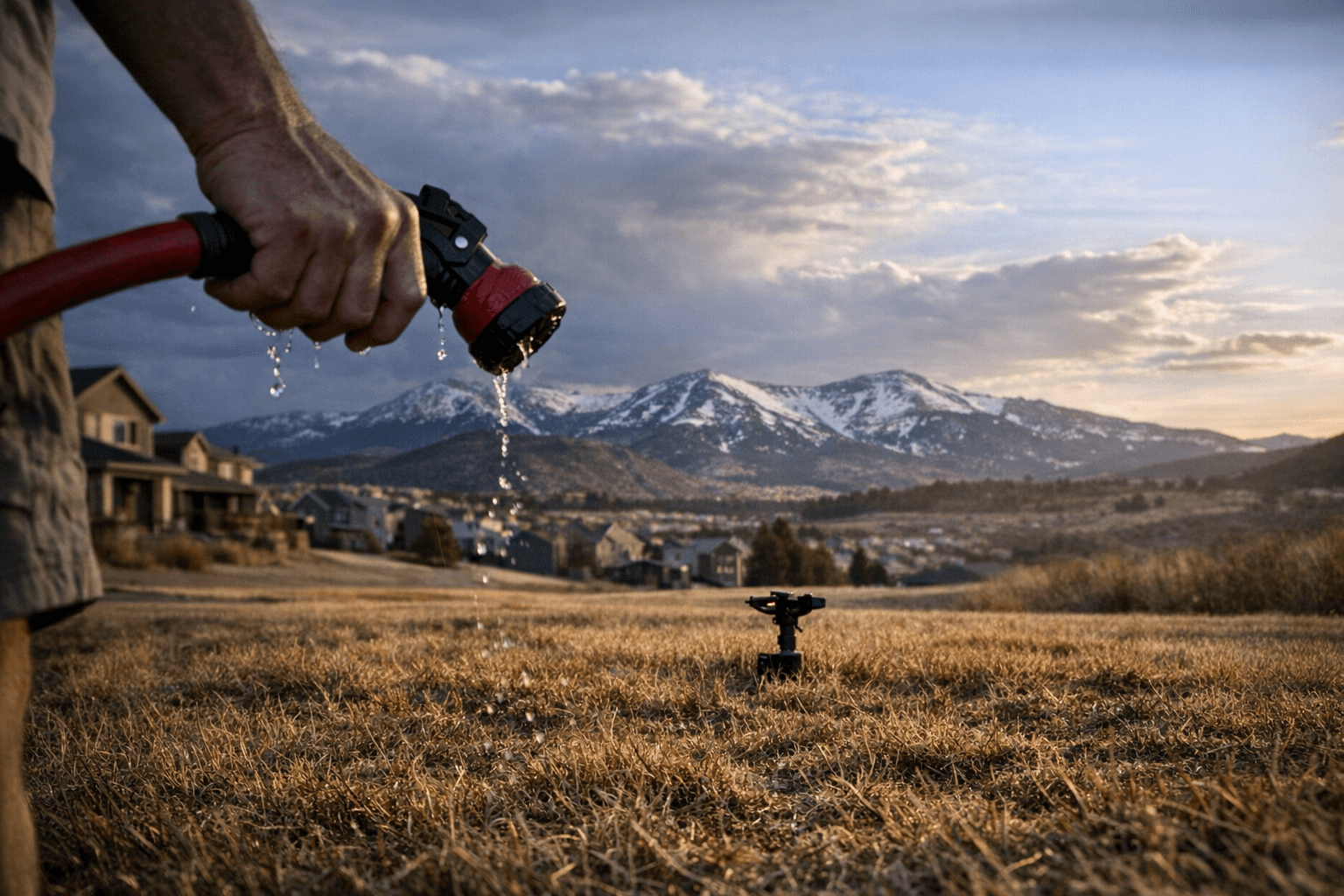
Castle Rock Water, Highlands Ranch Water, and Parker Water & Sanitation are reminding customers to use water wisely and practice conservation as the county heads into irrigation season against a backdrop of what state climatologists are calling the worst snowpack in modern records.
Snowpack levels across Colorado are at an all-time low after a historically dry winter. As of late March, those levels sit around 41% of where they should be for this time of year — a condition that prompted the three Douglas County providers to issue a joint call for conservation. In Denver Water's decades of records for its watershed collection areas, Colorado River snowpack ranked the worst on record, and the South Platte River snowpack remains ranked at the worst as of March 23.
The timing is urgent. Denver Water has asked customers to hold off on outdoor watering until mid-to-late May due to the record-low snowpack, and the Douglas County providers are echoing that message. Highlands Ranch Water General Manager Sam Calkins put it directly: "Water is always a valuable resource in Colorado, and dry conditions like we are experiencing this winter make conservation even more important. Small actions, like waiting to turn on your irrigation system until mid-May, can make a big difference."
The reasoning behind that mid-May threshold becomes clear when looking at how Douglas County households actually use water. Outdoor watering is the majority of water use for a typical customer during the year. Average winter usage for a Castle Rock customer runs about 5,000 gallons per day, but during the summer that figure climbs to 15,000 gallons per day. Across all three providers, outdoor watering typically accounts for the largest single spike in water use during spring and summer months.
Beyond delaying irrigation startup, the providers recommend that customers learn and follow local outdoor watering rules, check sprinkler systems for leaks or broken heads before the season begins, and take advantage of rebate programs designed to incentivize more efficient fixtures and landscaping.
Castle Rock Water has the most detailed incentive structure in place. At a March 3 town council meeting, the council approved $750,000 in rebates for 2026, funded through surcharges for excessive watering. Castle Rock's rebate programs have proven effective: the water district recorded its lowest gallons-per-capita-per-day usage in 2025 since tracking began in 2007. Offerings include up to $3.25 per square foot for converting turf to drought-tolerant ColoradoScape, up to $5 for each traditional spray nozzle replaced with a higher-efficiency rotary nozzle, and a toilet rebate equal to the cost of the fixture, not to exceed $150 per toilet, for customers who swap older units for ultra-high-efficiency 0.8-gallons-per-flush models. Rebates are offered on a first-come, first-served basis until funding is exhausted. Applications are available at CRconserve.com/Rebates.
The joint messaging from all three providers carries an implicit acknowledgment that not all Douglas County utilities face identical pressures. The three districts rely on different water sources, have varying storage capacities, and operate under unique local demands — factors that leave them with different sensitivities to drought conditions. Still, officials agreed that conservation is a key to ensuring the long-term sustainability of water for their communities.
Meteorologists note that 2026 is responsible for the top three or more highest March temperatures on record in many areas of Colorado. The state has seen temperatures spike fast enough to evaporate significant snowpack before, but never starting from a record-low snow base with so little to begin with. Colorado state climatologist Russ Schumacher said earlier this month that "the deficits are really big at this point," making low stream flow "a pretty safe bet for this spring and summer.
This article was produced by Prism’s automated news system from verified source data, official records, and press releases, then run through automated quality and moderation checks before publishing. The system is built and supervised by the people who set the standards it runs under. Read our full AI policy.
Did this article answer your question?