Parker downtown gets glow-up as Mainstreet evolves into destination hub
Parker’s downtown is turning into a mixed-use core, with apartments, retail, trail links and new parking rules reshaping Mainstreet around South Pine Drive.
Mainstreet’s reset is becoming visible on the ground
Parker’s downtown is no longer being treated like a sleepy suburban strip. The center of gravity is shifting to Mainstreet around South Pine Drive, where apartments, shops, parking fixes and public-space upgrades are coming together to push the district toward a more walkable, destination-style core.
That shift matters because Mainstreet is not just a place to pass through. It is becoming the town’s daily-use center, the spot where Parker is trying to keep more dining, shopping and entertainment spending close to home while also managing the tradeoffs that come with growth: heavier traffic, tighter parking and a downtown identity that will look different from the low-key Mainstreet many longtime residents remember.
A long plan is finally showing up in concrete and steel
The current transformation did not start overnight. Parker’s Mainstreet Master Plan was introduced in September 2015 as a 20-year framework for land use, urban form, circulation and parking along the corridor from Twenty Mile Road on the west to Pine Drive at Town Hall on the east. One of its clearest goals was to increase daytime population and activity, a sign that the town has long viewed downtown revitalization as an economic-development strategy, not just a streetscape project.
That planning backstory matters because it explains why the current wave of construction feels coordinated rather than random. Partnering for Parker’s Progress, the town’s urban-renewal arm, says the My Mainstreet community-engagement process began in 2018. In 2022, the Parker Town Council and the P3 Board approved a development agreement with Confluence Companies for six publicly owned parcels, and in March 2026 Confluence presented updated site plans and renderings to the council. The message is clear: Parker is not improvising downtown growth, it is building toward a long-planned mixed-use district.
The My Mainstreet buildout is broad, not single-project
The biggest change for readers to watch is that Mainstreet is being reshaped by several parcels at once. As of February 2025, the My Mainstreet plan called for 309 apartments at EastMain, 23 townhomes and 154 apartments at Pine Curve, and 124 for-sale condominiums at Pace Lot. It also included office, retail and restaurant space at multiple sites, including 9,300 square feet at Schoolhouse and 23,830 square feet at Par Property.
Taken together, those pieces point to a downtown with more people living, working and lingering within the same few blocks. P3 said the full My Mainstreet plan includes 1,049 parking spaces across the project components it has detailed, which shows the town understands that density will only work if access keeps pace. The upside is a stronger customer base for merchants and a more reliable stream of foot traffic. The pressure point is obvious too: more residents and more visitors will test parking, delivery access and traffic flow on a corridor that was built for a very different level of activity.
The Juniper on Mainstreet is the clearest sign of where downtown is headed
At Mainstreet and South Pine Drive, The Juniper on Mainstreet has become the most visible symbol of the downtown shift. The $107 million project began construction in 2024 and was expected to finish in the second quarter of 2025. It spans 8.1 acres and includes 264 apartments, 13,900 square feet of pedestrian-friendly retail and restaurant space, two four-story Class-A buildings and more than 400 covered and surface parking spaces.
Developers described The Juniper as the first Class-A apartment and retail project in Parker’s historic downtown, which is a meaningful marker for the local market. That kind of project tends to attract a different tenant mix, a different renter profile and a different level of daily activity than older suburban retail. For nearby property owners, that can support higher values and stronger leasing interest. For merchants, it can mean more customers nearby and a more consistent lunch-and-dinner crowd. It can also raise expectations for rents and change the feel of the corridor in ways that some longtime residents may welcome and others may question.
Parking, sidewalks and mobility are being rebuilt around the new density
Parker is not just adding buildings. It is also upgrading the public realm around them. The town said it would replace 40-year-old sidewalks and concrete on Mainstreet between Parker Road and South Pine Drive in summer 2025, a reminder that the physical backbone of downtown needs maintenance if it is going to support more people. That work is more than cosmetic. Better sidewalks signal a downtown meant for walking, lingering and short trips between retail and dining, not simply driving in and leaving.
Parking rules also show how the town is trying to balance turnover with access. In some downtown areas, on-street parking is limited to two hours Monday through Friday from 8 a.m. to 6 p.m. That policy favors visitors, customers and short stays over all-day parking, which can help local businesses by keeping spaces open. It also reflects a broader economic reality: as Mainstreet becomes more active, every curb space becomes more valuable, and the town will have to keep managing the tension between convenience for shoppers and storage for residents or employees.
The trail connection gives downtown a stronger civic spine
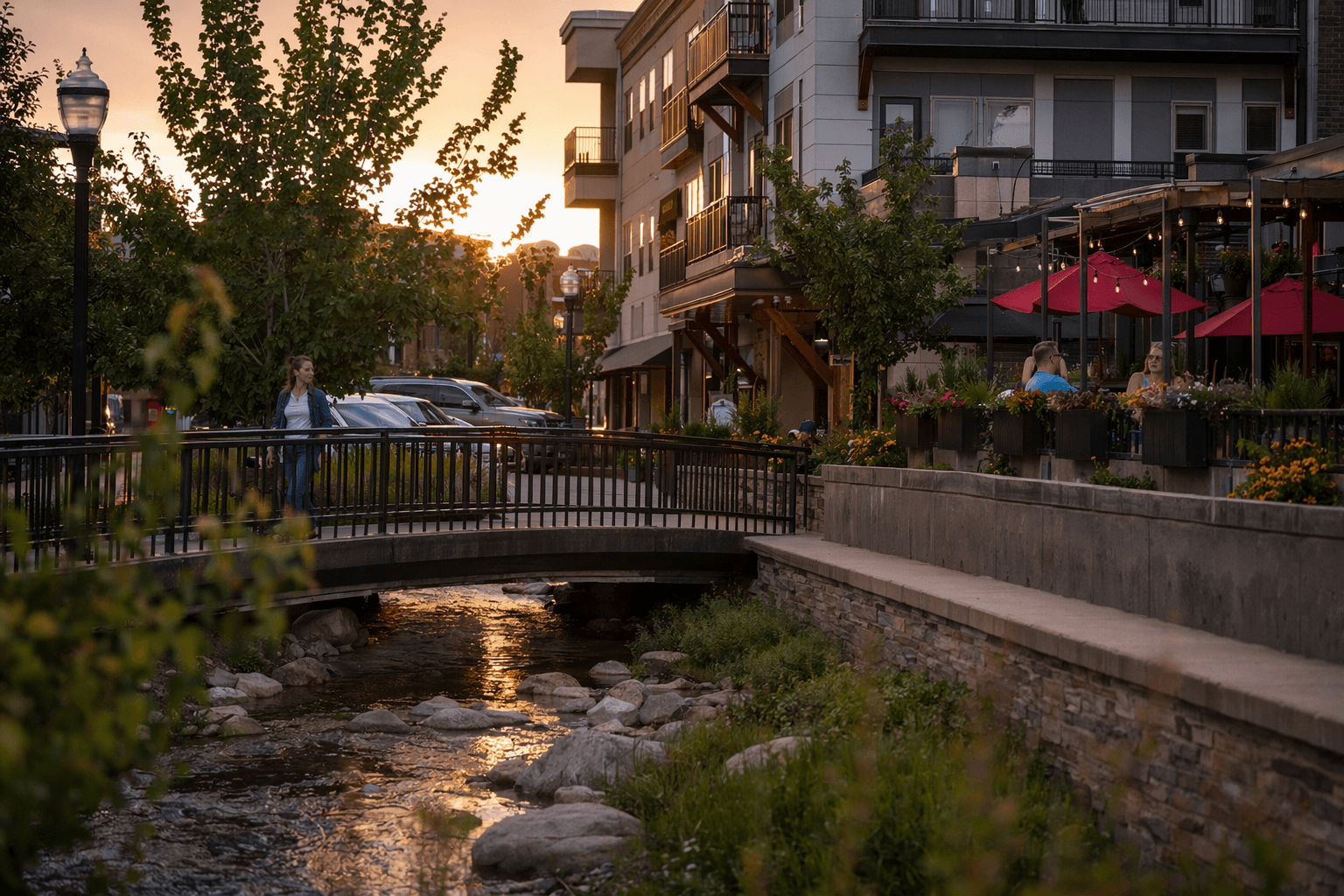
One of the most important changes for daily life is the growing connection between Mainstreet and the trail network. The Juniper site sits next to the Sulphur Gulch Trail, and Parker’s 2026 capital improvement update says the Parker Road east-side connection with a pedestrian bridge over Sulphur Gulch was completed in spring 2025. That improves access into downtown and makes it easier for pedestrians and cyclists to move between neighborhoods and the town center.
That kind of connection changes how downtown functions. A place that can be reached on foot or by bike becomes more than a drive-to commercial zone. It starts to behave like a civic hub, where lunch, errands, apartment living and recreation overlap. For Parker, that is the real long-term prize: a Mainstreet that works as an everyday destination, not just a backdrop for occasional events.
Growth is the force shaping the whole story
Parker’s fast growth helps explain why the downtown reset is happening now. The town says it had about 72,147 residents as of Jan. 1, 2026. The U.S. Census counted 58,512 residents in 2020 and estimated 65,473 in July 2024. That is a sizeable jump in a short period, and it inevitably raises demand for housing, retail, public space and parking.
That is why Mainstreet’s redevelopment is so consequential. The winners are easy to spot: merchants who gain more foot traffic, property owners who benefit from a stronger district, and visitors who get a more active downtown with more places to eat and gather. The pressure points are just as real: higher rents, more congestion, tighter parking and the risk that downtown Parker feels less like an intimate small-town core and more like another polished suburban center. The next phase of Mainstreet will be judged not just by how new it looks, but by whether it still feels like Parker while serving a much busier future.
This article was produced by Prism’s automated news system from verified source data, official records, and press releases, then run through automated quality and moderation checks before publishing. The system is built and supervised by the people who set the standards it runs under. Read our full AI policy.
Did this article answer your question?