29 Haskell, KU students to present research Friday at symposium
At Haskell’s Stidham Union, 29 students showed work from muskrat mounds to Yukon horse bones, spotlighting a KU-Haskell research pipeline rooted in Lawrence.
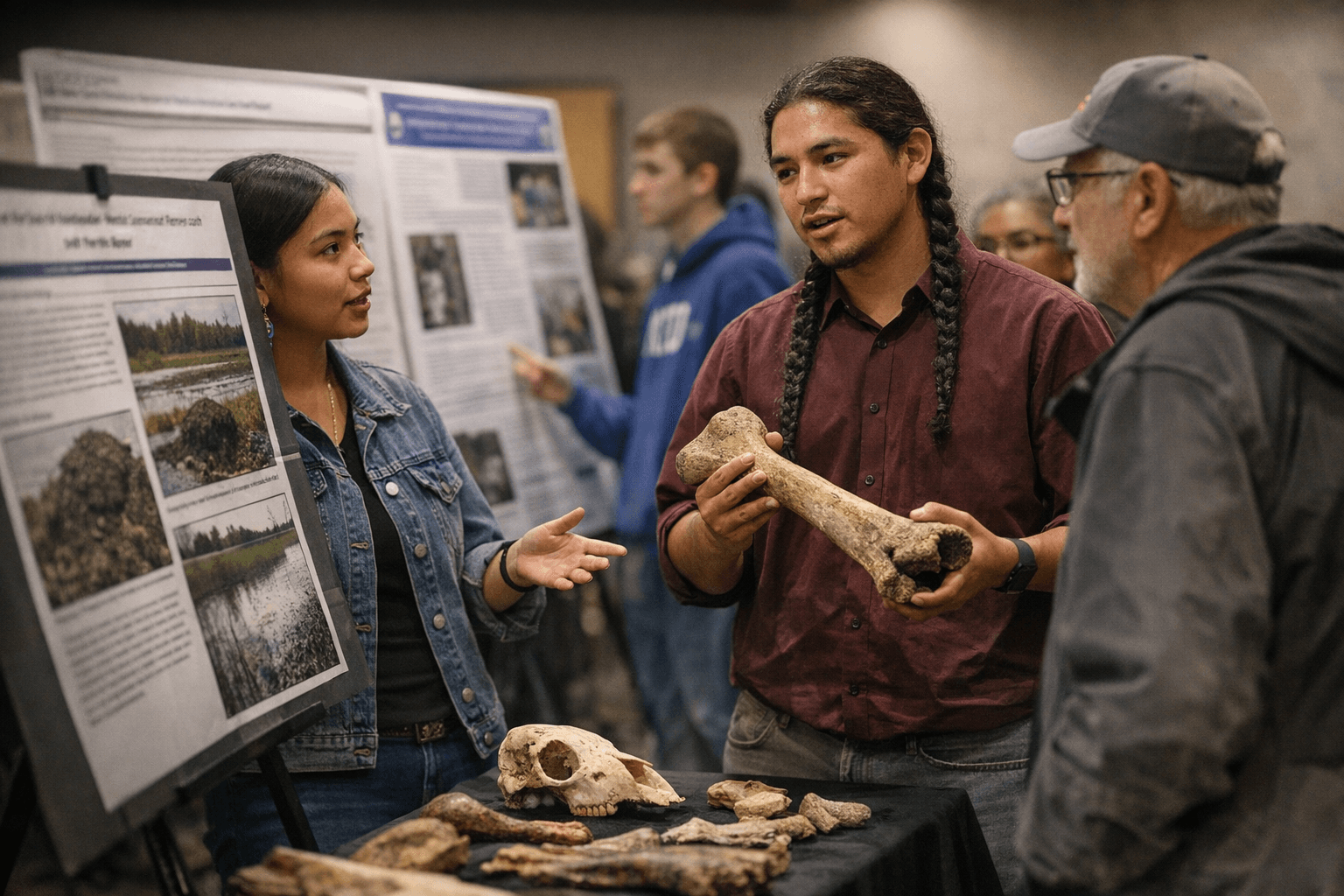
Twenty-nine undergraduate and postbaccalaureate scholars from Haskell Indian Nations University and the University of Kansas brought posters to Stidham Union on Haskell’s campus, turning the 26th annual Haskell-KU Student Research Symposium into a clear display of how the two Lawrence institutions share more than geography. The event drew students working across ecology, anthropology, geology and biomedical science, and it showed how a campus partnership can shape research, training and career paths for students who live, study and work in Douglas County.
The symposium was organized by KU’s Office for Advancing Success in Science, known as OASiS, which coordinates several federally funded training programs serving KU and Haskell students. Those programs included Bridges to Baccalaureate, HINU USDA-NIFA Equity, K-INBRE, BESST, MARC and BioGEM. Haskell said the training programs are supported by the National Institutes of Health, the National Science Foundation and the U.S. Department of Agriculture, underscoring how much of the partnership depends on outside grant support. That funding base has also made the program vulnerable: last year, four of five OASiS programs had federal grants cut without notice, even as the symposium went on.
The student projects reflected the range of the collaboration. Kiana Alo, a Haskell senior from Papakōlea, Oahu, and a White Mountain Apache student, studied muskrat mound distribution in the Haskell wetlands under Bridgett Chapin, Haskell’s faculty chair of natural sciences. Kathryn Borthwick, a KU senior from Coatesville, Pennsylvania, who is double majoring in anthropology and Spanish with a minor in Classical Antiquity, examined horse bones from Cave 2 of the Bluefish Caves site in the northern Yukon Territory of Canada with KU mentor Lauren Norman. The Bluefish Caves site has been cited by the Kansas Geological Survey as possibly the earliest well-documented evidence of humans in North America.
Other posters pushed the partnership into plant science and geology. Brynn Cruce, who earned a biochemistry degree from KU in May 2025 and is now an NSF RaMP postbaccalaureate scholar, studied how plants protect themselves from excessive light in different environments with Jennifer Johnson, who joined KU’s ecology and evolutionary biology faculty in fall 2024. Madeline Dopp, a KU senior from Olathe, worked with geologist Noel Jackson on periodicity in California earthquakes, linking a local student project to a broader body of Kansas geology research that includes induced earthquakes in Kansas and the surrounding region.
The symposium has been held for 26 years, and the student count grew from 24 presenters at last year’s 25th annual event to 29 this spring. Bridges to Baccalaureate is designed to help Haskell students move into bioscience study at KU, while KU’s MARC program recruits six juniors each year for a two-year biomedical research experience and BioGEM trains ten scholars, including recent graduates with limited prior research experience. In a county where Haskell and KU sit only minutes apart, the symposium has become a visible measure of how a cross-campus pipeline can strengthen both institutions and the communities they serve.
This article was produced by Prism’s automated news system from verified source data, official records, and press releases, then run through automated quality and moderation checks before publishing. The system is built and supervised by the people who set the standards it runs under. Read our full AI policy.
Did this article answer your question?