Armadillos becoming more common around Lawrence, wildlife experts say
Armadillos are no longer a novelty around Lawrence. From Eudora parking lots to Clinton Lake, experts say the best response is simple: give them room and expect more sightings.
Why this little roadside scene matters
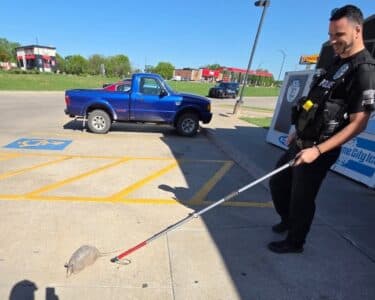
An armadillo in the Kwik Shop parking lot in Eudora might have looked like a one-off oddity, but it fits a much bigger pattern now reaching Lawrence and the rest of Douglas County. Eudora police moved the animal to a safer rural area on April 20, 2026, a reminder that these animals are no longer just passing through Kansas by accident. Police chief Wes Lovett said the sighting was notable, but not isolated.
What makes the story useful is the shift it reflects in everyday life. Armadillos are showing up in places where people live, garden, drive and recreate, which means a strange-looking animal at the edge of a yard or near a gas station is becoming part of the local landscape rather than a rare surprise.
Armored visitors have been in Kansas for decades
The nine-banded armadillo is not new to the state. The Kansas Department of Wildlife and Parks says the species was first reported in Kansas in the 1940s, was common by the 1990s, and has now built a substantial breeding population across the state. That timeline matters because it shows the change is not temporary or isolated to one neighborhood.
KCUR has also reported that nine-banded armadillos, which are native to Central and South America, have been migrating north for decades as average temperatures rise. In other words, the Lawrence area is not suddenly discovering an exotic animal for the first time. It is seeing the edge of a long-running range expansion move closer to everyday places people already use.
Why they are moving north
For years, cold temperatures and dry conditions were thought to be the main reason armadillos did not spread farther north. Kansas wildlife officials later pointed to another factor that may matter more: soil hardness. Armadillos need ground they can dig through easily, so the texture of the soil can shape where they settle as much as the weather does.
That detail is important for Douglas County because the region blends yards, fields, road shoulders and recreation areas, creating plenty of disturbed ground and mixed habitat. A hard freeze alone does not tell the whole story, and neither does a warm spell. The broader pattern is a combination of climate, soil and land use that makes armadillos more likely to keep appearing in places people notice.
What this means around Lawrence, Eudora and Clinton Lake
For residents, the practical takeaway is that armadillos are not just moving through the countryside, they are intersecting with daily routines. A homeowner may spot one in a backyard after dark, a gardener may notice disturbed soil near beds or fence lines, and a driver may encounter one crossing a rural road or moving through the shoulder. In southern Douglas County, where suburban edges quickly give way to rural ground, those encounters are likely to feel increasingly ordinary.
The Clinton Lake area gives the trend even more context. Kansas Department of Wildlife and Parks says the Clinton Wildlife Area lies mostly within the Clinton Reservoir flood pool, with Deer Creek, Rock Creek and the Wakarusa River as its main drainages. The area also includes native grassland, deciduous forest and cropland, plus two man-made wetland complexes, a mix of habitats that makes the lake region a natural place for wildlife movement. For people spending time there, an armadillo should be treated as part of the area’s changing wildlife mix, not as a freak sighting.
What to do if you see one
The safest response is to give the animal space. Armadillos are usually more interested in moving along than confronting people, and the Eudora example shows that when one turns up in the wrong place, local officials can help move it out of harm’s way. If it is in a yard or parking lot, keep pets and children back, avoid trying to corner it, and let it leave on its own or wait for help if it appears trapped.
A few common-sense steps go a long way:
- If you see one near a road, slow down and do not swerve suddenly.
- If it is in a yard or garden, watch from a distance and avoid trying to grab it.
- If you are near Clinton Lake or another wooded edge, assume it is moving between cover and open ground, and give it a clear path.
- If an animal is injured or stuck in a risky spot, contact local authorities rather than trying to handle it yourself.
That approach matters because the main issue is not whether armadillos belong in Kansas anymore. They already do. The real question is how people adjust as a once-unusual animal becomes part of the background noise of Lawrence-area life.
A quirky sighting with a serious message
The armadillo in Eudora was funny enough to become a story, but the larger lesson is practical. Kansas is seeing more of a species that once seemed limited to much warmer country, and the reasons include decades of northward migration, rising temperatures and habitat that can support digging. In a county where city streets, farm ground and lake country overlap, that means more chances to cross paths with an animal that is now settling in for the long haul.
This article was produced by Prism’s automated news system from verified source data, official records, and press releases, then run through automated quality and moderation checks before publishing. The system is built and supervised by the people who set the standards it runs under. Read our full AI policy.
Did this article answer your question?