Black Jack battlefield marks first clash of Bleeding Kansas
About 100 men fought at Black Jack for three hours, and the Baldwin City battlefield now draws roughly 3,000 visitors a year as a landmark, classroom and tourist stop.
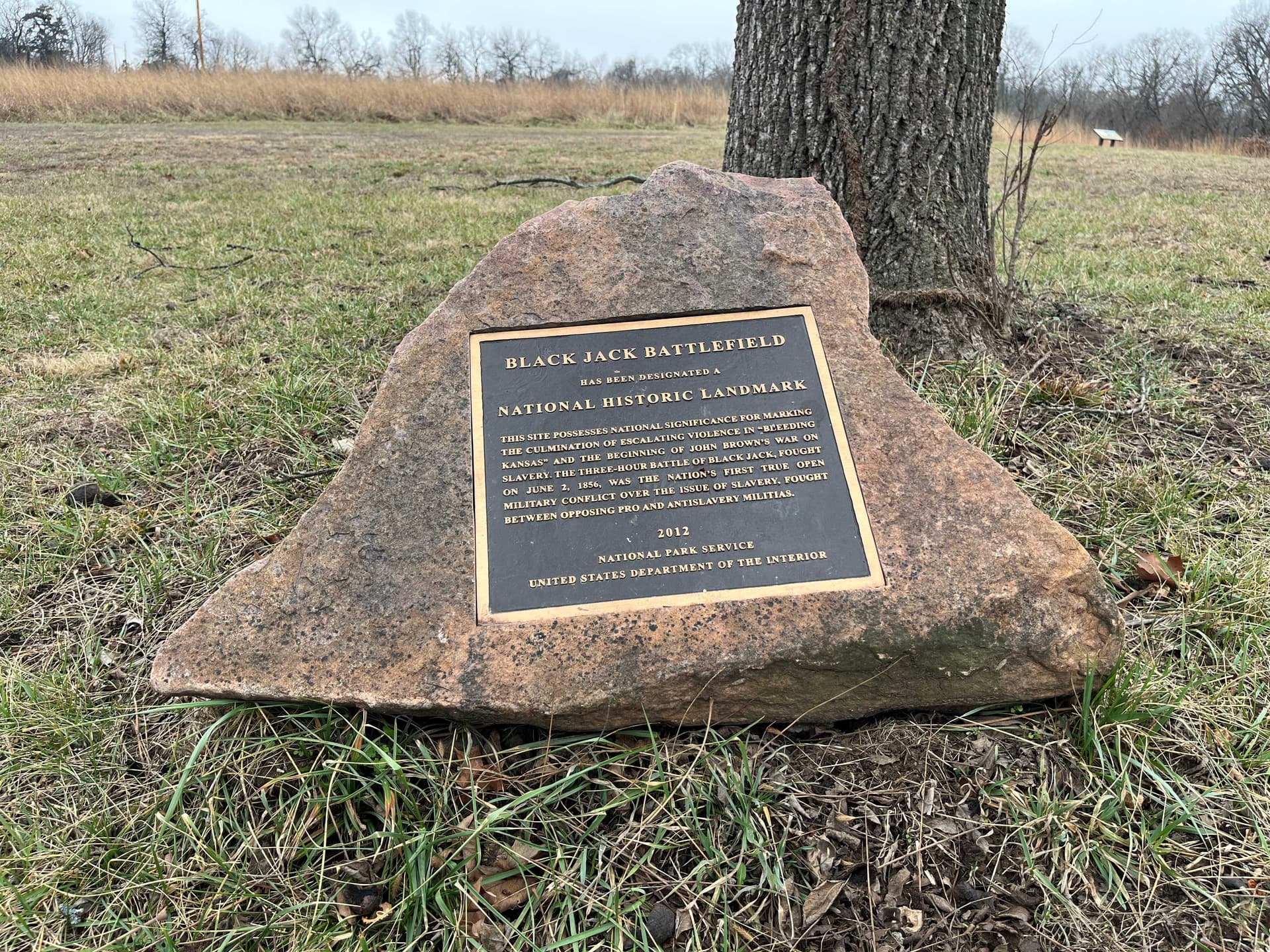
At Black Jack, about 100 men fought for three hours on the edge of Baldwin City, and Douglas County now treats that 38-acre battlefield as both a public park and a warning about how quickly Kansas descended into violence. The clash on June 2, 1856, is widely described as the first armed conflict between proslavery and antislavery forces in the United States, with John Brown’s anti-slavery men attacking at dawn and Henry Clay Pate leading the proslavery camp before surrender.
The fight came from the political explosion set off by the Kansas-Nebraska Act of 1854, which opened Kansas Territory to popular sovereignty on slavery. Just days before Black Jack, proslavery forces raided Lawrence on May 21, 1856, and Brown retaliated in the Pottawatomie killings on May 24. Historians have long treated Black Jack as the opening shot of Bleeding Kansas, and some have called it the first battle of the Civil War, even though the war itself did not begin until Fort Sumter in 1861.
That history now sits inside Black Jack Battlefield and Nature Park, a county-city property that includes the Robert Hall Pearson farmhouse, nature trails, Captain’s Creek, restored prairie, picnic areas and a sugar maple grove. Douglas County and Baldwin City jointly own and operate the site, which is open daily from dawn to dusk at 163 E. 2000th Road near Baldwin City. County and city officials said about 3,000 people visit each year for the natural setting, reenactments and tours, giving the site a role that reaches beyond memory and into local tourism and education.

The battlefield’s value also lies in what has been preserved around it. Black Jack Battlefield was designated a National Historic Landmark in 2012, making it one of three such sites in Douglas County and one of only 26 in Kansas. The park sits beside the Ivan Boyd Prairie Preserve, owned by Douglas County and maintained by the Santa Fe Trail Historical Society of Douglas County, and near the Black Jack Ruts, where fighters hid from enemy fire during the battle. The ruts can be up to 15 feet wide and 4.5 feet deep, a physical reminder that the Santa Fe Trail and the border war once crossed the same ground.
Preservation efforts have shifted over time, from the Black Jack Battlefield Trust, created in 2003, to the joint ownership agreement signed Nov. 26, 2025. Baldwin City and Douglas County are expected to seat an equal-representation advisory board by spring 2026, a step meant to keep the site active inside Freedom’s Frontier National Heritage Area. For Douglas County, the stakes are plain: if Black Jack fades into a forgotten marker, the county loses a rare landmark, a steady stream of visitors and one of the clearest places to teach how Kansas helped shape the nation’s path to war.
This article was produced by Prism’s automated news system from verified source data, official records, and press releases, then run through automated quality and moderation checks before publishing. The system is built and supervised by the people who set the standards it runs under. Read our full AI policy.
Did this article answer your question?