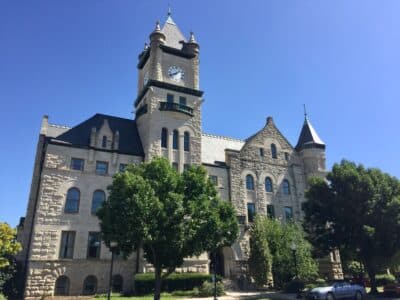
Douglas County delayed courthouse for decades after 1855 founding
Douglas County spent decades without a courthouse, then voters funded one in 1899 and turned downtown Lawrence into the county’s permanent seat of government.
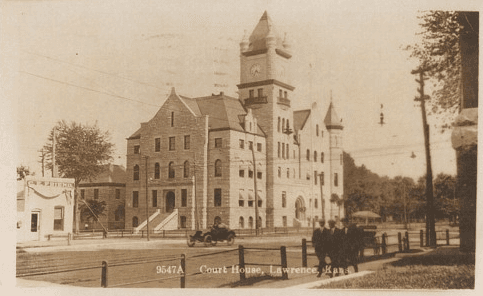
Douglas County’s courthouse story is really a story about delayed public investment. The county was founded on August 25, 1855, among the first counties organized in Kansas, and for years it ranked among the state’s most populous and wealthy counties. Yet by the end of the 19th century, it still had no permanent courthouse, and county business was spread across other locations.
A county that grew before it built
That gap matters because it shows how local priorities can lag behind local growth. Douglas County was established in the territorial era, and Clio places that earlier date at May 15, 1854, when the county was named for Illinois Senator Stephen A. Douglas. Clio also notes the irony of that naming: many Lawrence settlers held Free Soil views that opposed slavery’s expansion, a political tension that marked the county’s early years and the wider Kansas territory.
Lawrence, the county seat, sat at the center of the Free State movement before the Civil War, so Douglas County’s civic development unfolded in a highly charged political landscape. The county was early, wealthy, and important, but its public institutions did not immediately take physical form in the way residents now expect from a county seat. That makes the courthouse delay more than an architectural footnote. It is evidence that even a prominent county can postpone the kind of visible civic investment that signals stable government.
Why the courthouse took so long
The key turn came in 1899, when Douglas County voters approved levying additional real estate taxes to pay for a courthouse. The authorization was a local referendum, and the tax levy was set to raise $80,000 for construction. By then, many county offices were still housed in other places instead of a single permanent public building.
That arrangement tells its own story about administration in a growing county. County government still functioned, but it did so in a scattered and improvised way, without the centralized home that residents could point to downtown. The vote in 1899 gave county government a clearer public mandate and converted a long-delayed need into a funded project.
From tax vote to cornerstone
Construction began in 1903, and the cornerstone was laid on July 4, 1903. Historical records place the building period between 1903 and 1905, with the courthouse built in 1903 and completed in the early 1900s. The design came from John G. Haskell and Frederick C. Gunn, and the building is in the Richardsonian Romanesque style, a late example of that form.
The courthouse’s design and timing matter because they reflect a county finally choosing permanence. Instead of continuing with temporary offices, Douglas County invested in a substantial stone public building that marked its authority in the civic landscape of Lawrence. The courthouse became more than a site for records and hearings. It became the county’s public face.
The county’s only courthouse
One historical presentation describes the Douglas County Courthouse as the first and only courthouse the county has ever known. That fact gives the building unusual weight in local memory. In many places, courthouses are replaced or supplemented over time; in Douglas County, this one building has carried the county’s institutional identity across generations.
The building still serves that role today. It houses county administration, the Board of County Commissioners, the appraiser’s office, the county clerk, the register of deeds, and the treasurer’s office. The commission chamber, formerly the courtroom, occupies the southeastern corner of the second story. Those details matter because they show that the courthouse is not just a preserved landmark. It remains an active government building where the county’s most basic functions are carried out in one place.
What the delay reveals about public priorities
Douglas County’s long delay in building a courthouse says as much about public finance as it does about architecture. The county was strong enough to matter early, but not every public need received immediate capital investment. A courthouse requires land, taxes, consent from voters, and a willingness to tie civic legitimacy to a building that people can see and use every day. Douglas County only made that commitment after decades of operating without it.
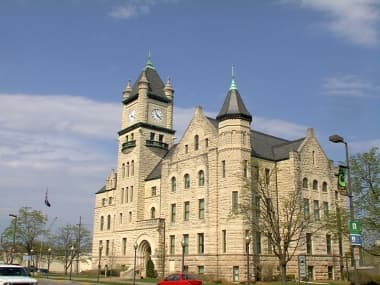
That sequence is useful for understanding how local government earns trust. A county seat is not only a legal center. It is also a physical promise that public business belongs in public view. The 1899 tax vote, the 1903 cornerstone, and the courthouse’s continued use all show how residents eventually converted an abstract county into a place with a durable civic home.
Why it still matters in downtown Lawrence
The courthouse remains important because visible public buildings still shape how people judge government. Residents rarely assess legitimacy through ordinances alone. They see it in whether county offices are centralized, whether public services are easy to find, and whether downtown institutions still carry authority.
Douglas County’s courthouse answers those questions in stone. The county clerk, register of deeds, treasurer, appraiser, administration, and commissioners all operate from the same historic building, tying daily government to a permanent downtown presence. That is the lasting lesson of Douglas County’s delayed courthouse: public confidence grows when government is not just functional, but physically anchored in a place people recognize as their own.
This article was produced by Prism’s automated news system from verified source data, official records, and press releases, then run through automated quality and moderation checks before publishing. The system is built and supervised by the people who set the standards it runs under. Read our full AI policy.
Did this article answer your question?