Douglas County explains rural road dust control and open burning rules
Rural Douglas County landowners face seasonal dust-control deadlines and burn rules that require notice before any open flame. Miss the windows, and the county can treat it as a compliance problem.
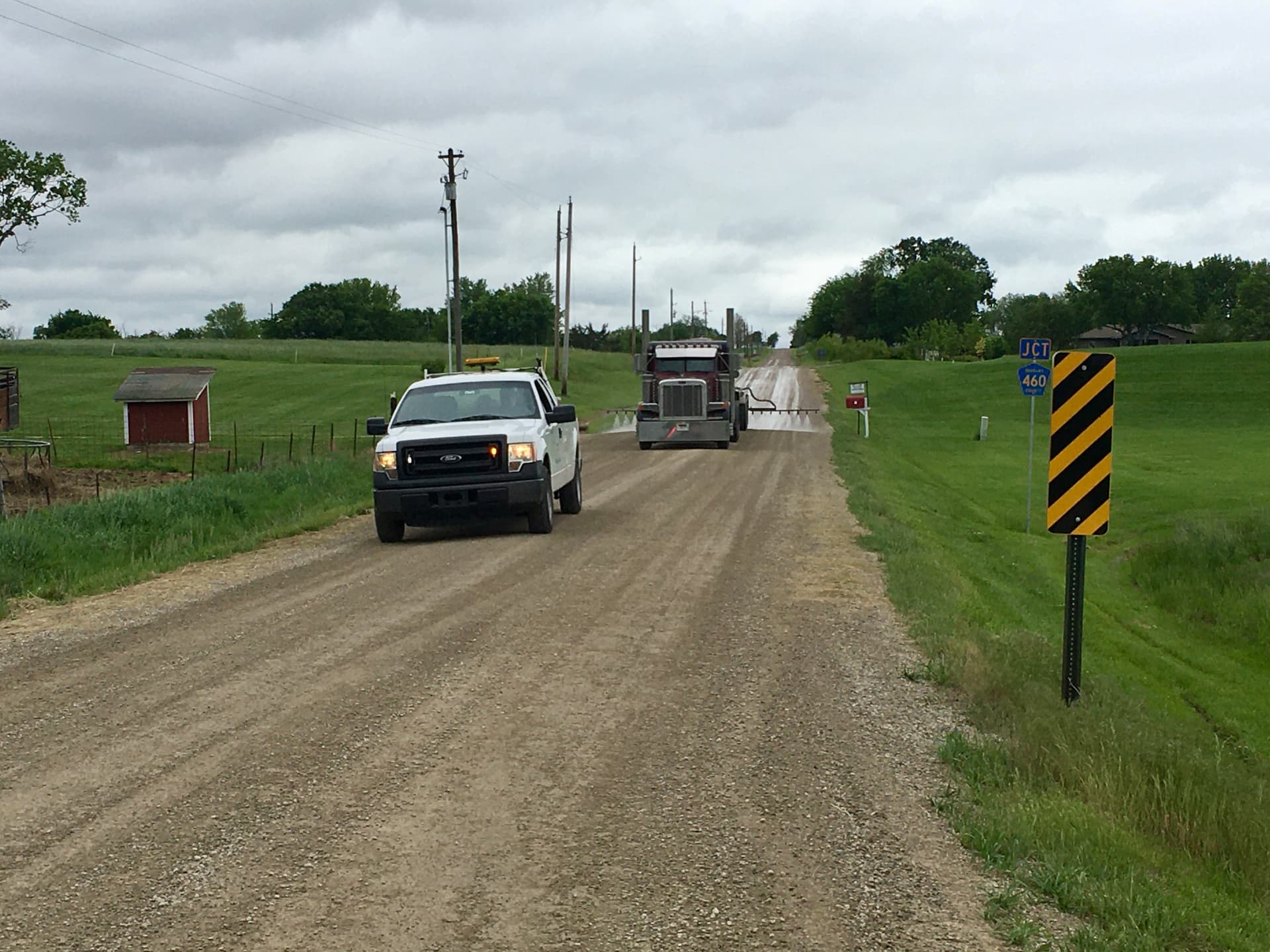
A gravel road can turn a calm rural day into a cloud of dust, and a brush pile can become a compliance problem fast. In Douglas County, both issues are handled through tightly defined rules: an annual user-fee dust-control program for rock roads and open-burning requirements that apply in the unincorporated area. If you live outside Lawrence, Baldwin City, Eudora or Lecompton, the key is knowing the deadline, the cost structure and who has to be notified before work starts.
Dust control is not a countywide paving program
Douglas County’s dust-control program is designed for rock roads, typically in front of houses, where passing vehicles throw up dust. The county applies liquid calcium chloride or magnesium chloride to those roads to reduce the dust plume, and it describes both products as brine solutions found naturally in various regions of the USA. That matters because the program is targeted and practical, not a broad promise to improve every rural road surface.
The county treats the work as a user-fee program. That means the property owner pays up front for the estimated cost of applying the dust-control material, and the owner also pays about half the cost of preparing the road for treatment. Public Works says the program also requires approval from the Douglas County Board of County Commissioners, so it is tied to a formal seasonal process rather than an automatic road service.
Watch the late-winter application window
The dust-control program runs on a deadline, and missing it means waiting for the next cycle. Douglas County announced on Jan. 29, 2024 that it was accepting applications for the 2024 user-fee dust control program, with a deadline of Friday, March 8. For 2025, the county announced on Feb. 17, 2025 that applications were open again, with a deadline of Friday, March 7.
That timing is important for rural property owners who deal with spring traffic, construction access or simply the daily churn of a busy gravel lane. The county’s annual schedule shows that residents cannot assume dust control will be added later in the year on request. If the road fronting a home or farm needs treatment, the paperwork has to move during the county’s enrollment period.
How to reach Public Works
Douglas County Public Works handles chemical sales and equipment rental connected to the program. The county lists those hours as 7 a.m. to 3:30 p.m., and the contact number is 785-331-1322. For anyone planning dust control on a rural parcel, those details are more than administrative trivia: they are the practical starting point for cost questions, materials and timing.
The county’s own dust-control page also makes clear that the program is intended for rock roads in front of houses. That narrower scope is a useful reminder for residents who live on larger parcels and may expect the county to do the work automatically. In Douglas County, this is a cost-sharing arrangement tied to a specific frontage, not a general road-maintenance subsidy.
The county model fits a wider Kansas pattern
Douglas County is not alone in using a cost-share approach for dust abatement. Johnson County also runs a dust abatement cost-share program for residents in unincorporated areas, which shows this is part of a broader rural-road strategy in Kansas. The county’s approach is also consistent with a 2016 Lawrence Journal-World report that Douglas County commissioners were considering sharing dust-control costs with a rural facility, a sign that the question of who pays has come up before.
That recurring debate helps explain why the county keeps the program structured around applications, approvals and upfront payment. Dust control on rural roads can reduce neighborhood friction, but it also raises a basic public-finance question: whether a particular property owner, a county program or both should bear the cost of treating a stretch of gravel.
Open burning has to follow county and state rules
Douglas County’s open-burning policy draft says all outdoor burning in the unincorporated area must follow Home Rule Resolution HR-23-11-4, Douglas County Code Section 6, and Kansas Department of Health and Environment rules for open burning, including K.A.R. 28-19-645 et seq. The state regulation generally prohibits open burning except where specific exceptions allow it, and the framework is built to limit air pollution as well as fire danger.
The county code adds a practical step before any burn starts. Chapter 6, Article 1 says anyone conducting outdoor open burning must notify the Douglas County Emergency Communication Center or the jurisdictional fire department before burning. That means a brush pile, ditch burn or other outdoor fire is not just a private property decision; it is a notified activity that has to fit into the county’s emergency and fire-safety system.
What changed for burn notifications and enforcement
Douglas County has been trying to make the burn rules easier to follow while also tightening compliance. The county launched a revised open-burning regulations resource on Nov. 30, 2023, describing it as a one-stop source for information. On June 4, 2024, the county said it was increasing options for open-burn logging and burn-ban notifications, which suggests a push for better communication rather than a purely punitive approach.
At the same time, a local report on Nov. 29, 2023 said the county planned to start enforcing open-burning regulations in rural areas more strictly. That is the consequence rural homeowners and land managers need to understand: the rules are not just advisory, and the county has signaled that compliance matters. If you are clearing brush, burning yard waste or planning any outdoor fire in the unincorporated area, the notice requirement is now part of the process.
Why the air-quality rules matter in practice
Kansas’ open-burning fact sheet adds the public-health reason behind the restrictions. Burning releases particulate matter, carbon monoxide, sulfur oxides, nitrogen oxides, volatile organic compounds and potentially hazardous air pollutants. Those emissions can worsen haze and visibility problems and can pose greater risks for children and older adults.
That science gives the county’s rules a clear local purpose. In a county that includes rural homes, gravel roads, farms and wooded parcels, dust and smoke are both everyday quality-of-life issues. Douglas County’s current approach puts each into a defined channel: one seasonal, fee-based program for road dust, and one notification-based system for outdoor burning.
What rural property owners should do next
If your roadfront turns dusty every time a vehicle passes, the dust-control program is the one to watch each late winter. If you are clearing brush or planning any outdoor burn, the open-burning rules apply before the first match is struck. In both cases, the county has set out named contacts, formal deadlines and specific rule frameworks, which means the safest approach is to treat these as active seasonal tasks, not as background county policy.
For rural Douglas County, the message is simple: dust control and open burning are both manageable, but only if they are handled on the county’s timetable and under the county’s rules.
This article was produced by Prism’s automated news system from verified source data, official records, and press releases, then run through automated quality and moderation checks before publishing. The system is built and supervised by the people who set the standards it runs under. Read our full AI policy.
Did this article answer your question?