Douglas County history loop links Lawrence, Baldwin City and Vinland
A day loop through Lawrence, Baldwin City and Vinland connects a restored depot, Kansas's first university building and a rare trail remnant that still shapes local identity.
Douglas County’s history is not sealed behind glass. You can trace it in a restored railroad depot in Lawrence, a three-story limestone building in Baldwin City, a rural library in Vinland and a preserved trail segment west of town, all of them still part of daily community life in one form or another. The result is less a heritage roundup than a working tour of how the county turned threatened places into public assets.
Start in Lawrence, where preservation became the first stop
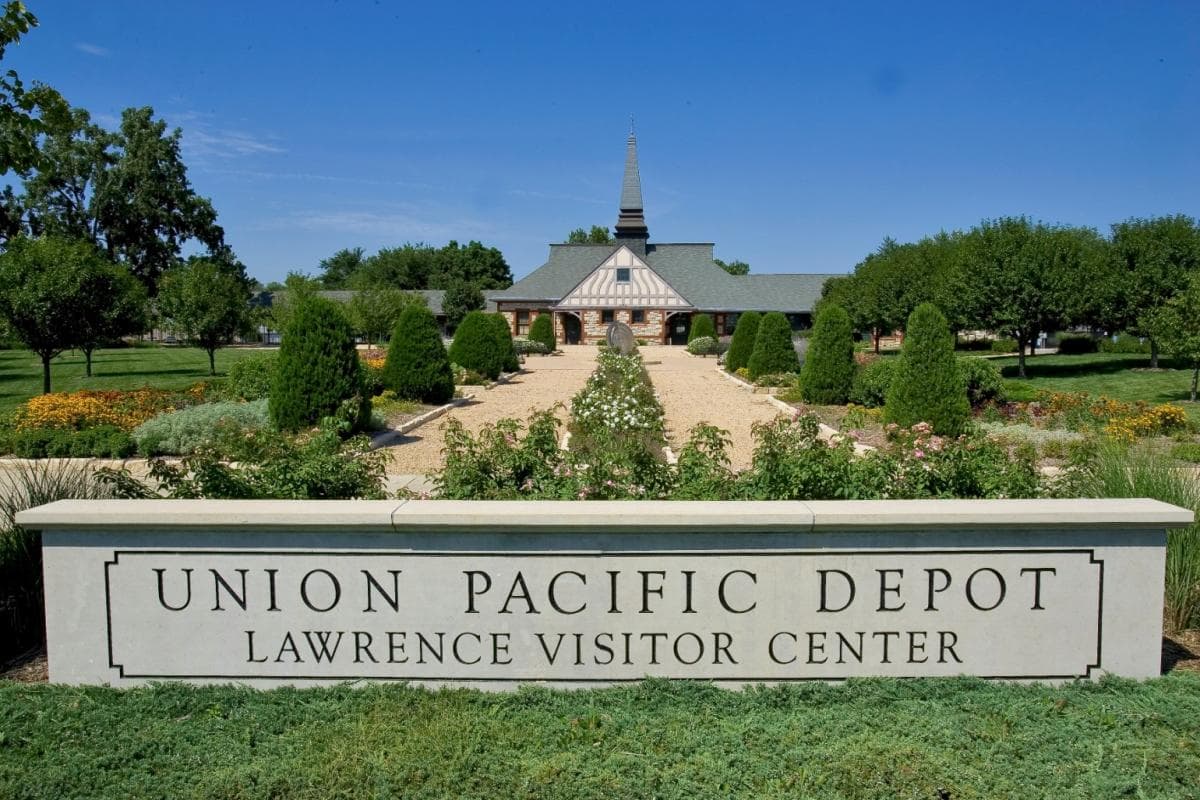
At 402 N. 2nd Street, the old Lawrence Union Pacific Depot anchors the loop with one of the county’s clearest preservation stories. Built in 1888-1889 of Johnson City limestone, pressed brick and Colorado red stone, and designed by Henry Van Brunt, the depot outlasted its original function because local preservation advocates refused to let it disappear after passenger service ended in 1971 and freight use continued until 1984.
The building’s civic life changed in 1991, when the Union Pacific Railroad deeded it to the City of Lawrence after the Save the Depot Task Force helped push preservation forward. Restored and reopened as the Lawrence Visitor Center in 1996, it now serves as a reminder that historic buildings can still generate foot traffic, orientation and civic pride, not just nostalgia. The awning and spire were reconstructed, which matters because the depot is as much a statement about community persistence as it is about 19th-century rail design.
Douglas County’s own heritage framing makes sense of that stop immediately. The county story stretches from Native American presence before U.S. settlement to the Oregon and Santa Fe trails, Bleeding Kansas, the growth of higher education and later preservation efforts. The Lawrence depot sits right at that intersection, turning transportation history into a present-day gateway for visitors moving between downtown, campus and the rest of the county.
Baldwin City’s Old Castle ties higher education to the territorial era
In Baldwin City, the loop shifts from rail and preservation to the county’s academic origins. Old Castle Museum at 513 5th Street opens Saturdays and Sundays from 1 to 4 p.m., and the site is built around a three-story limestone structure that began in 1858 as Kansas’ first four-year university building. Baker University opened in November 1858, making it the first university in Kansas, and Old Castle Hall was its first building.
That timing matters because it places the site in the same territorial world that produced much of Douglas County’s early turbulence and ambition. Old Castle Hall was used for classes until 1871, later restored in the 1950s, and added to the National Register in 1971. Inside the museum, the collection ties together early Kansas, Methodist history and Baker history, so the stop works both as a campus landmark and as a place where statehood-era education can still be read in the stone.
The museum complex also broadens the story beyond one building. Baker’s history notes that Blood’s Grocery, which stood in Palmyra from 1857 to 1862 and served as the town’s post office, was moved to the present site and opened as part of the museum in 1976. That detail gives the Baldwin City stop a practical edge: it shows how ordinary commercial and civic spaces were preserved alongside university history, so the county’s past is not reduced to one institution or one founder.
Vinland’s library proves the county’s history was built locally, not only nationally
Vinland adds a quieter stop with a powerful local lesson. Coal Creek Library at 698 E. 1719 Road is believed to be the oldest continuously operating library in Kansas, and the Coal Creek Library Association was founded in 1859. Before the dedicated building went up in 1900, the books were first kept in local homes, which tells you a great deal about how much of Douglas County’s civic life depended on volunteer effort and steady community support.
That history gives the site more than sentimental value. It shows that rural institutions in Douglas County were often built by neighbors who wanted durable access to books, meetings and shared learning long before those things were easy to provide. In a county that still leans on education, public history and neighborhood identity, Coal Creek Library is a reminder that some of the oldest local infrastructure was never a courthouse or a rail line. It was a roomful of books and the people who kept them moving.
The western trail remnant makes migration history visible
To finish the loop, head to the Oregon and California Trail segment protected by First United Methodist Church on U.S. 40 in the Lawrence vicinity. The National Park Service places the period of significance from 1840 to 1860, and the segment survives in a pasture south of the old highway, one of the reasons it remains so striking. So many intact pieces elsewhere were destroyed by cultivation and development that even a short surviving stretch changes how the trail era feels on the ground.
The county’s tourism history notes that this corridor once carried more than 400,000 pioneers from 1840 to 1860. That number gives the landscape its weight: the remnant is not just a preserved strip of land, but part of a migration network that helped define western settlement. At this stop, Douglas County’s trail story becomes physical again, not just something recorded in a book or museum case.
Haskell gives the loop its living present tense
A final Lawrence stop ties the county’s history to the present. Haskell Indian Nations University began in 1884 with 22 American Indian students, and enrollment grew to more than 308 by the end of that same year. Today the university serves Alaska Native and American Indian students and averages about 1,000 students per semester, which makes it one of the county’s most important living institutions.
Haskell also gives the loop its necessary moral dimension. The university identifies 1839 as the start of the federal boarding school policy and notes that the early years were traumatic for children and families. That history belongs in the same county story as the trails, the depot and Old Castle because it shows that Douglas County’s past is not only about preservation and progress. It is also about the policies and institutions that shaped Native lives, and the community that now carries that history in public view.
Douglas County’s history works as a loop because the pieces still do something. The Douglas County Historical Society, founded in 1933, and the Watkins Museum of History, operated by the society since 1975, have helped build the interpretive backbone for that story, but the places themselves do the most persuasive work. A restored depot, a first university building, a volunteer-built library, a surviving trail remnant and a university still serving Native students show how Lawrence, Baldwin City and Vinland remain linked by more than memory.
This article was produced by Prism’s automated news system from verified source data, official records, and press releases, then run through automated quality and moderation checks before publishing. The system is built and supervised by the people who set the standards it runs under. Read our full AI policy.
Did this article answer your question?