Lawrence downtown art exhibition ties public works to the World Cup
Lawrence is turning its World Cup art walk into a downtown traffic play, with six pieces, storefront stops and guided tours designed to keep visitors on Massachusetts Street.
A World Cup route built for downtown
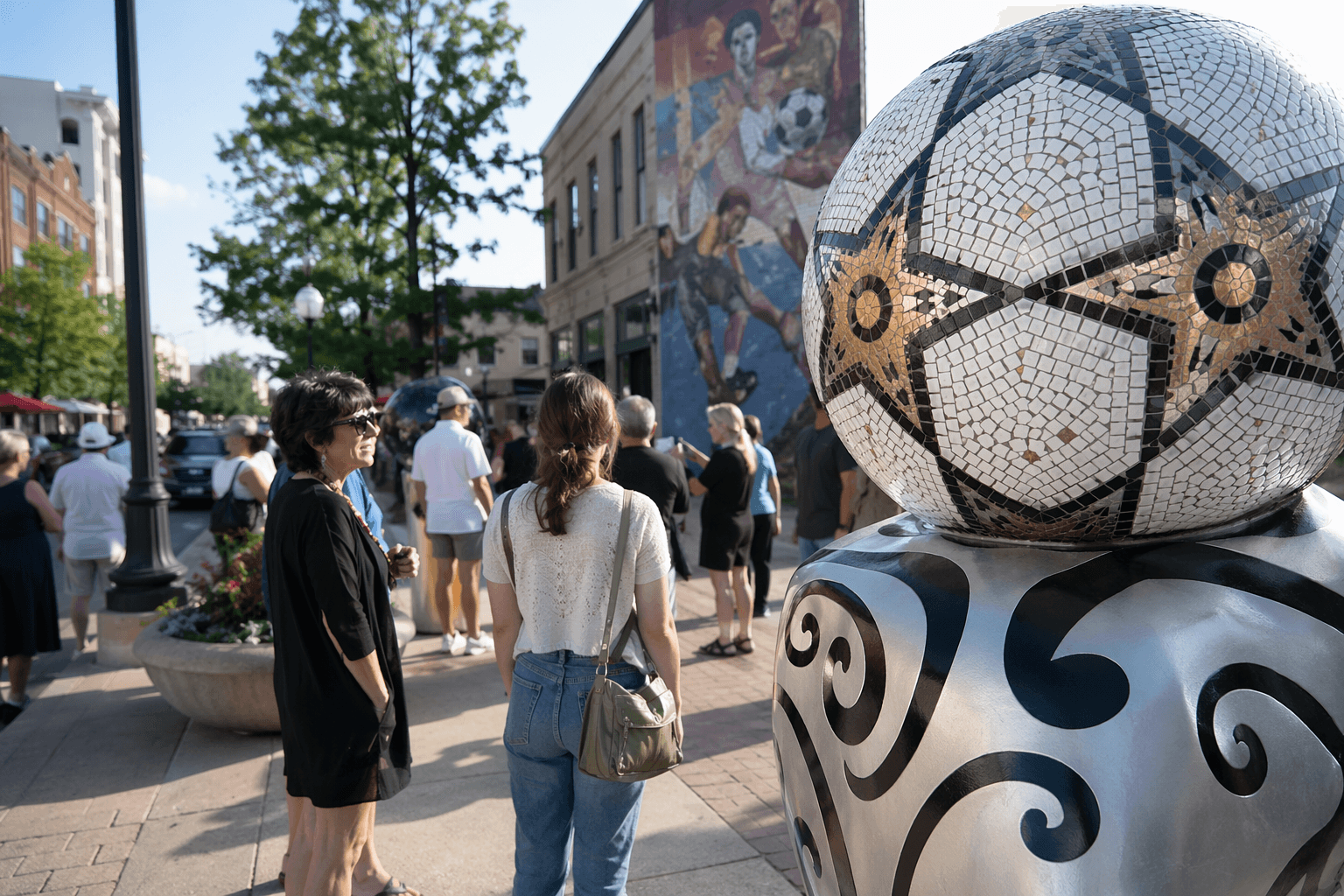
Downtown Lawrence is using the 2026 World Cup to turn public art into a foot-traffic strategy. The City of Lawrence and the Cultural Arts Commission have spread six World Cup-themed works across Massachusetts Street and nearby blocks, giving visitors a reason to move between the library plaza, storefront windows, City Hall and local shops instead of treating downtown as a quick pass-through.
The city is pairing the exhibition with two walking tours, one tied to an opening reception on Friday, June 5, and another on Final Friday, June 29. Both tours begin at 5:30 p.m. at 9th and Massachusetts, and the full exhibition can also be explored through the Otocast mobile app. For downtown merchants, the setup is less about a static art display than a curated loop that can draw people past storefronts, linger them on the sidewalks and turn a World Cup buzz into real visits.
What is on display and where to find it
The 2026 Unmistakable Public Art Exhibition uses the World Cup theme to scatter art across the core of Lawrence in a way that is easy to walk and shop. The city selected six artists or artist teams, and each one is placed in a spot that fits into an ordinary downtown outing.
Here is the route the city has built:
- Randall Warren’s Fútbol 50 v 50 is a painted steel sculpture at the Lawrence Public Library plaza, 707 Vermont St.
- Nathaniel Pierce’s Gestura sits at the southwest corner of 7th and Massachusetts streets. The piece is a stainless steel and acrylic sculpture, which gives it a different material presence from the others in the series.
- Alicia Kelly has two window works downtown, Close Up at 812 Massachusetts St. and Six Sides of Connection at The Roost, 920 Massachusetts St. Both are cut window graphics, which means they bring the exhibition directly into places people already stop to eat, shop or wait.
- Javy Ortiz’s FRGMNTS {WRLD CP 26} is installed on the east side of Massachusetts between 8th and 9th streets. Its panel format makes it one of the clearest block-to-block markers in the exhibit.
- The wearable public art by Tim Hossler and Lizzy Arnold, Lawrence United F.C., is being shown at Wonder Fair, 841 Massachusetts St., and Sunflower Outdoor & Bike Shop, 804 Massachusetts St. That choice pushes the exhibition into two independent businesses that already draw regular downtown traffic.
- Gary Mark Smith’s Soka Kila Mahali/Soccer Everywhere is a banner at Lawrence City Hall. The city’s exhibition page lists it through July, while a city news post says it will come down in August after World Cup festivities conclude.
That mix of sculpture, graphics, banners and wearable pieces matters because it makes the exhibition feel less like a single stop and more like a string of commercial and civic anchors. Someone can start at the library plaza, move south along Massachusetts, pause at The Roost or Wonder Fair, and end at City Hall without leaving the retail corridor that downtown depends on.
Why the city is betting on this now
The exhibition is not a one-off marketing stunt. The public art program dates to 1988, when it began as the Outdoor Downtown Sculpture Exhibition, and the city renamed it the Unmistakable Public Art Exhibition in 2025 to reflect a wider range of media beyond sculpture. The city says public art is part of Lawrence’s “Unmistakable Identity,” which is a civic-branding message as much as an arts statement.
The World Cup connection gives that branding push a sharper economic purpose. In its 2026 call for artists, the city described the tournament as a “once-in-a-generation moment” and said Lawrence is co-hosting the 2026 World Cup in June and early July. Selected works are intended to speak to beauty, passion, culture and community around soccer and fútbol, while also reflecting themes like identity, resilience and global unity.
There is also money built into the program. Each selected work received a $3,500 stipend, which signals that the city is treating the exhibition as commissioned civic infrastructure, not decorative filler. The city says the exterior works will remain on display from May 2026 through May 2027, so the World Cup effect is designed to last long after the tournament’s first Kansas City matches are over.
How the World Cup schedule raises the stakes
Lawrence is not hosting World Cup matches itself, but it is close enough to Kansas City to feel the spillover. FIFA lists Kansas City as a host city for nine games, including group-stage matches on June 17, June 21, June 25 and June 28, along with a Round of 32 match on July 4 and a quarterfinal on July 12. Visit KC says the full FIFA World Cup 2026 runs from June 11 to July 19, 2026, and that Kansas City’s official FIFA Fan Festival will be a free, 18-day celebration with live match broadcasts and performances.
That regional schedule matters for Douglas County because Lawrence sits in the tourism orbit of the event. The city’s downtown art walk gives visitors who may be in the area for matches or fan-festival activity a reason to extend their trip west to Lawrence, and downtown businesses get a chance to benefit from people who come for the World Cup atmosphere but stay for lunch, shopping or a second stop.
What this means for a downtown visit
The most practical way to experience the exhibition is as a walkable circuit. The June 5 opening reception and walking tour, and the June 29 Final Friday walking tour, both start at 5:30 p.m. at 9th and Massachusetts, which places the route squarely in the heart of downtown. From there, the exhibition threads through the blocks that already define Lawrence’s retail identity, including the Lawrence Public Library plaza, The Roost, Wonder Fair, Sunflower Outdoor & Bike Shop and City Hall.
That design is the point. Instead of treating the World Cup as something happening somewhere else, Lawrence is using it to make downtown itself feel like part of the event, with public art doing the work of wayfinding, branding and shopper retention at the same time. If the plan works, the legacy will not just be six art pieces on Massachusetts Street, but a stronger argument that civic art can also be economic development.
This article was produced by Prism’s automated news system from verified source data, official records, and press releases, then run through automated quality and moderation checks before publishing. The system is built and supervised by the people who set the standards it runs under. Read our full AI policy.
Know something we missed? Have a correction or additional information?
Submit a Tip