LMH Parkinson’s fitness class builds strength, support, and hope
At Sports Pavilion Lawrence, Roy James says Parkinson’s class feels like a “quasi-family,” turning exercise into strength, support, and a practical local lifeline.
A class built around movement and belonging
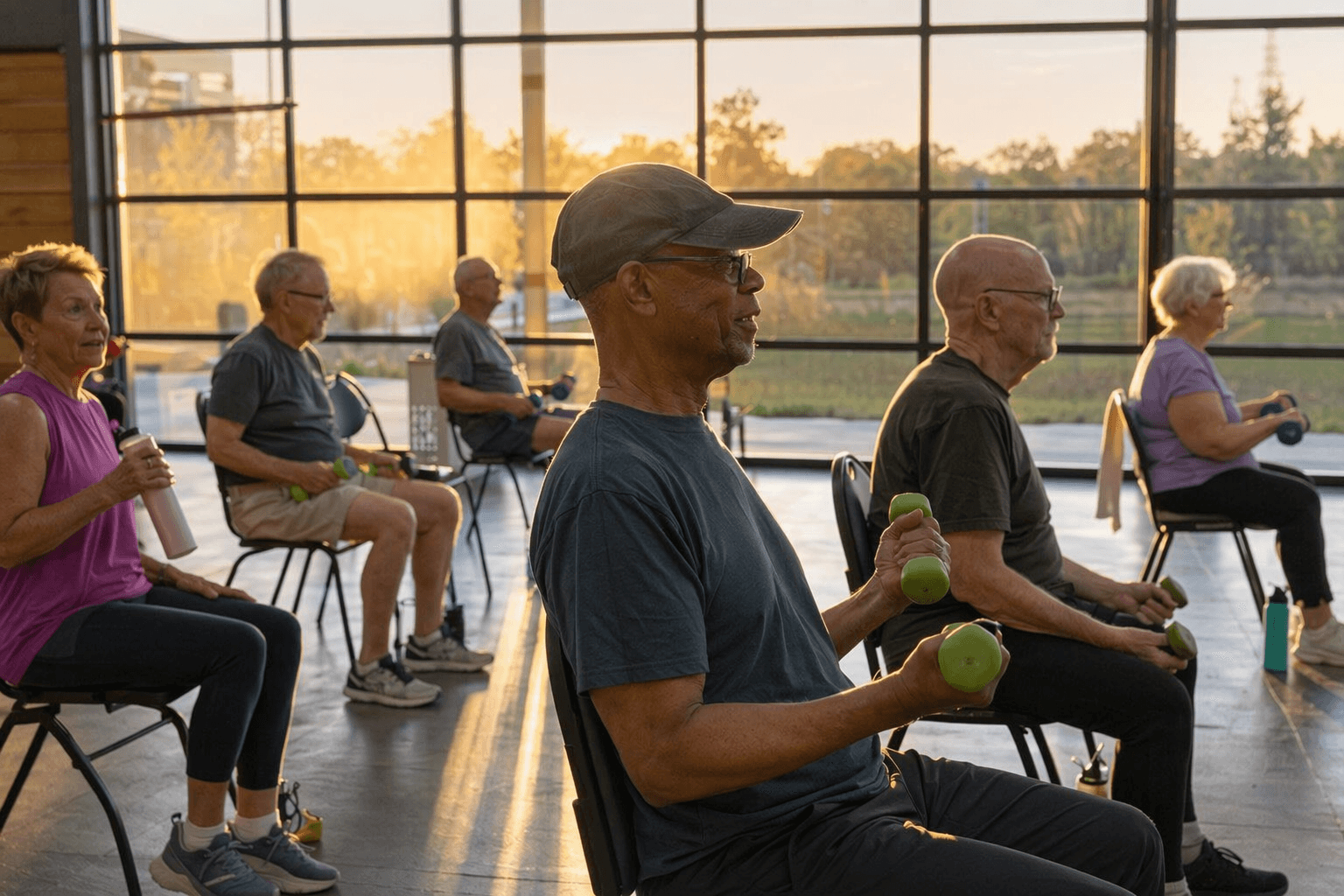
Roy James does not talk about LMH Health’s Parkinson’s Fitness and Wellness class like a routine workout. He calls the group a “quasi-family,” a description that captures what the class has become for people living with Parkinson’s disease in Lawrence: a place to move, to be understood, and to stay connected.
That matters because Parkinson’s can be deeply isolating. At Sports Pavilion Lawrence, the class begins with an emotional check-in before stretching and exercise, a small but meaningful signal that the program treats mood, self-perception, and daily resilience as part of the disease, not side issues. The workouts are structured, but they are also social, giving participants a space where the people around them know the same challenges.
Why exercise is part of treatment, not a bonus
The class is built on a simple idea with serious medical backing: movement helps. The Parkinson’s Foundation says exercise is a vital part of Parkinson’s management and that consistent exercise of at least 2.5 hours a week can help maintain balance, mobility, flexibility and overall quality of life. The foundation also says exercise may slow symptom progression and improve physical and emotional well-being.
That science matters in Douglas County because the condition is not rare. More than 1.1 million people in the United States live with Parkinson’s disease, nearly 90,000 are diagnosed each year, and annual U.S. healthcare costs tied to the disease are nearing $82.2 billion. The Parkinson’s Foundation says Parkinson’s is the second-most common neurodegenerative disease after Alzheimer’s, and men are 1.5 times more likely to have it than women.
Against that backdrop, a community class in Lawrence is doing more than filling a schedule. It is offering a way to protect independence, preserve routines and keep people engaged in everyday life.
Inside the LMH approach at Sports Pavilion Lawrence
Suzie Craig oversees the LMH Health class and brings deep experience to it. LMH Health says she has spent 30 years in physical therapy, 10 of those years focused on Parkinson’s, and four years teaching Parkinson’s-specific exercise classes. She is one of four PWR!-certified trainers involved in the program, along with physical therapists Renee Rettele and Carol Steele and exercise physiologist Susie Wilson.
The class is held at Sports Pavilion Lawrence, the city recreation center at 100 Rock Chalk Ln. in Lawrence. That setting matters. The facility includes a walking and running track, fitness rooms and indoor turf, which makes it a natural fit for a program that blends guided exercise with room to move, practice and adapt. It is a public place with the feel of a neighborhood gathering spot, not a clinical wing.
The structure also reflects how Parkinson’s-specific exercise is supposed to work. The class uses the Parkinson Wellness Recovery, or PWR!, approach, which centers on high-amplitude, functional movement. PWR! says its Basic 4 PWR!Moves are core Parkinson’s-specific exercises designed to target the skills that deteriorate with the disease, and that they can be adapted for group exercise, daily activities, recreation, sports and hobbies.
That last part is important. The class can sound, at a glance, like an ordinary sports program. Baseball even appears in the routine. But the goal is not recreation for its own sake. Participants are using movement as a therapeutic tool, with every reach, step and repetition aimed at helping them function better in daily life.
What the class gives people beyond fitness
For people with Parkinson’s, the emotional gains can be as significant as the physical ones. Craig says misconceptions still linger, including the idea that people with Parkinson’s cannot improve or that wellness options are out of reach. The class is designed to push back against that thinking by showing that progress is possible and that support does not have to come only from a prescription or a clinic visit.
The emotional check-in at the start of class reflects that broader view of care. Parkinson’s affects how people move, but it also affects confidence, outlook and isolation. A program like this gives participants a reason to show up consistently, which can help anchor the week and make life feel more manageable. In that way, the class supports independence not just by building strength, but by helping people stay connected to their routines and to one another.
Roy James’ description of the group as a “quasi-family” gets to the heart of it. The disease can narrow a person’s world. A class that offers movement, understanding and shared experience can widen it again.
A local resource families can actually use
April is Parkinson’s Awareness Month, which makes the timing of this program especially relevant for Douglas County families looking for support. The practical takeaway is that Lawrence already has a local network built around community-based care, not just medical appointments.
Families can look to two key resources:
- LMH Health’s Parkinson’s Fitness and Wellness class at Sports Pavilion Lawrence, where participants work with trained staff in a structured setting.
- The Lawrence Parkinson’s Support Group, which meets monthly at First Presbyterian Church and offers support, information and socialization for people with Parkinson’s and their families.
That combination matters. One piece focuses on movement and function; the other offers conversation, information and emotional support. Together, they show how care can extend into ordinary life, where independence is preserved one routine at a time.
Craig is also helping spread that model beyond the class itself. LMH Health says she is hosting a two-and-a-half-hour workshop this month for physical therapists, a sign that the impact may reach other providers who work with Parkinson’s patients across the region.
In Lawrence, the lesson is clear. A well-run exercise class can be more than a fitness offering. At Sports Pavilion Lawrence, it becomes part of a support system that helps people with Parkinson’s stay active, stay connected and keep living with as much steadiness as possible.
This article was produced by Prism’s automated news system from verified source data, official records, and press releases, then run through automated quality and moderation checks before publishing. The system is built and supervised by the people who set the standards it runs under. Read our full AI policy.
Did this article answer your question?