Watkins Museum tour brings revolutionary-era stories to Oak Hill Cemetery
Oak Hill Cemetery’s sold-out Watkins Museum tour traced Lawrence graves back to the Revolutionary era, from soldiers and freedom seekers to pioneer women.
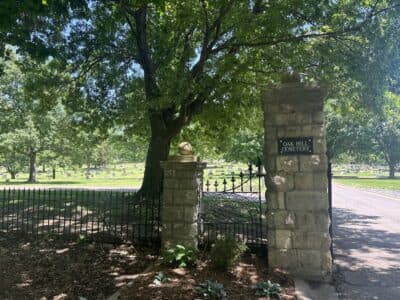
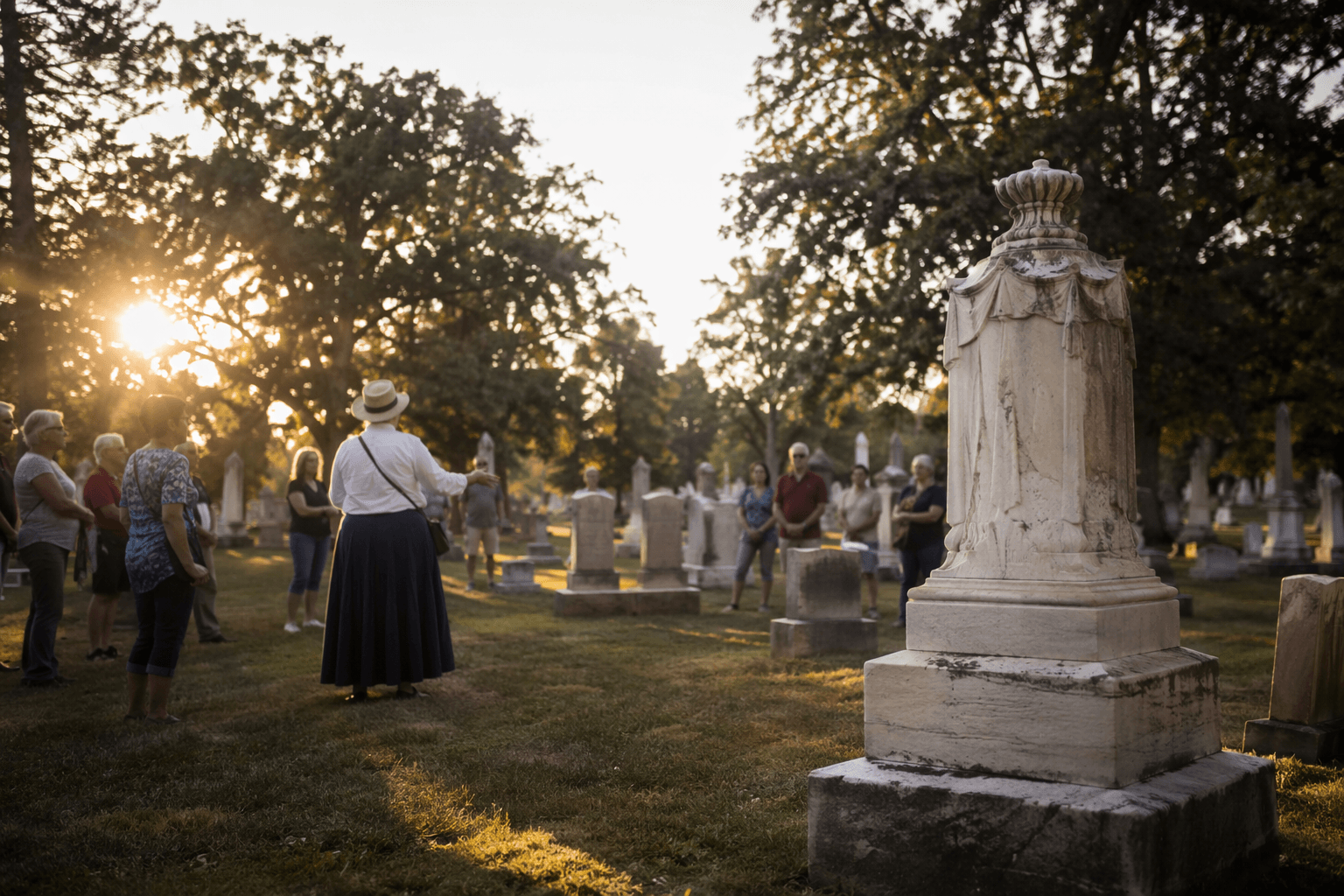
Oak Hill Cemetery drew a different kind of crowd for a one-hour walk that sold out before it began: visitors looking for the Revolutionary-era lives hidden among Lawrence’s best-known graves. The Watkins Museum’s Revolutionary People of Oak Hill Cemetery tour met at Old Section 5 in the southeast corner of the cemetery and ran from 6 to 7 p.m., turning a familiar east Lawrence landmark into a link between Douglas County and the nation’s founding generation.
The tour was part of America at 250, a yearlong Lawrence commemoration organized by the Watkins Museum of History, the Robert J. Dole Institute of Politics, Freedom’s Frontier National Heritage Area and the Lawrence Arts Center. The program is built around the upcoming 250th anniversary of the Declaration of Independence, but this walk pushed that history into a very local frame, using Oak Hill to show how people born in the late 1700s later became part of Lawrence’s story.
Watkins said the tour highlighted people who were born in the revolutionary era and grew up with the young American republic before settling in Lawrence. The walk was designed to introduce soldiers, freedom seekers, pioneer women and others buried in Oak Hill, a reminder that the city’s historical record does not begin in the 1850s with Kansas settlement. Some of the most consequential national stories are sitting in plain view on a hillside cemetery on the east edge of town.
Oak Hill itself carries that layered history. The city purchased land for the cemetery in 1865, in part to memorialize victims of Quantrill’s Raid. County surveyor and later city engineer Holland Wheeler laid out the first plat in 1868, and the grounds were expanded in 1886 and 1918 while keeping the rural cemetery design. Spanning about 60 acres, Oak Hill has long been treated as one of Lawrence’s richest historic landscapes, with William Allen White calling it the “Arlington of the West.”
The cemetery has also become a center for preservation work rather than just memory. In 2022, the Douglas County Historical Society joined with Friends of Oak Hill Cemetery to create the Oak Hill Cemetery Committee, which has backed cleanup efforts, headstone preservation and other tours. Watkins said in February 2026 that headstone cleanings were suspended while the group looked for more volunteers.
That broader effort has also reached Oak Hill’s potter’s field, which was used from 1866 to 1917 and holds the graves of marginalized residents, including immigrants, African Americans, the poor, the indigent and unbaptized infants. A Kansas Geological Survey project with the Oak Hill Cemetery Program Committee and Watkins worked to identify unmarked graves there, surveying about an acre with 18 community volunteers and support from a $13,000 Douglas County Heritage Conservation Council grant and a $10,000 Humanities Kansas grant.
For Lawrence, the sold-out walk was more than a seasonal program. It showed how Oak Hill still ties the city’s everyday landscape to the earliest decades of the United States, and how a cemetery walk can reveal that local history runs deeper than the town itself.
This article was produced by Prism’s automated news system from verified source data, official records, and press releases, then run through automated quality and moderation checks before publishing. The system is built and supervised by the people who set the standards it runs under. Read our full AI policy.
Did this article answer your question?