Dubois County Clerk explains ballot tracking, no early vote tallies before Election Day
Dubois County voters are being told plainly: mail ballots are tracked, but nothing is tallied before Election Day, and the 6 p.m. deadline still rules.
What the clerk is clarifying
Dubois County voters do not need to guess when ballots are counted or how they are protected. The clerk’s office stepped in to clear up two common misconceptions: that early voting produces early results, and that mailed ballots move through the system without a clear record. The office’s message is simple, and it matters in a county where election rumors can spread faster than the official count.
No votes are tallied before Election Day. That means there are no early results to read into, no hidden totals being assembled in the background, and no final numbers waiting to be released ahead of time. The process is designed to keep every ballot in view until the proper counting begins.
How absentee-by-mail voting works
Dubois County does allow absentee-by-mail voting, but only for voters who meet specific eligibility rules. That includes people who expect to be outside the county on Election Day, voters with disabilities, residents age 65 or older, military members, some public-safety officers, people working the entire day, some voters with illness or injury, people without transportation to the polls, certain sex offenders, and participants in the state’s address confidentiality program.
That narrow list is important because absentee voting is not a casual alternative to showing up at the polls. It is a defined path for voters who qualify under Indiana law and county guidance. Once a ballot is requested, the system is supposed to create a paper trail, so election officials can follow the ballot from application to delivery and processing.
That tracking is the heart of the county’s reassurance. The point is not just that a ballot exists, but that it can be accounted for at each step. In election administration, that chain-of-custody is what prevents ballots from becoming loose paperwork or easy targets for doubt.
Ballot tracking is built into the process
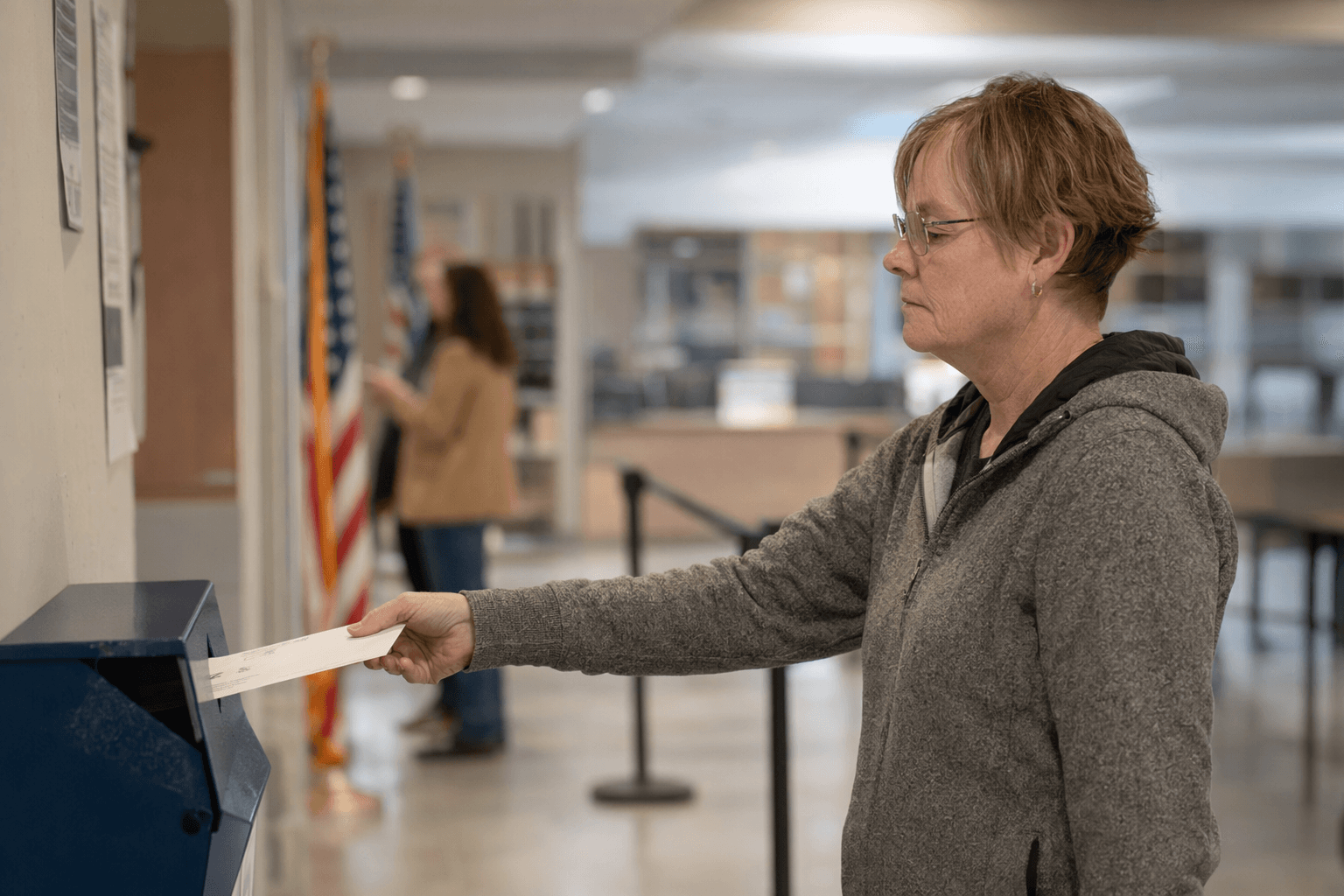
The clerk’s clarification puts a spotlight on the mechanics behind the scenes. Mail-in ballots are not simply dropped into a box and forgotten. They are tracked through the process so election officials can see where they came from, when they were issued, and how they move toward counting.
That kind of accounting is especially important when people hear political chatter about “missing” ballots or imagined early totals. In Dubois County, the office is signaling that the system is designed to answer those concerns with procedure, not speculation. Every stage is supposed to leave a record.
Indiana election officials also say absentee and early-voting ballots are not counted until Election Day. That timing is part of the guardrail. Even if a voter submits a ballot early, the count does not begin early.
Timing is not a footnote, it is the rule
One detail carries outsized weight: absentee ballots must be received by 6 p.m. on Election Day to be counted. That deadline is what separates a valid ballot from one that arrives too late.
For voters, that means the calendar matters as much as the signature or the envelope. A ballot that is mailed but not received by the cutoff can miss the count entirely. That is why the timing question is not bureaucratic trivia, it is the difference between a vote being included or left out.
The May 5, 2026 Indiana primary adds another layer of urgency. The ballot includes nominations for statewide offices such as secretary of state, comptroller, and treasurer, along with U.S. House, state legislative, and several county offices. In a contest like that, timing, eligibility, and ballot handling are not abstract topics. They decide whether local and statewide choices are recorded on time.
Who runs the election system in Dubois County
Amy L. Kippenbrock is the current Dubois County clerk, and the office she leads sits at the center of the county’s election machinery. The clerk serves as a member and secretary of the Dubois County Election Board, which conducts elections and oversees election administration. The office is also responsible for certifying results.
That role matters because the clerk’s office is not standing off to the side while other agencies do the work. It is part of the structure that organizes the election, keeps the records, and helps certify the outcome. In practical terms, the same office that explains the rules is also helping enforce them.
A 2024 public-radio report quoted Kippenbrock describing election procedures that include layered protections, ballot accounting, and machine testing before Election Day. That is the kind of detail voters often do not see, but it is central to how the county says its elections are run.
Security is procedural, not theatrical
Election security in Dubois County relies on routine safeguards. County clerks in Indiana describe bipartisan election-worker teams, testing of voting equipment, and careful accounting for each ballot as standard parts of the process. Those steps are not flashy, but they are the backbone of public confidence.
Bipartisan teams help reduce the risk that any one side controls the handling of ballots or equipment. Machine testing before Election Day helps make sure the equipment works as intended before the first vote is cast. Ballot accounting helps confirm that the number of ballots issued, returned, and counted can be matched against the records.
That is what the clerk’s clarification is really about. It is not trying to sell voters on trust by slogan. It is pointing to the structure that makes trust possible.
What voters in Dubois County should take from this
The plain-English takeaway is that ballots are handled in stages, not in secret, and not on impulse. If a voter uses absentee-by-mail, the ballot is supposed to be tracked, monitored, and processed under rules that require it to arrive by 6 p.m. on Election Day if it is going to count. If a voter hears talk about early results, the official answer is that none should exist before Election Day because the votes are not tallied until then.
That is especially important in a county where election administration is part of everyday civic infrastructure. The clerk’s office handles records, the election board oversees the process, and election workers use checks built into Indiana’s system. In a season crowded with noise, the county’s message is a grounded one: the ballots are watched, the deadlines are real, and the count begins only when it is supposed to.
This article was produced by Prism’s automated news system from verified source data, official records, and press releases, then run through automated quality and moderation checks before publishing. The system is built and supervised by the people who set the standards it runs under. Read our full AI policy.
Did this article answer your question?