Dubois County residents press commissioners on solar project concerns
Neighbors pressed Dubois County commissioners over Duff Solar Phase 2, asking what it adds for locals as setbacks, road access and land-use rules remain unsettled.

Dubois County residents again pressed commissioners at their June 16 meeting over the next phase of the Duff Solar project, saying the county needs clearer rules before more private farmland is converted to an industrial-scale solar field. The biggest questions now are what happens to nearby landowners, road use and fire response, and how much oversight the county can still exert.
Barb Hopf, speaking for neighbors who did not want to appear publicly, asked what benefit the solar parks provide to Dubois County as a whole. Residents also raised concerns about fire safety, road closures and the lack of independent county oversight. Commissioner Chad Blessinger said his role was not to declare the projects good or bad, only to note that they had met the legal requirements to operate in the community. Nick Hostetter said the state will not let the county ban solar power, while Serice Stenftenagel stressed that the projects are on private property.
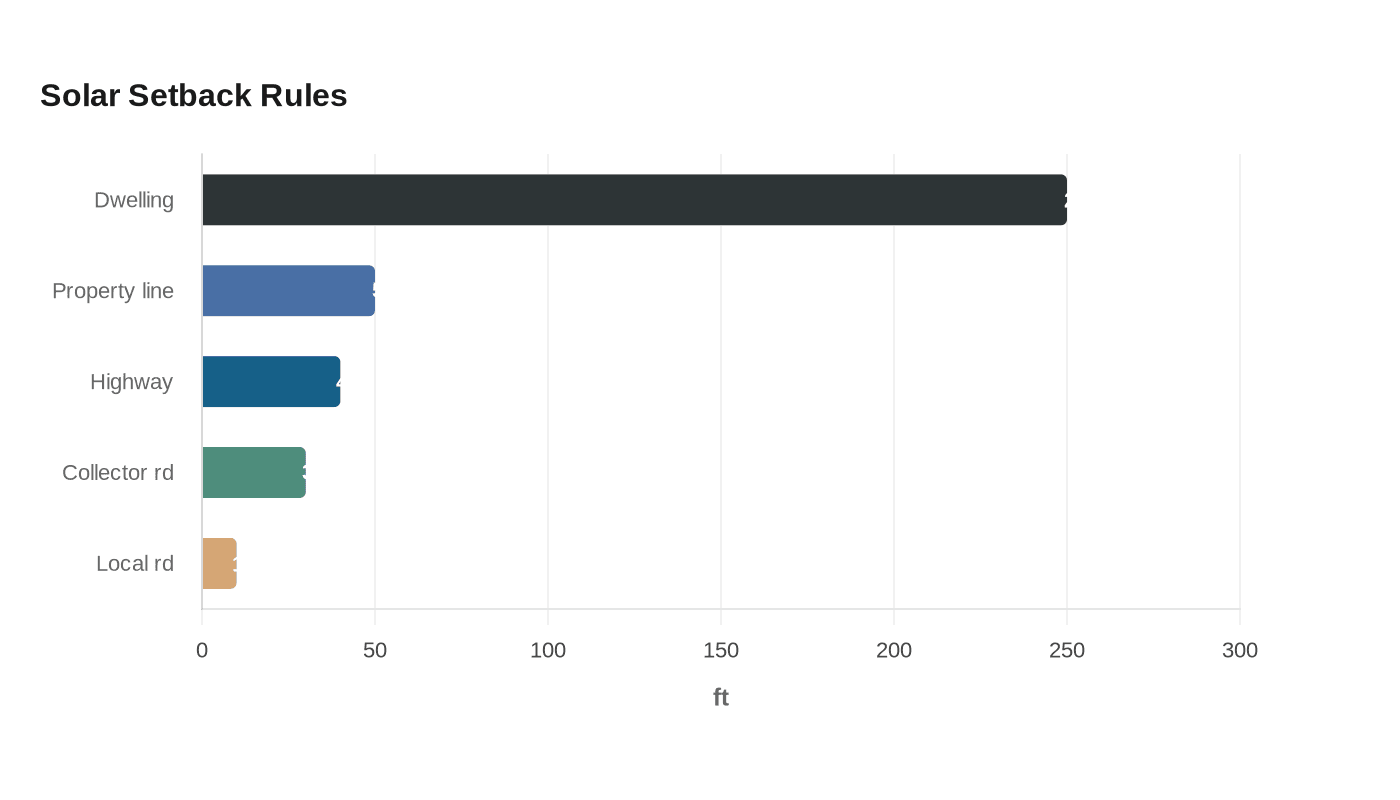
The county’s current solar rules come from Ordinance No. 2022-12, adopted July 5, 2022. Under those standards, commercial solar systems must sit 250 feet from a dwelling on nonparticipating property, 50 feet from a nonparticipating property line, 40 feet from highways, 30 feet from collector roads and 10 feet from local roads. County permit materials reference that ordinance and tell applicants to measure setbacks from all sides of the proposed improvements. Indiana’s state default solar law sets the same minimum dwelling and property-line setbacks, which helps explain why commissioners say they have limited room to impose much tighter rules.

Hopf pushed back by comparing Dubois County’s standards with Daviess County’s 2,500-foot setback rule. Hostetter said a setback that large would likely not survive legal challenge because it would be too restrictive.
That tension surfaced in January, when commissioners paused Duff Solar Phase 2 while they reviewed possible new ordinances. The proposed expansion would run north of the railroad tracks along County Road 600 West toward the Patoka River access near Division Road, and officials were also looking at what they can regulate about solar and battery storage. At the time, commissioners said they had "no appetite" to approve anything new until the county finished its review.
EDP Renewables has kept the project moving. In May, the company said Duff Solar, a 100-megawatt project west of Huntingburg, remained on track for commercial operation by September 2026. EDP said the substation was fully energized, pile driving was nearing completion despite underground problems tied to the area’s coal-mining history, racking installation was about 60% complete and panel installation was about 17% complete. The company says the project carries more than $150 million in capital investment, more than $30 million in payments to landowners, about $8 million in payments to local governments, 500 construction jobs and two permanent jobs.
EDP has also said a possible second 100-megawatt project in the same area is being discussed for 2029, with leases secured on about 70% of the needed land. As Dubois County works through a comprehensive plan meant to guide growth for the next 8 to 10 years, the Duff Solar fight is forcing a harder question: whether the county’s rules are keeping pace with the scale of development already headed its way.
This article was produced by Prism’s automated news system from verified source data, official records, and press releases, then run through automated quality and moderation checks before publishing. The system is built and supervised by the people who set the standards it runs under. Read our full AI policy.
Did this article answer your question?