Public comment period opens for Mid-States Corridor in Dubois County
Dubois County residents have until July 1 to weigh in on the Mid-States Corridor. The federal review now centers on the I-64 to SR 56 section, where access, property and business impacts are still being shaped.
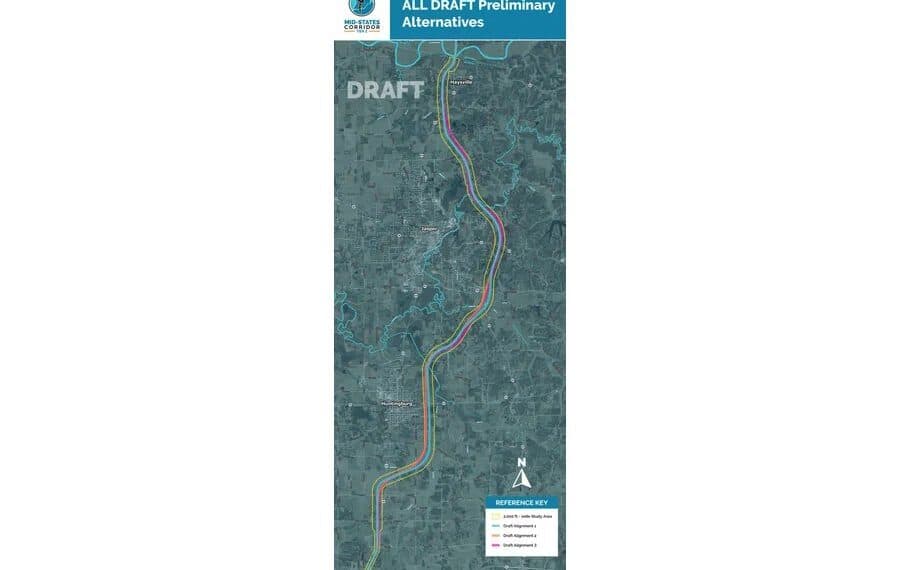
Dubois County residents have a short window to shape the next stage of the Mid-States Corridor before the July 1 deadline closes. The Federal Highway Administration has opened a 30-day comment period for the project’s Section 2 study, covering the proposed new highway connection between Interstate 64 at Dale and State Road 56 in Haysville. That makes this one of the few points in the process where people in Jasper, Huntingburg and across the county can put concerns directly on the record.
What the federal notice covers
The current review is a Tier 2 Environmental Impact Statement for Section 2 of the corridor. The federal notice says comments on the notice itself or on the accompanying project information document must be received by July 1, 2026. For Dubois County, the stakes are practical and immediate: this is the stretch that could influence property access, traffic patterns, business entrances and long-term land values along the route under study.
This Tier 2 work builds on the Tier 1 Final Environmental Impact Statement and Record of Decision completed in September 2023. That earlier federal and state decision selected Refined Preferred Alternative P and divided the larger corridor into sections of independent utility, allowing each segment to move through later study on its own timeline.
Why local property and access questions still matter
The corridor is no longer just an abstract route on a map. The Mid-States Corridor team says detailed engineering and environmental studies have been underway since the fall 2025 Screening of Alternatives Report, and the project website says six locations still have access or alignment variations under consideration. That means the shape of the road, and how people reach homes, farms, shops and industrial sites near it, is still in motion.
Right-of-way planning is already part of the picture. Indiana Department of Transportation procurement records show a consultant was selected in 2025 for right-of-way plan review and land acquisition services for Section 2. For residents, that is a clear sign that land questions are not theoretical. Even before a final design, corridor decisions can affect driveway access, parcel boundaries, farm operations, business visibility and whether property sits closer to, farther from or cut off from the new road.
What has already been studied
The project’s current direction did not appear overnight. The screening report says the project team presented six alternatives at a public meeting in April 2025. After further review, Alternatives 2B and 3B were carried forward for more detailed analysis in the fall 2025 Screening of Alternatives Report.
The project website says a Draft Environmental Impact Statement is expected in fall 2026. That next document will matter because it should narrow the field further and show how the preferred route could affect specific locations in Dubois County. For now, the comment period is the place to flag what still needs attention, especially where a road shift could change access to a home, a farm field, a storefront or a workplace.
How to file a comment before July 1
Residents have several ways to respond, and the instructions are straightforward.
1. Go to Regulations.gov and search docket FHWA-2026-0562.
2. Click the Comment button.
3. Complete the submission steps and include the docket number in your message.
Comments can also be mailed or hand delivered to the Mid-States Corridor Project Office at the Vincennes University Jasper Campus Administration Building, Room 216, 850 College Avenue, Jasper. They may also be sent directly to Erica Tait, the interim deputy division administrator for the Federal Highway Administration Indiana Division.
If you are commenting, be specific. The most useful responses describe exactly where you live, work, farm or do business, and what part of the corridor creates concern. Road access, noise, drainage, traffic flow, nearby property use and land value are all the kinds of issues that can matter when a federal agency is deciding what to carry forward.
Why this moment is especially important in Dubois County
The Mid-States Corridor has been debated for years in Jasper, Huntingburg and across Dubois County, but this deadline gives the public a concrete way to respond while the project is still under environmental review. Recent local reporting said the Dubois County commissioners were split over the corridor in March 2026, which underlines how unsettled the issue remains even as the project advances.
That split is important because this is not just a transportation plan. It is a long-term land-use decision that could influence where traffic goes, how easily businesses are reached and how property near the corridor is valued and used. For households and employers along the I-64 to Haysville segment, the remaining access and alignment questions are the ones most likely to determine whether the final route feels like a connection, a barrier or something in between.
What to watch next
Once the July 1 comment period closes, the project will move deeper into the Tier 2 review leading toward the expected Draft Environmental Impact Statement in fall 2026. That report should give residents a clearer picture of the likely route and the specific impacts that federal and state planners believe still need to be resolved.
Until then, the public record is still open. For Dubois County, this is the moment when a federal highway study meets everyday local concerns about property, traffic, business access and the future shape of the county’s eastern and central transportation corridor.
This article was produced by Prism’s automated news system from verified source data, official records, and press releases, then run through automated quality and moderation checks before publishing. The system is built and supervised by the people who set the standards it runs under. Read our full AI policy.
Did this article answer your question?