VU Jasper symposium focuses on boosting third-grade reading proficiency
VU Jasper brought Lindsay Kemeny to campus as teachers eyed classroom changes that could lift Dubois County’s third-grade reading scores this fall.

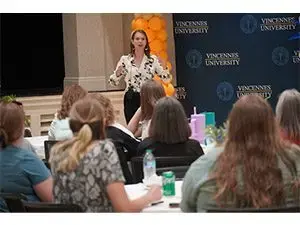
Dubois County teachers left Vincennes University Jasper with a practical assignment: turn reading research into daily classroom routines that help more children read by third grade. The June 9 Science of Reading Symposium at the Green Activities Center on the Vincennes campus put Indiana’s literacy goal at the center of the conversation, and the stakes stretch well beyond one professional development day.
The free event featured Lindsay Kemeny, a national literacy expert, author, podcast co-host and elementary school teacher. VU described the symposium as open to media, and the focus stayed squarely on what teachers can use in classrooms now, not abstract theory. That matters in a county where early reading skills shape everything that comes after, from confidence in school to long-term workforce readiness.
Indiana has set a goal of having 95% of third graders reading proficiently by 2027. The Indiana Department of Education says the state’s early literacy endorsement was created to support that target, and the urgency behind it is hard to miss: in 2023, state officials said nearly one in five third graders could not read proficiently. Indiana later reported 81.9% of third graders proficient in 2023, 82.5% in 2024 and 87.3% in 2025, or about 73,500 students statewide. More than 67,000 third graders passed IREAD in 2024, and more than 450 elementary schools reached the 95% goal in 2025.
The policy changes are now moving into classrooms. Indiana requires many new teachers seeking initial Pre-K-5 or special education licensure after June 30, 2025, to earn an early literacy endorsement. Current teachers must add the endorsement at renewal on or after July 1, 2027. The state also now requires all second graders to take IREAD and gives students five chances to pass before fourth grade, with summer school support from a science-of-reading-trained instructor for those who need it.

For local educators, that means the work this fall is likely to be more structured and more intentional: explicit reading instruction, tighter classroom routines and faster intervention when children fall behind. For Dubois County families, the payoff could show up in stronger third-grade scores, fewer students entering upper elementary years without foundational skills and a stronger academic base for the county’s future workforce.
This article was produced by Prism’s automated news system from verified source data, official records, and press releases, then run through automated quality and moderation checks before publishing. The system is built and supervised by the people who set the standards it runs under. Read our full AI policy.
Did this article answer your question?