Cumming’s historic core anchors a walk through Forsyth County history
101 School Street is more than a landmark, it ties downtown Cumming to Forsyth County’s growth, memory, and the choices shaping its future.
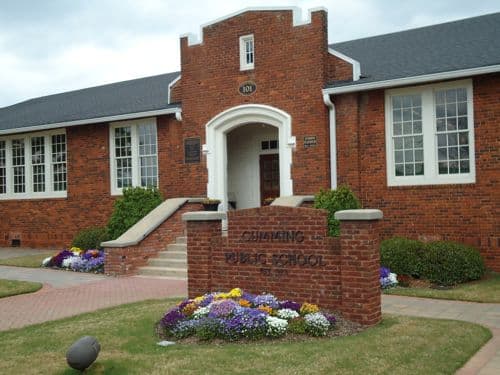
Downtown Cumming is small enough to cross on foot, but its core holds a compressed version of Forsyth County’s story. The walk from Cumming Square to 101 School Street and City Hall passes buildings that still shape daily life, from city offices and live performances to a historical society headquarters and a restaurant, which is why preservation here matters as an economic and civic decision, not just an aesthetic one.
A walkable core with countywide reach
The Historical Society of Cumming/Forsyth County places Cumming Square, the Bandstand, Cumming Cemetery, Cumming Public School, and Fowler House on the same preservation map, which makes downtown one of the clearest places to read the county’s early settlement pattern. Cumming itself was chartered in December 1834, after land had been bought in 1833 and 1834 to make it the county seat, and it was reorganized under a mayor-council charter in 1845. That early town grew as an agricultural center, but it also carried some of Forsyth County’s first retail, recreation, and civic institutions.
The broader county context explains why those blocks matter. The Federal Road drew traffic through the area, gold-mining activity linked Forsyth County to wider commercial movement, and schools such as Cumming Academy were already part of county life by 1840. Later, railroads shifted commerce elsewhere and slowed the town’s growth, leaving the downtown grid with a compact set of buildings that now serve as both memory and infrastructure.
101 School Street and the building that became a civic engine
The most important stop on that walk is Cumming Public School at 101 School Street. It was first built in 1923 to serve grades 1 through 11, and it provided Cumming’s first high school diploma. The original structure burned soon after, then was rebuilt inside the same brick walls and reopened in 1927, giving the building a layered physical history that still reads in its preserved shell.
The school later moved through several civic lives, first as a primary school, then as a middle school, and finally as headquarters for the Forsyth County Board of Education. The City of Cumming acquired the building in 1999, and the National Register of Historic Places listed it in 2000, with the nomination file dated February 18, 2000. That designation matters because the National Register is the federal program that recognizes nationally significant historic properties, and the listing placed 101 School Street inside a preservation framework that encourages reuse rather than demolition.
Restoration funded through SPLOST preserved details such as the tongue-and-groove pine flooring and the vaulted auditorium ceiling. The old auditorium was then transformed into the 184-seat Cumming Playhouse, which opened in July 2004. A historic marker followed in April 2006. Today, the building does more than commemorate a schoolhouse: it houses the Historical Society of Cumming/Forsyth County in Room 112 and Tam’s Backstage Restaurant, and the society’s space includes an historic tour of Old Cumming with photos, annuals, artifacts, and restored classrooms.
That mix of uses is why 101 School Street still matters to Forsyth County’s future. The building draws visitors for performances, dining, and local history in one stop, which is exactly the kind of layered reuse that gives a downtown more than one reason to stay busy. A civic asset that generates foot traffic after office hours, supports a restaurant, and gives residents a place to understand local history functions differently from a preserved façade kept only for appearances.
City Hall and the way downtown chose to build new civic space
A few blocks away, Cumming City Hall shows how the city extended its historic language into a new building. Completed in 2002, it was designed to reflect the general look of the courthouse that burned in the 1970s, using parapets, archways, red brick, white cast stone, and a clock tower. The city’s current courthouse was built in 1977 after the Forsyth County Courthouse burned in 1973, so City Hall’s design deliberately ties the newer civic center to the old county seat.
The first city hall was far more modest, a small building on the northeast corner of the courthouse grounds that served mainly as a police and fire station. The current building now houses the Mayor and City Council, the City Clerk, Utilities, Planning and Zoning, Human Resources, and Public Information. Inside, the rotunda’s Municipal Montage traces local business owners and elected leaders over the past century, while photographs of past and present officials, former police chiefs, and municipal court judges turn the building into a record of public administration. On the front lawn, the statue of Hiram Parks Bell adds another marker to the site.
What downtown preservation says about Forsyth County
Forsyth County’s historic core cannot be separated from the county’s harder history. The county expelled all 1,098 Black residents in 1912, and the county remained widely known as a sundown county for decades. The New Georgia Encyclopedia places the county’s growth in stark terms, showing a population of 16,928 in the 1970 Census and 98,407 in 2000. That growth turned Forsyth into a much larger and more complex place, but it also raised the stakes for how downtown Cumming would handle the buildings that still anchor its identity.
Preservation here is not just about keeping old walls standing. It affects tourism potential, because a downtown with a playhouse, a civic museum space, and a walkable cluster of landmarks can pull visitors for a few hours or an evening. It affects redevelopment choices, because the city must decide whether older structures remain part of the active economy or get reduced to decorative backdrops. It also affects what residents learn about the county seat: that the visible landmarks on School Street and around City Hall are not separate from public life, but part of the civic infrastructure that helps define how Cumming understands where it came from and what it still chooses to protect.
This article was produced by Prism’s automated news system from verified source data, official records, and press releases, then run through automated quality and moderation checks before publishing. The system is built and supervised by the people who set the standards it runs under. Read our full AI policy.
Did this article answer your question?