Downtown Cumming marker confronts Forsyth County's 1912 racial expulsion
The downtown Cumming marker turns a square into a reckoning with Rob Edwards' 1912 lynching and the forced expulsion that hollowed out Black life in Forsyth County.
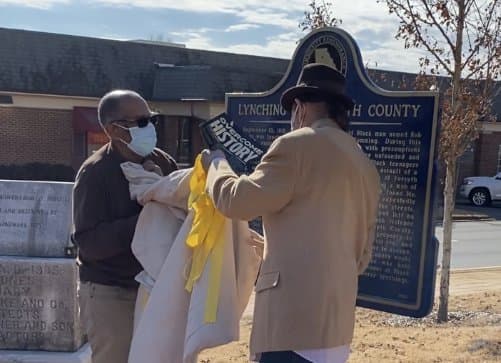
A historical marker now stands in downtown Cumming, turning the county seat’s everyday foot traffic into a confrontation with the 1912 lynching of Rob Edwards and the forced removal of Black residents that followed. The plaque is part of the Equal Justice Initiative’s Community Historical Marker Project and Lynching in America memorialization work, but in Forsyth County it functions as something more immediate: an official public acknowledgment in the middle of town.
Forsyth News reported the marker’s unveiling on Jan. 25, 2021, after 11Alive said in July 2020 that a historical marker recognizing the 1912 lynching was being made for display in downtown Cumming. That sequence matters because it shows the marker was not just a symbolic gesture. It was built for a public place where residents, students, and visitors would encounter the county’s past as part of ordinary civic life.
What the marker confronts
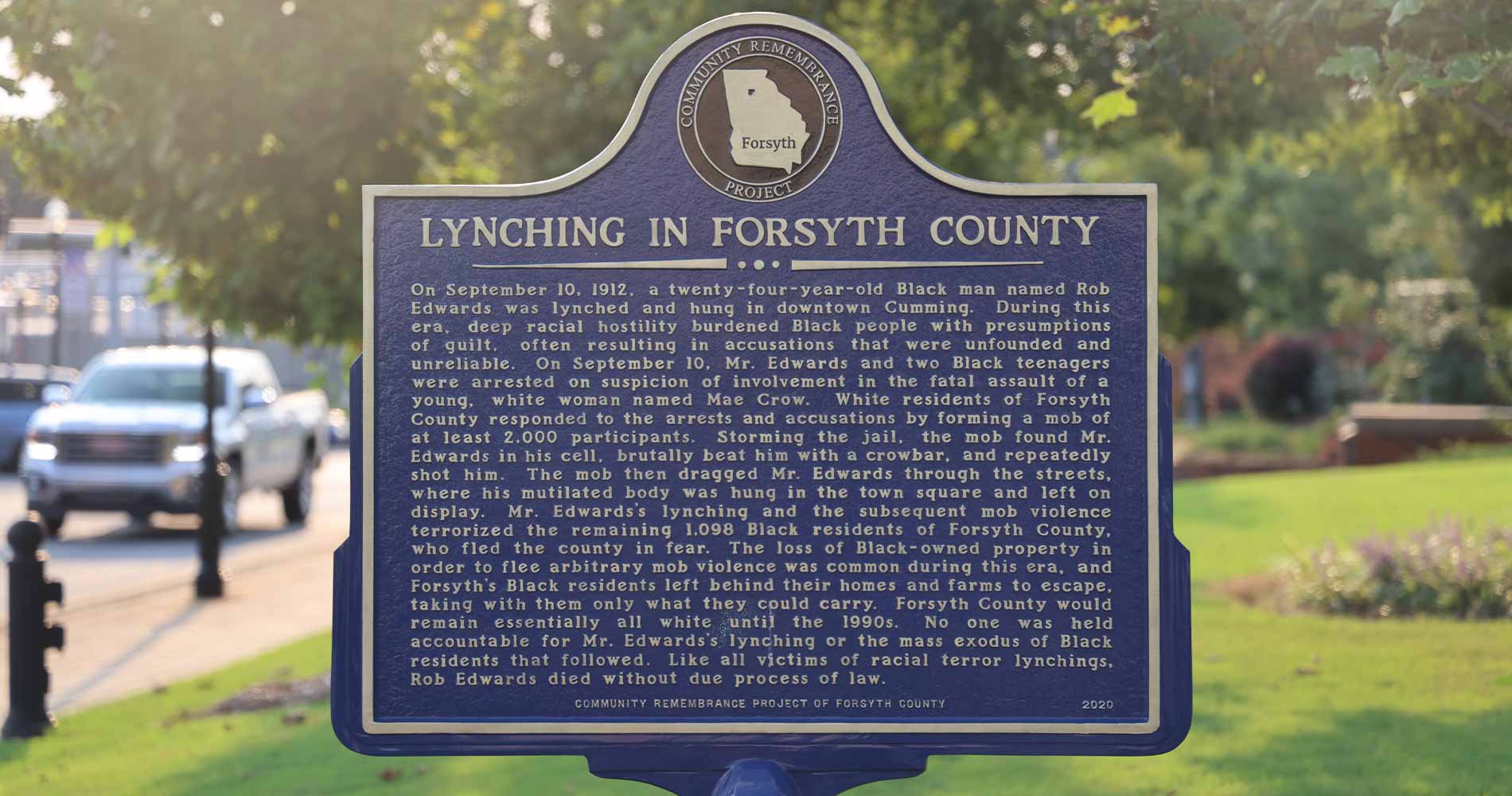
The history behind the marker begins with the 1912 violence tied to the assault and death of Mae Crow. Available reporting identifies Rob Edwards as the lynching victim. In the historical record, the episode is also described as a racial cleansing or racial conflict, because the violence did not stop with one killing. White mobs set fire to Black churches and Black-owned businesses, then drove out the county’s entire Black population.
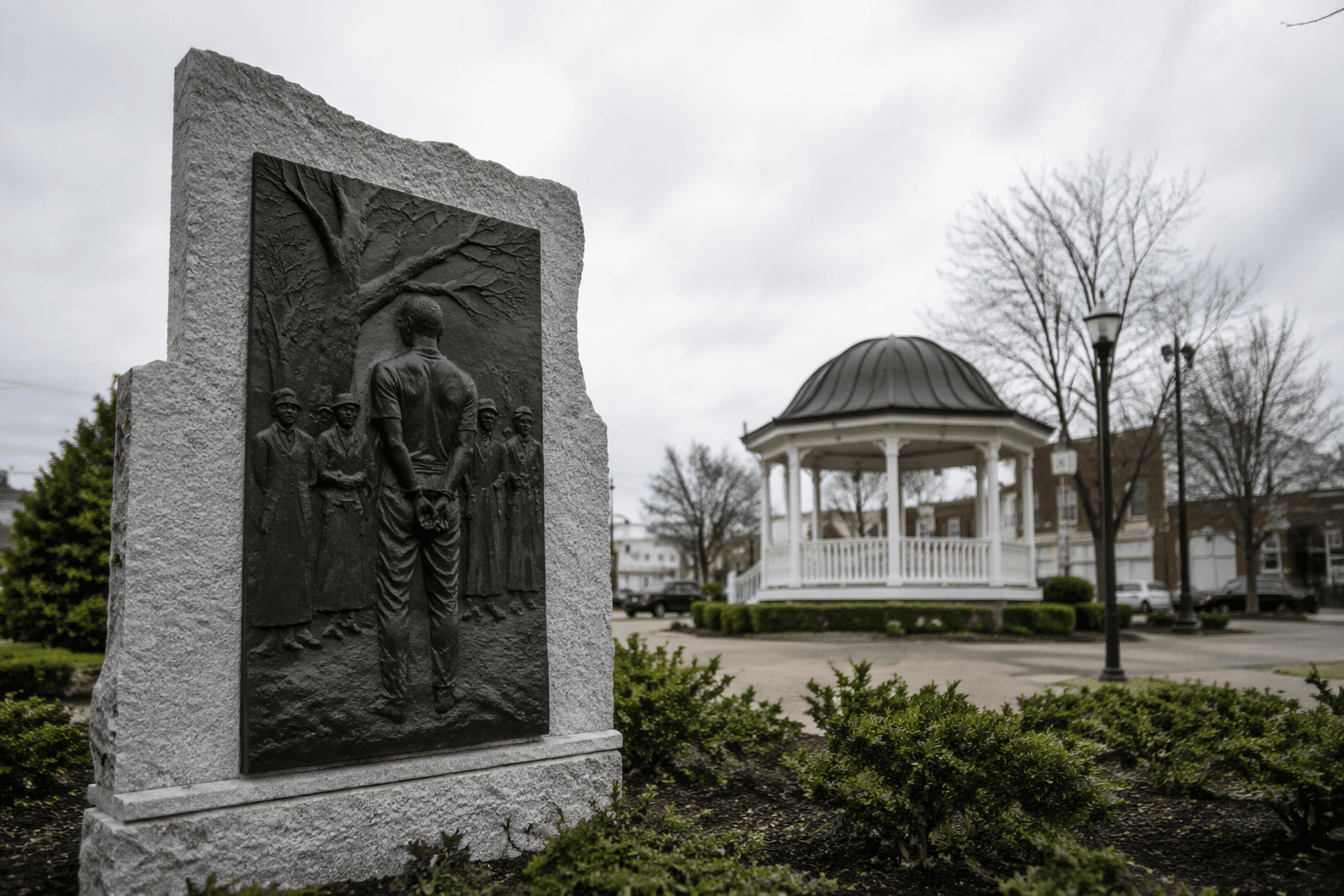
That broader pattern is what makes the marker more than a memorial to one man. It points to a campaign that combined terror, displacement, land loss, and the rewriting of who could belong in Forsyth County. A 2022 resolution introduced in the U.S. House said more than 1,100 Black Americans were terrorized and driven out by white supremacist mobs in Forsyth County in 1912, including dozens of Black landowners. That detail puts the episode squarely in the history of housing and property, not just racial violence.
How the county was changed
11Alive reported that Forsyth County remained nearly all-white for roughly 75 years after 1912. That long demographic freeze shows how deeply the expulsion shaped the county’s development and public life. When violence removes families, it also removes homes, farms, businesses, church communities, and the intergenerational wealth that comes with land ownership.
NPR’s 2016 reporting described the same events in blunt terms: white mobs burned Black churches and Black-owned businesses, then drove out the entire Black population. A 2022 NPR podcast page said the expulsion involved more than 1,000 Black residents and examined the lasting impact on affected families. Those accounts help explain why the marker belongs in downtown Cumming, where the county’s public identity is still formed and debated.
What local and regional institutions are doing now
The marker is only one part of the public history work now attached to the 1912 expulsion. Georgia Public Broadcasting focused on descendants of victims returning to share family history in a Feb. 24, 2022 story, shifting the center of gravity from the perpetrators’ violence to the families who were forced out and are still piecing together what happened to their relatives.
Atlanta History Center has taken a similar approach with its project titled “Forsyth 1912: A Timeline of the Forced Exile of Black Residents From Forsyth County.” The center says it is uncovering and sharing the histories of descendants of Forsyth County’s Black residents who were expelled in 1912. That work gives the public a timeline and a family archive, which are both essential in a county where the official record once minimized the scale of the expulsion.
The New Georgia Encyclopedia has also built an exhibition titled “Race and Reckoning in Forsyth County, 1912-2020.” Together with the marker, that exhibition helps move the history from a single plaque into a wider civic conversation about memory, responsibility, and how the county explains itself to later generations. 11Alive has also covered a scholarship program for descendants of victims of the 1912 racial cleansing campaign, another sign that the legacy still reaches into present-day opportunities for families.

Why the marker still matters in downtown Cumming
Downtown Cumming is not a museum district. It is the county’s civic center, where public business, daily errands, and local identity overlap. Placing the marker there forces the 1912 expulsion into the same space where Forsyth County presents itself to the people who live there now.
That is why the marker matters beyond the anniversary cycle. It gives schools a visible teaching tool, gives descendants a public point of return, and gives civic leaders a standard for how seriously the county is willing to face its own record. In a place whose public spaces once reflected silence, the marker says the silence is over, and the full history now belongs in the open.
This article was produced by Prism’s automated news system from verified source data, official records, and press releases, then run through automated quality and moderation checks before publishing. The system is built and supervised by the people who set the standards it runs under. Read our full AI policy.
Did this article answer your question?