Tolbert Street Cemetery reveals more than 180 unmarked graves
More than 180 unmarked graves surfaced at Tolbert Street Cemetery, and Forsyth's next challenge is keeping small burial grounds mapped and protected as downtown grows.
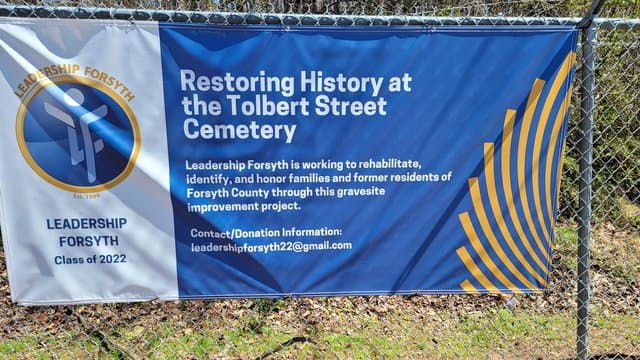
Tolbert Street Cemetery at 351 Tolbert St. is no longer just a forgotten patch beside the recycling center. A Leadership Forsyth restoration uncovered more than 180 unmarked graves on county property, turning the site into a direct test of how Forsyth County handles Black burial grounds as growth and redevelopment push closer to older neighborhoods.
What stands at 351 Tolbert St.
The cemetery sits on land owned by Forsyth County next to the Tolbert Street Recycling Center, and the county has said County Public Facilities will maintain it. The restoration added a walkway, maintained landscaping, benches, parking and historical signage, which makes the site easier to visit and easier to read as a public place rather than a hidden lot of graves. County Manager Kevin Tanner said, “We are honored to preserve the cemetery and honor those buried there.”
The history dug up during the cleanup runs back far beyond the modern restoration. Leadership Forsyth class members used deed records at the County Courthouse to trace the land to the Colored Methodist Church of Cumming, deeded in 1871, with headstones dating to the late 1800s. Kathy Hines, a class member, said, “We became curious as we started cleaning the property,” before the team pieced together the cemetery’s past. That trail matters because it links the burial ground to the Black religious life that anchored Cumming generations before today’s redevelopment pressure.
How the grave count changed the story
What looked like a neglected cemetery turned out to hold more than 100 unmarked graves, and ground-penetrating radar supplied by the Forsyth County Water & Sewer Department identified 80 more formerly unidentified graves. That is more than a tidy restoration story, because it means the visible stones only told part of the story and the site’s real footprint was larger than anyone could see from the surface.
That kind of discovery changes how preservation has to work. A small historic burial ground is not just a landscaping problem or a heritage marker problem, it is an above-ground and below-ground resource, which is exactly how Georgia’s cemetery context says historians and archaeologists should evaluate these places when Section 106 review is involved. The state guidance says cemeteries can qualify for historic recognition if they have enough significance and integrity, and it asks reviewers to consider burial traditions, socioeconomic status, marker art and links to institutions or organizations.
Where the policy gap shows up
Georgia law does provide some protection. The state’s abandoned cemeteries and burial grounds chapter authorizes counties and municipalities to preserve abandoned cemeteries, and it says no known cemetery, burial ground, human remains or burial object can be knowingly disturbed for development or a change in use unless the developer first gets a permit from the local governing authority. The same chapter also covers identification and notification of descendants and requires a public hearing process for abandoned cemetery development applications.
But the protection stops short of creating a broad buffer around every historic burial ground. The Georgia Department of Natural Resources says no state law prohibits development around a historic cemetery and no statewide buffer is required, and it adds that the laws mainly protect burials from disturbance, not the surrounding land. It also notes that private landowners are not required to clean up a cemetery, though some counties and cities have adopted local ordinances with buffers and other requirements.
That gap is why small burial grounds are so vulnerable when land use changes nearby. On private property, the state guidance says heirs and descendants may have an implied easement for access under Georgia case law, but even then landowners can set reasonable routes and still should be approached in advance. For families trying to keep track of old burial sites, access, maintenance and disturbance are separate questions, and the law does not solve all three at once.
What Forsyth residents should watch as the area changes
The most important local files are not just the cemetery grounds themselves but the county offices that control what happens around them. Forsyth County’s Unified Development Code, updated April 2, 2026, covers permits, zoning, subdivision rules, land development and enforcement, while the county’s planning and building pages point residents to development checklists, permits, plan review, inspections, zoning and code compliance. The Building and Licensing department says it handles online plan submissions and permit applications, and Code Compliance says its job is to enforce county codes to keep the county safe, healthy and attractive.
That is the practical lens for Tolbert Street. The cemetery’s story began with courthouse deed records, and the Clerk of Superior Court still indexes deeds, plats and other land records that can help map old burial grounds before they are lost in newer site plans. If more redevelopment reaches the area, the key questions are whether the burial ground stays mapped in county files, whether permit reviewers treat it as a protected resource, and whether County Public Facilities keeps up the long-term maintenance that the 2022 project put in place. The county’s own FoCo 15 podcast offers more background, but the larger lesson is already on the ground: once a burial site is identified, preservation only holds if records, permits and maintenance all keep pace with growth.
This article was produced by Prism’s automated news system from verified source data, official records, and press releases, then run through automated quality and moderation checks before publishing. The system is built and supervised by the people who set the standards it runs under. Read our full AI policy.
Did this article answer your question?