Fresno County Adds Remote Meeting Access, Cuts Public Comment Time
Fresno County supervisors cut individual public comment time from 3 minutes to 2, while adding remote dial-in access for the first time under state law.
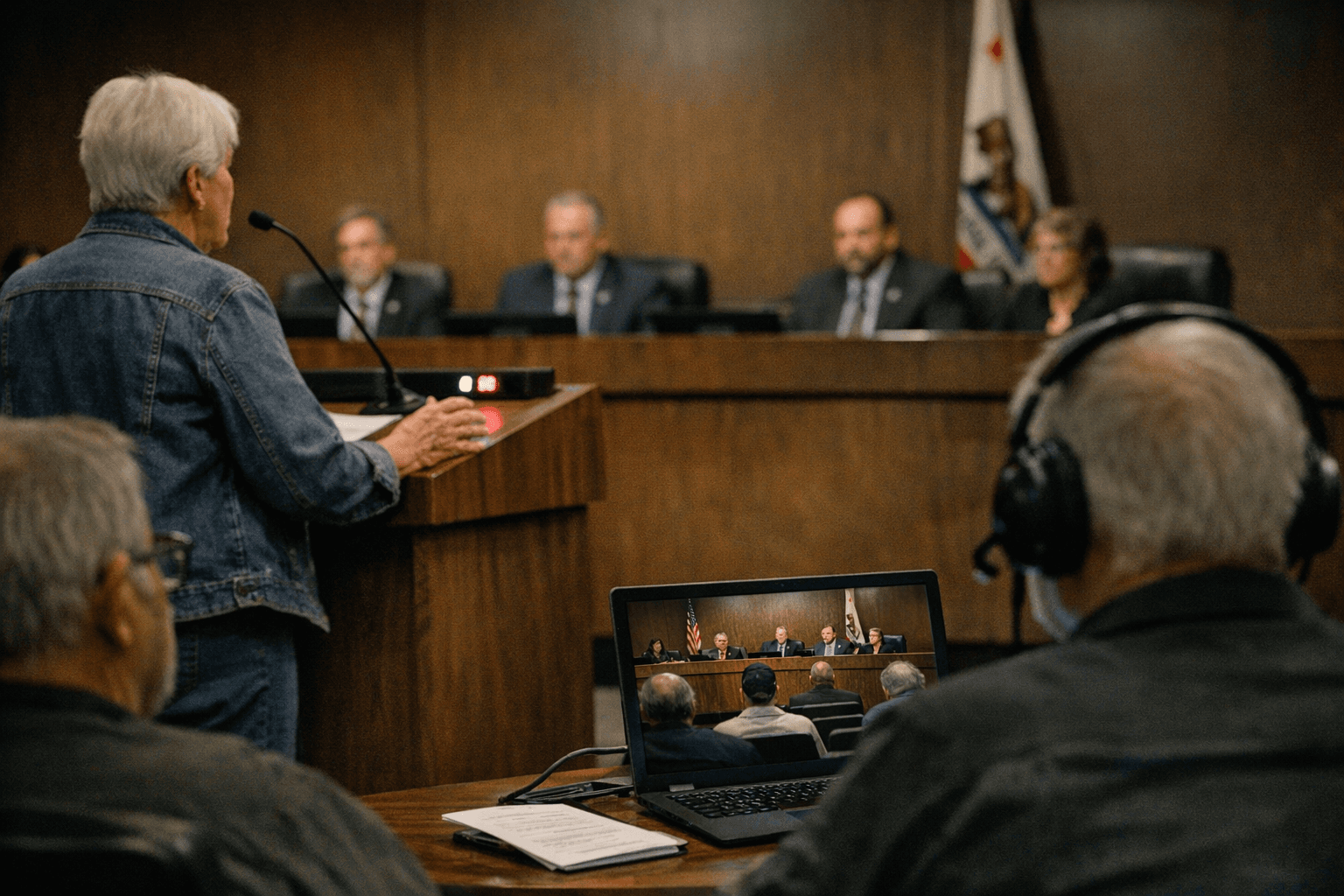
Every speaker before the Fresno County Board of Supervisors now has one fewer minute at the podium, but for the first time can deliver that testimony from a phone or laptop anywhere in the county.
The board voted unanimously on April 7 to amend its administrative policy under the requirements of Senate Bill 707, California's most sweeping update to open-meeting law in years. The changes add remote participation by telephone or internet while simultaneously cutting individual speaking time from three minutes to two and reducing the maximum total time per topic from 15 minutes to 10.
SB 707, signed by the governor in October 2025, required local agencies statewide to formalize remote participation mechanisms in their Brown Act meeting rules. Fresno County had until July 1, 2026 to comply; the board acted more than two months ahead of that deadline.
The arithmetic of the change captures the core tradeoff precisely. At two minutes per speaker against a 10-minute per-topic ceiling, a maximum of five speakers can address any single agenda item before time expires: the identical number allowed under the prior three-minute, 15-minute configuration. The total comment window shrinks by one-third, but the speaker ceiling per topic stays the same. What changes is how much any one person can say.
That compression drew direct opposition at the meeting. Leslie Martinez of the Leadership Counsel for Justice and Accountability told the board that public participation is "a crucial component" of its decision-making. The League of Women Voters of Fresno submitted written opposition through co-presidents Kay Bertken and Robin Chier, calling the reduction an "inappropriate denigration of [constituent] input." Resident Radley Reep also argued against the cuts from the podium.
County staff framed the paired changes as a net gain in overall access. Remote participation opens the door to residents who previously had to appear in person at the Hall of Records during business hours, a barrier that has long disadvantaged shift workers, residents in more distant corners of Fresno County, and people with disabilities or mobility limitations. Under the new procedures, participants join by phone or internet-based platform, and the policy establishes specific steps the board will take if those services are disrupted mid-meeting.
The Brown Act permits local bodies to adopt "reasonable regulations" on public testimony time but sets no minimum floor. Courts have upheld per-speaker limits of three minutes as constitutionally sound; at two minutes, Fresno now sits below that commonly applied benchmark.
Those wishing to comment under the new rules can join remotely using the county's telephonic or internet access option rather than appearing at the Hall of Records. Written submissions remain available for residents who want their positions formally entered into the record without speaking. In-person speakers retain the two-minute window at the podium.
The League of Women Voters and Leadership Counsel for Justice and Accountability both signaled they would track how the shorter limits affect testimony on high-stakes items, particularly land-use decisions, budget hearings, and public safety matters where two minutes can compress weeks of personal impact into a countdown.
This article was produced by Prism’s automated news system from verified source data, official records, and press releases, then run through automated quality and moderation checks before publishing. The system is built and supervised by the people who set the standards it runs under. Read our full AI policy.
Did this article answer your question?


