How Goochland County development approvals move from idea to hearing
Goochland land-use fights start early, and the most useful chance to influence a project often comes before a hearing is even posted.
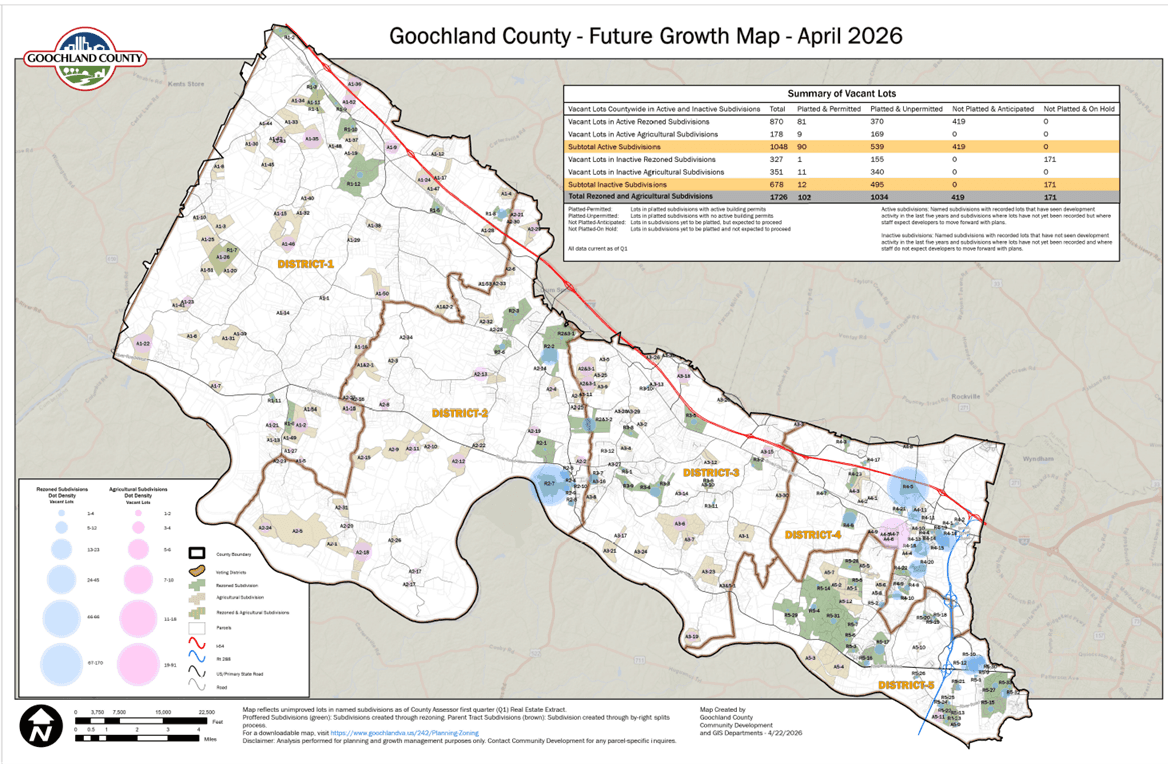
In Goochland County, a rezoning, conditional use permit or variance request starts with a pre-application meeting, a checklist and staff review before the Planning Commission takes it up. Those steps can affect traffic, nearby land use, infrastructure demands and property values across a county that spans 289 square miles and is home to about 23,000 residents.
Where the first decisions happen
The county’s process is built around formal review, not informal back-and-forth. Rezonings, conditional use permits and variances each follow separate procedures with specific requirements in Goochland’s applications, forms, policies and processes materials and its Planning & Zoning checklists. The county’s policy for placing rezoning and conditional use permit applications on the Planning Commission agenda was adopted to create a “fair and consistent process” for starting public hearings, and it took effect on July 3, 2012.
A rezoning changes what a property may be used for under the zoning ordinance. A conditional use permit allows a use that is not automatically permitted in a district if the county approves it through the established process. A variance is different again, because it asks for relief from a zoning requirement when strict compliance would create hardship.
Goochland rewrote its zoning ordinance in 2019, moving it from Appendix A to Chapter 15 of the county code. A public hearing notice said the rewrite was meant to modernize, simplify and clarify the ordinance.
The pre-application meeting is not optional
For rezoning and conditional use permit requests, Goochland requires a pre-application meeting before filing. A pre-application meeting must be scheduled before an application is submitted, and the Planning and Zoning Department will provide comments on the proposal. The pre-application is valid for six months from the initial filing date, and after that the application is closed and a new filing is required.
Under the June 2026 preapplication development process document, the Director of Planning and Zoning assigns a case planner once the pre-application is complete. That planner becomes the point of contact for the applicant.
Staff review is built into the process before anything reaches the Planning Commission. A pre-application questionnaire is completed first, with meetings between the applicant and the Planning Office possible before filing. Planning staff then review the pre-application and checklist and schedule a development review meeting. The conditional use permit process follows the same general pattern, with staff review and a development review meeting before the next stage.
Where neighbors can still change the outcome
The public has more than one chance to weigh in before a vote. The county’s rezoning and CUP checklists require a community or neighborhood meeting, which means nearby property owners can raise traffic, access, compatibility and infrastructure issues before the Board of Supervisors votes.
It is part of the application package for rezonings and conditional use permits, and the county’s process expects minutes from that meeting to be submitted. That leaves time for a project to be revised or opposed before the formal hearing. Once it moves onto the Planning Commission agenda, the process is further along and the room for meaningful changes is smaller.
The county also requires applications to be complete, signed and notarized where applicable, with fees submitted and a site plan included when required. For rezonings, the application must be complete and signed by the applicant, and property-owner authority can be shown through the application signature or a limited power of attorney. For conditional use permits, the checklist includes a disclosure affidavit requirement.
Why variances are a different kind of request
Variance requests follow their own track and usually deal with a narrower problem than a rezoning or CUP. Goochland requires a pre-application meeting, a completed application, a signed and notarized application, fees submitted, and a site plan when required for variance requests. If the request involves a change of use and a building permit is required, building inspection requirements may also come into play.
A variance usually does not rewrite what a parcel can become in the way a rezoning can, but it still changes how a site is built or used.
The county’s long-term standard is compatibility
Goochland’s 2035 Comprehensive Plan land-use chapter sets a goal of balanced development that preserves rural character and supports high-quality commercial, industrial, employment and residential development compatible with adjacent land uses. It gives the Planning Commission and Board of Supervisors a policy standard to measure projects against, especially when a request could change the character of a road corridor, a neighborhood edge or an employment area.
How to track a case before it reaches a vote
Goochland maintains an Active Development and Zoning Cases page and a Planning & Zoning calendar, which makes it possible to track current applications and meeting dates. The county also posts public hearing notices, and rezoning and CUP cases are placed on the Planning Commission agenda through the policy adopted in 2012.
This article was produced by Prism’s automated news system from verified source data, official records, and press releases, then run through automated quality and moderation checks before publishing. The system is built and supervised by the people who set the standards it runs under. Read our full AI policy.
Did this article answer your question?