Coast Guard hosts Great Lakes response meeting in Traverse City
Dozens of agencies met at Northwestern Michigan College to sharpen response plans for spills, fires and vessel casualties on Grand Traverse Bay and the Great Lakes.
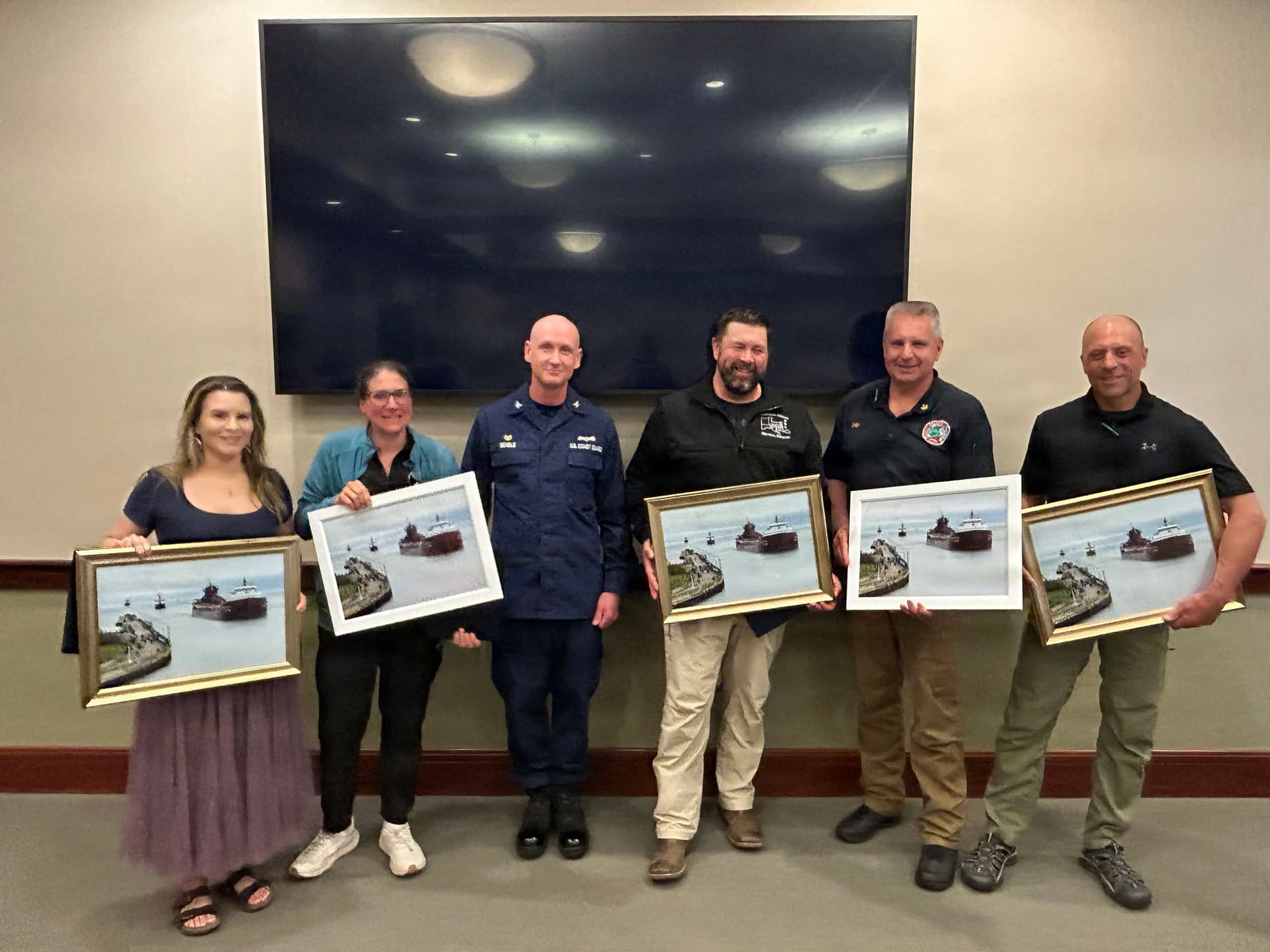
A fuel spill, ship fire or sinking on Grand Traverse Bay could pull in crews from across the region, and Coast Guard leaders used Traverse City to test how that response would work.
U.S. Coast Guard Sector Northern Great Lakes gathered with partnering agencies on May 27 at Northwestern Michigan College’s maritime campus, where about 42 federal, state, tribal and local agencies joined industry, academia and the Canadian Coast Guard to discuss maritime readiness and response capabilities. The meeting centered on Great Lakes response, with attention to new and emerging technologies, salvage, marine firefighting and an underwater unmanned autonomous vehicle demonstration.

Capt. James Bendle, the sector commander, was photographed with five members of the Honorable James L. Oberstar unified command at the campus, underscoring the Coast Guard’s focus on the people and teams expected to work side by side when a real incident hits. Sector Northern Great Lakes also presented the Public Service Commendation to those five members, recognizing their effort and commitment to the Northern Michigan Area Committee.
For boaters, beach communities and waterfront businesses from Traverse City to the Straits of Mackinac, the meeting pointed to a simple question: how fast can response agencies get organized when the water turns dangerous? Sector Northern Great Lakes covers all Coast Guard missions on Lake Superior and the northern portions of Lake Michigan and Lake Huron, along with surrounding navigable waterways, a stretch that includes about 1,850 miles of shoreline and 560 miles of international maritime border with Canada. The sector oversees eight multi-mission small boat stations, one Marine Safety Unit and two Aids to Navigation Teams.
The district-wide picture is larger still. The U.S. Coast Guard Great Lakes District is responsible for 6,700 miles of shoreline and 1,500 miles of border with Canada, a network that depends on local coordination as much as federal command. Air Station Traverse City, established in 1945 on the southern end of Grand Traverse Bay, remains part of that maritime response system, with an area of operations that includes Lake Michigan and portions of Lake Superior and Lake Huron.
The Traverse City meeting also came as the Coast Guard prepares for another major drill. Sector Northern Great Lakes and Enbridge are scheduled to hold a deployment exercise in the Cut River area near the Straits of Mackinac on Aug. 17 and 18, followed by an exposition on Aug. 19 where response agencies, industry and academia are expected to show equipment and static displays.
Sector Northern Great Lakes, renamed from Sector Sault Sainte Marie in 2023, was originally established on June 27, 2005. The 2025 Hay Lake marine casualty response involving the Honorable James L. Oberstar showed how quickly a local incident can scale into a Unified Command and a 28-hour transit to Fraser Shipyards in Superior, Wisconsin. That kind of coordination is exactly what Coast Guard leaders were pressing into place in Traverse City.
This article was produced by Prism’s automated news system from verified source data, official records, and press releases, then run through automated quality and moderation checks before publishing. The system is built and supervised by the people who set the standards it runs under. Read our full AI policy.
Did this article answer your question?


