Grand Traverse Commons rises from state hospital to public landmark
The Commons turned a 500-acre state hospital site into trails, shops, housing, and a downtown-adjacent landmark. Its history still shapes county redevelopment.
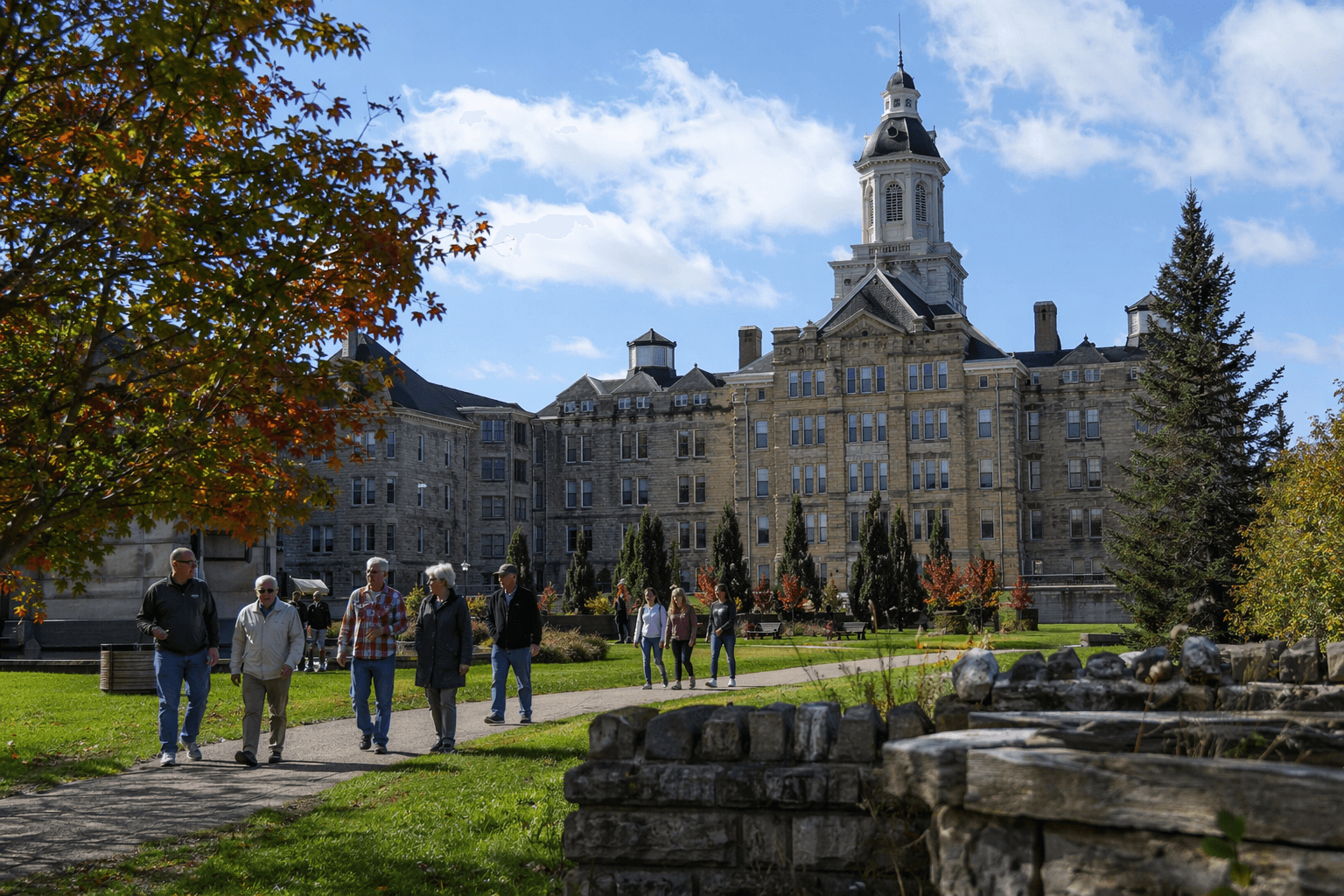
Grand Traverse Commons is one of Grand Traverse County’s most dramatic examples of public land being remade for a new era. What began as a state psychiatric hospital campus now functions as a mixed-use district, a park system, and a major historic destination across Traverse City and Garfield Township. The shift was slow, deliberate, and expensive in time: the hospital closed in 1989, a redevelopment corporation formed in 1991, and The Minervini Group did not acquire the property until 2002.
From hospital campus to county landmark
The scale of the original institution still defines the place. County records say the site opened in 1885 as the State Hospital and, over time, housed 50,000 patients, employed 20,000 workers, and received 250,000 visitors before it closed. It sat on a sprawling campus of more than 30 structures, with its own food and power systems, which made it almost a self-contained town on the edge of Traverse City.
That footprint matters because the Commons was never a small adaptive-reuse project. The redevelopment area covered about 500 acres, and the historic core became the foundation for a much larger public-private landscape. Today, the county describes the historic area as part of the largest historic redevelopment effort in the United States, a claim that reflects both the size of the campus and the scale of the reinvention.
Why the design still shapes the place
The Commons still carries the architectural logic of the institution it replaced. Building 50 followed the Kirkbride Plan, a 19th-century model that tied patient care to light, fresh air, natural surroundings, and active treatment. That approach treated the grounds as part of the medicine, not just the backdrop, and it helps explain why the site still feels unusually open even after redevelopment.
Friends of Historic Commons connects that philosophy to Dr. James Decker Munson’s belief that “Beauty is Therapy.” That idea is visible in the broad lawns, ordered building lines, and the way the campus was designed to feel restorative rather than institutional. Subsidiary cottages were added after the main hospital opened, reinforcing a campus built around healing, movement, and daylight instead of confinement.
The core story also reaches back to the beginning of the asylum itself. In January 1882, architect Gordon W. Lloyd of Detroit was chosen to design the Northern Michigan Asylum, and the original hospital was constructed in 1882. The 1883 brick steam tunnel remains part of the visitor experience today, a reminder that the old campus was engineered to heat and connect itself as a working complex.
What was preserved, and what changed
The redevelopment did not preserve the campus as a museum piece. It preserved the historic architecture and the sense of place, but much of the land and many of the buildings were repurposed into a functioning district with condos, rental housing, retail, restaurants, and offices. That mix is what turned a closed state institution into a place where people live, work, eat, shop, and walk.
At the same time, the public side of the Commons stayed central. Parkland now reaches along multiple sides of the historic core, and the campus is woven into the city and township rather than sealed off from them. The result is a place where private investment and public access coexist, which is exactly why the Commons remains a policy case study as much as a local landmark.
The redevelopment timeline shows how hard that transition was. The City of Traverse City and Garfield Charter Township created the Grand Traverse Commons Redevelopment Corporation on June 26, 1991 to guide the effort. After 11 years of unsuccessful attempts to redevelop the property, The Minervini Group acquired it on May 6, 2002 and pushed the transformation that residents and visitors see now.
How the Commons functions today
The best way to understand the Commons is to see how many uses overlap on the same ground. The City of Traverse City describes the Grand Traverse Commons Natural Area as a 140-acre park with about 50 miles of trails, and those trails support hiking, biking, nature watching, and cross-country skiing. Users move through woods, streams, meadows, wetlands, and nearby wooded parcels, which makes the natural area feel like a public park wrapped around a historic district.
Next door, The Village at Grand Traverse Commons adds another layer. Its retail, office, and residential uses sit adjacent to the natural area, with a park-like center called The Piazza and a European-style layout that gives the district a planned, walkable feel. That design keeps traffic on the property year-round, not just in peak tourist season, and it has helped make the Commons a place people use rather than just visit.
A few specific parts of the site are especially useful for first-time visitors:
- Historic walking tours explain the Kirkbride plan and the evolution of patient care.
- Twilight asylum tours add an after-hours look at the old campus.
- Golf-cart tours include the 1883 brick steam tunnels.
- An indoor farmers market runs every Saturday from November through April.
Those activities matter because they keep the Commons active in every season. The market brings steady weekend foot traffic, while the tours turn the preserved structures into living interpretive spaces instead of sealed-off relics.
Why the Commons matters beyond one property
The Commons is more than a successful reuse project. It shows how Grand Traverse County can repurpose a major public asset without erasing its history, and how that choice can reshape nearby development pressure, tourism patterns, and business activity at the edge of Traverse City and Garfield Township. The site draws walkers, shoppers, residents, and history-minded visitors into the same complex, which spreads activity across the campus instead of concentrating it in one use.
It also fits a broader preservation framework. The National Register of Historic Places is the federal list of places considered worthy of preservation, and the National Park Service maintains that record. The Commons belongs in that tradition, but it also goes further: it is not only preserved, it is inhabited, commercial, and publicly used every day.
That combination, a saved historic core, private reinvestment, public trails, and an active mixed-use district, is what makes the Commons one of the county’s most revealing redevelopment stories. It shows how a place built for institutional isolation can become one of the region’s most public landmarks.
This article was produced by Prism’s automated news system from verified source data, official records, and press releases, then run through automated quality and moderation checks before publishing. The system is built and supervised by the people who set the standards it runs under. Read our full AI policy.
Did this article answer your question?


