Traverse City bald eagle nest partially collapses, eaglet Snow still too young to fly
A snapped limb left the Traverse City eagle nest tilted 45 degrees, with eaglet Snow still too young to fly and the parents' options limited.
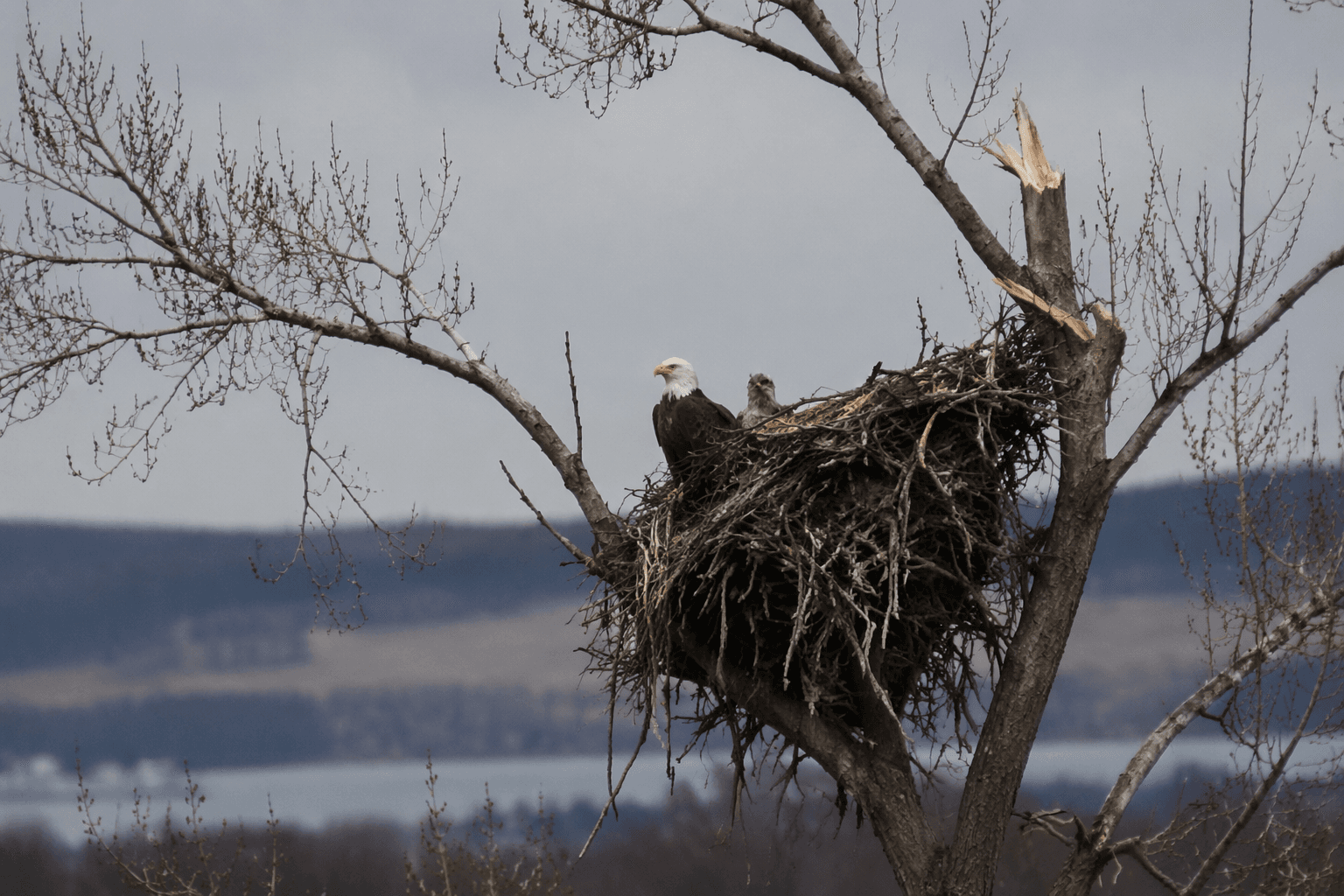
A broken lower limb in Traverse City left the well-known bald eagle nest hanging at a 45-degree angle, raising immediate concern for Snow, the eaglet inside. Snow was reported to be about 45 to 46 days old, still too young to fly and still dependent on the nest and the adults for food and protection.
The nest belongs to Harry and Harriet, the mated bald eagle pair that has drawn steady attention along the west arm of Grand Traverse Bay near Traverse City. It sits on private 60-acre property, where eagle-watchers have followed the birds through livestreams and local media coverage for multiple breeding seasons. The recent damage made the nest more precarious because bald eagles are territorial birds that typically defend a breeding area that can include an occupied nest tree and alternate nests.
This year’s clutch began with three eggs, laid on March 2, March 5 and March 8. One egg hatched on April 11, 2026, while the other two were later reported as nonviable. That left Snow as the only eaglet in the nest, and the only one still depending on Harry and Harriet as the nest shifted after the limb snapped.
The situation has drawn concern because bald eagle pairs in Michigan usually attempt to reproduce in one nest each year, and clutch sizes are generally one to three eggs. In Michigan, bald eagles are protected, and state officials have estimated the population at 3,500 to 4,000 birds, including about 1,035 breeding pairs. The Michigan Department of Natural Resources also lists trauma and lead poisoning among the top mortality factors for bald eagles over the last three decades.
That backdrop makes the Traverse City nest more than a local curiosity. It is a live example of how quickly a breeding site can become unstable, and how little margin exists when a young eaglet is still unable to leave the nest. With Snow not yet capable of flight, the fate of the nest depends on whether the adults can continue to use the damaged structure or shift care around it without further collapse.
For people watching the nest near Traverse City, the clearest course is to stay back and let the birds manage the site. The pair’s long use of the nest, the private-property setting and the species’ protected status all leave little room for direct interference, even as the damaged tree limb keeps the nest under close scrutiny in Grand Traverse County.
This article was produced by Prism’s automated news system from verified source data, official records, and press releases, then run through automated quality and moderation checks before publishing. The system is built and supervised by the people who set the standards it runs under. Read our full AI policy.
Did this article answer your question?


